Anatomical patellofemoral joint prosthesis

A femoral, anatomical technology, applied in prosthesis, knee joint, elbow joint, etc., can solve the problems of patellar prosthesis wear, skin coloration, high shear force of patella joint

CN114569294AInactive Publication Date: 2022-06-03WUXI NO 2 PEOPLES HOSPITAL
0 Cites 0 Cited by

Patent Information

Authority / Receiving Office
CN · China
Patent Type
Applications(China)
Current Assignee / Owner
Publication Date
2022-06-03
Estimated Expiration
Not applicable · inactive patent

Smart Images

  • Figure 1
    Figure 1
  • Figure 2
    Figure 2
  • Figure 3
    Figure 3
Patent Text Reader

Abstract

The invention discloses an anatomical patellofemoral joint prosthesis which comprises a thighbone part, a fibula part is connected to the thighbone part, a tibia part is connected to one side of the fibula part, a patella part is installed on the thighbone part, and an installation assembly is arranged on the outer wall of the thighbone part. The mounting assembly comprises threaded fastening grooves formed in the inner walls of the two sides of the thighbone part, threaded fastening rods in threaded connection with the threaded fastening grooves and limiting mounting plates fixed to the outer walls of the threaded fastening rods, and the upper end and the lower end of the patella part are connected with quadriceps femoris and patella tendons correspondingly; according to the patella prosthesis, the installation assembly is arranged and comprises the threaded fastening groove, the threaded fastening rod, the limiting installation plates, the closing plate and the groove, the installed patella can be placed correctly through the pushing-in direction formed by the two sets of limiting installation plates, and the patella prosthesis is not prone to being abraded.
Need to check novelty before this filing date? Find Prior Art

Description

technical field

[0001] The invention relates to the technical field of patella joints, in particular to an anatomical patellofemoral joint prosthesis. Background technique

[0002] Among the artificial joint replacements, hip and knee replacements are the most widely used clinical procedures. With the development of various artificial joints, researchers have found that the mechanical properties of the prosthesis and the mechanical distribution of the patient's joint after implantation have a decisive impact on the life of the artificial joint. Among the artificial joint replacements, hip and knee replacements are the most widely used clinical procedures. The structure and function of the knee joint are the most complex among the human joints. The initial research methods are all based on the finite element analysis method of the hip joint. Due to the anatomical complexity of the knee joint (three bones: femur, tibia, skeleton and the surface cartilage tissue of the three;...

Examples

Embodiment

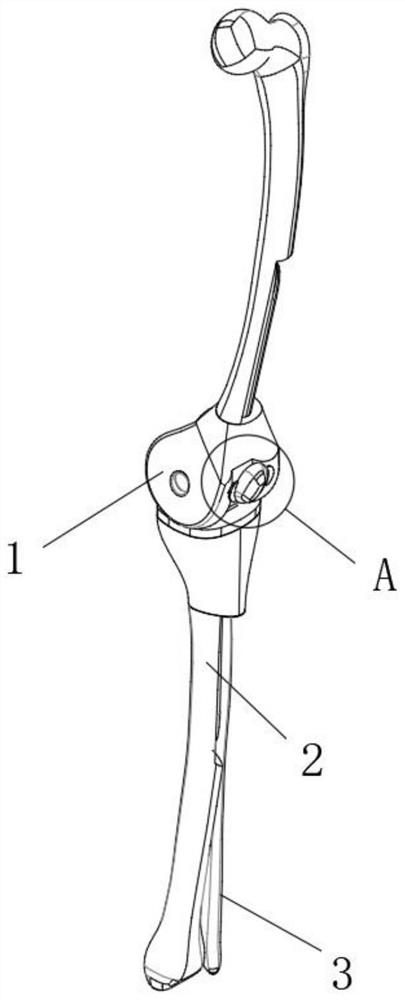
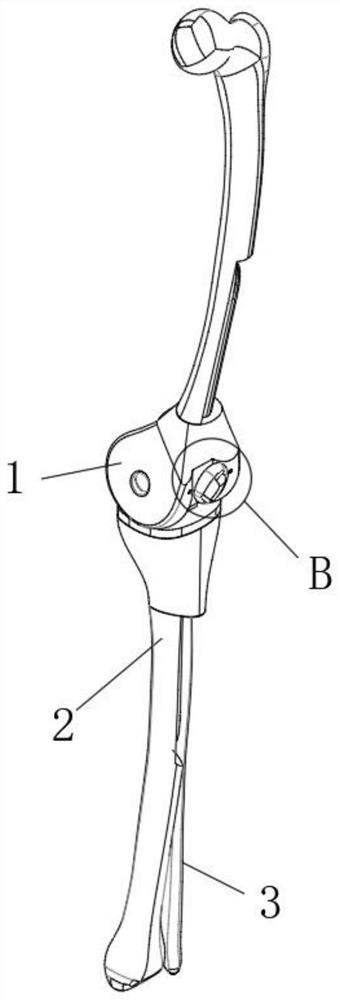
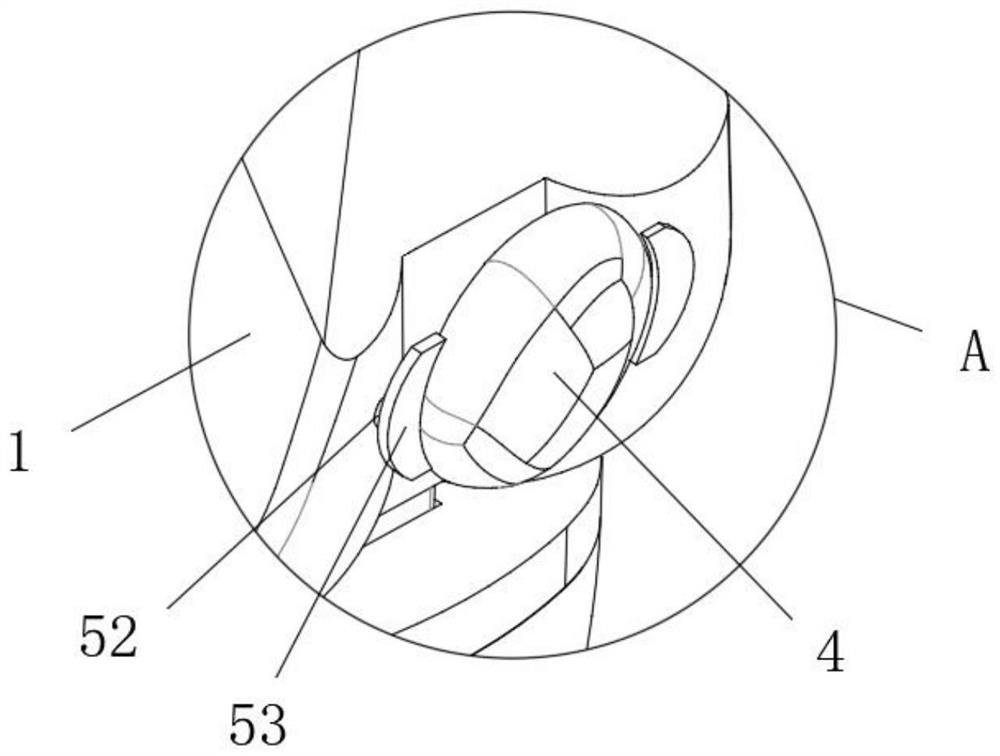
[0033] like figure 1 - Figure 7 As shown, an anatomical patellofemoral joint prosthesis comprises a femoral part 1, a fibula part 2 is connected to the femoral part 1, a tibia part 3 is connected to one side of the fibula part 2, a patella part 4 is installed on the femoral part 1, A mounting assembly 5 is provided on the outer wall of the femoral portion 1, and the mounting assembly 5 includes a threaded fastening groove 51 opened in the inner walls of both sides of the femoral portion 1, a threaded fastening rod 52 threadedly connected with the threaded fastening groove 51, and fixed on the threaded fastening groove 51. The limit mounting plate 53 on the outer wall of the rod 52 and the upper and lower ends of the patella portion 4 are respectively connected with the quadriceps femoris muscle 6 and the patellar tendon 7 .

[0034]Two screw fastening grooves 51 are provided on the outer wall of the femoral part 1 at the contact position of the femoral part 1 and the patella...