The above-mentioned methods have their own advantages and disadvantages. For example, the
gravity separation method and air suspension method are mature in technology and low in cost, but the separation effect is average and the separation speed is slow; the
coarse particle method,
flocculation method, and membrane
separation method have good separation effects but are easy to block and cost. Higher; biological treatment, adsorption, and
magnetic separation have good separation effects but high infrastructure costs and high costs; electrochemical separation has high efficiency but consumes a lot of power, and has high requirements for conductor materials
In the prior art, such as
patent document 1 (CN111054094A), it discloses an embedded oil-water separator, which passes oil-water mixed liquid into the oil-water inlet
pipe, and after the liquid passes through the cylindrical
oil filter cloth, the oil remains in the filter
cartridge Inside, the oil-water separation is realized after the water flows out of the filter
cartridge, and a structure that can specially clean the
oil filter cloth is also set up. The oil in this separator is left in the
oil filter cloth, which has the problem of clogging the oil filter cloth, which greatly reduces the separation efficiency. At the same time, the oil filter cloth is also a consumable product and needs to be replaced regularly. It is difficult to replace because it is arranged in the filter
cartridge; another example is
patent document 2 (CN109502675A), which discloses a high-efficiency oil-water separation for different oil particle diameters method, which is deduced by the classic Stokes
sedimentation formula, and the finite element calculation analysis is used to obtain the bubble particle size corresponding to the
oil droplet-bubble adherent body completely removing the
oil droplet. Bubbles of different particle sizes are injected. For oil droplets with
large particle sizes, bubbles with
small particle sizes should be injected, and for oil droplets with
small particle sizes, bubbles with
large particle sizes should be injected. However, in a The particle size of the air bubbles introduced in the oil removal cycle is uniform, and it does not consider that the oil droplets will coagulate with each other, so the particle size of the oil droplets will also change. , obviously can't remove the oil droplets very well, on the contrary, it will waste the air and energy. Although it discloses that it can carry out secondary
cycle oil removal, it will undoubtedly make the cost higher and the efficiency lower; finally , as in
patent document 3 (CN109675346B), which discloses a continuous working device for oil-water separation, which drives the oil and water in the separation
pool to separate oil and water with the
buoy as the boundary through the rotation of the motor. This separation method utilizes
centrifugal force Carry out oil-water separation, but it takes a long time for oil-water separation, and the separation effect is not good for small-sized oil droplets, especially for the separation at the connecting liquid surface of oil and water.
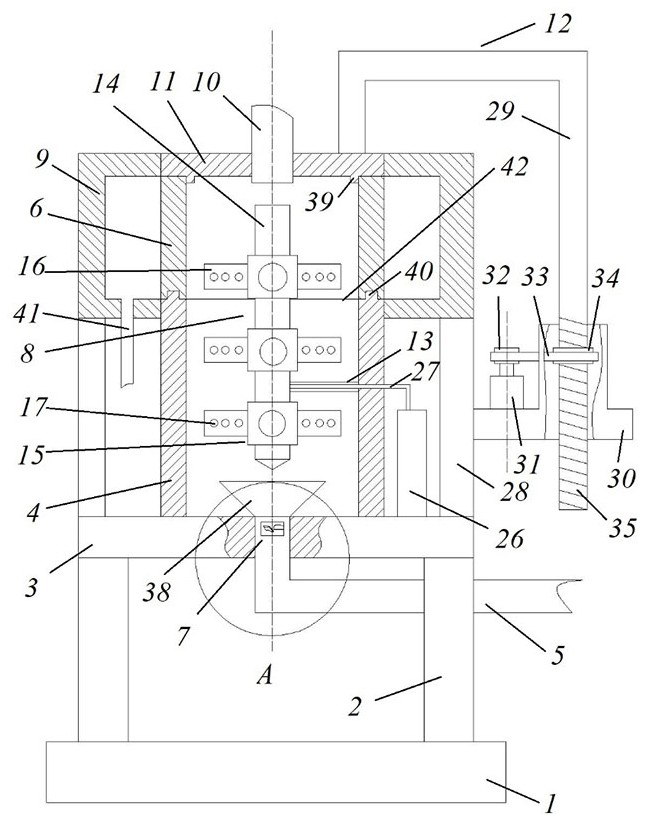
[0003] To sum up, in the prior art, for the oil-water separation equipment, the air suspension method or the membrane separation method is used alone, and there is no oil-water separation equipment that can make up for the defects of the two methods, and the existing oil-water separation In the equipment, it is also inconvenient to replace the oil filter membrane used. The existing membrane separation will take a long time for oil-water separation because the oil will adhere to the membrane. When the air suspension method is used for oil-water separation, only the oil droplets are considered. A certain particle size does not take into account that the size of oil droplets will change, and air bubbles with different pore sizes need to be adaptively introduced to remove oil. Based on this, the present invention provides a combination of air suspension method and membrane separation method, which can It is an adaptive oil-water separation equipment that is convenient for membrane replacement, has high oil-water separation efficiency, and can feed air bubbles with suitable diameters according to different
oil droplet sizes, and the longitudinal position of the air bubbles is adaptively changed with the speed of the stirring motor



 Login to View More
  Login to View More