Process for removing PH3 from residual gas after fumigant insect killing
A technology for residual gas and gas outlet, which is applied in chemical instruments and methods, separation methods, separation of dispersed particles, etc.
- Summary
- Abstract
- Description
- Claims
- Application Information
AI Technical Summary
Problems solved by technology
Method used
Image

Examples
Embodiment 1
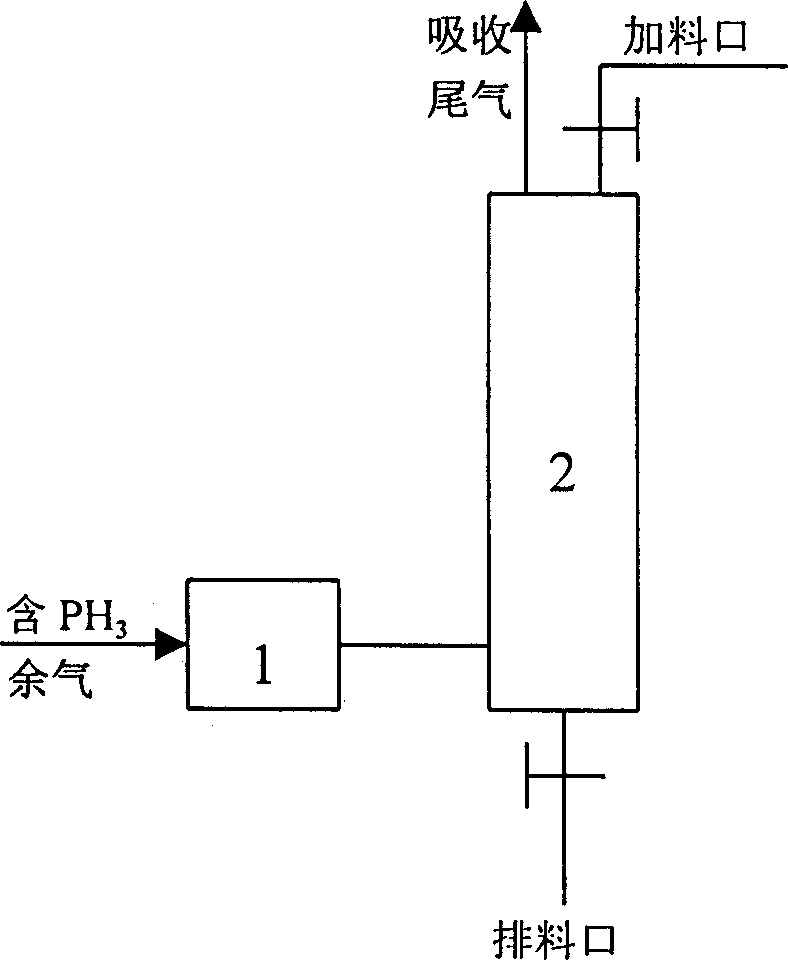
[0023] Get 1000ml of bleaching powder fine saturated solution (solvent is deionized water), and add in the absorption tower whose diameter is φ70mm and height h=500mm. The operating conditions are as follows:
[0024] Normal temperature and normal pressure; the air velocity of the absorption tower is 70mm / s; the inlet PH 3 The concentration is 180ppm.
[0025] Result: Export PH 3 It can't be detected by the specific length tube test method and chemical analysis method, that is, it is close to zero.
Embodiment 2
[0027] Take 600ml of bleaching powder fine saturated solution (solvent is deionized water) and 400ml of deionized water, and add them together into an absorption tower with a diameter of φ70mm and a height of h=500mm. The operating conditions are as follows:
[0028] Normal temperature and normal pressure; air velocity of absorption tower 93mm / s; inlet PH 3 The concentration is 240ppm.
[0029] Result: Export PH 3 It can't be detected by the specific length tube test method and chemical analysis method, that is, it is close to zero.
Embodiment 3
[0031] Take 80g of bleaching powder, dissolve it in 1000ml of tap water, and add it into an absorption tower with a diameter of 70mm and a height of h=500mm. The operating conditions are as follows:
[0032] Normal temperature and normal pressure; air velocity of absorption tower is 36mm / s; inlet PH 3 The concentration is 360ppm.
[0033] Result: Export PH 3 It can't be detected by the specific length tube test method and chemical analysis method, that is, it is close to zero.
PUM
 Login to View More
 Abstract
Description
Claims
Application Information
 Login to View More