
Bidirectional three-level soft switch DC/DC for superconducting energy storage and its voltage side pulse width controlling method
A superconducting energy storage, three-level technology, used in control/regulation systems, high-efficiency power electronic conversion, electrical components, etc., can solve the problems of shortening the life of the switch tube, high stress of the switch tube, and high price.
- Summary
- Abstract
- Description
- Claims
- Application Information
AI Technical Summary
Problems solved by technology
Method used
Image

Examples
Embodiment Construction
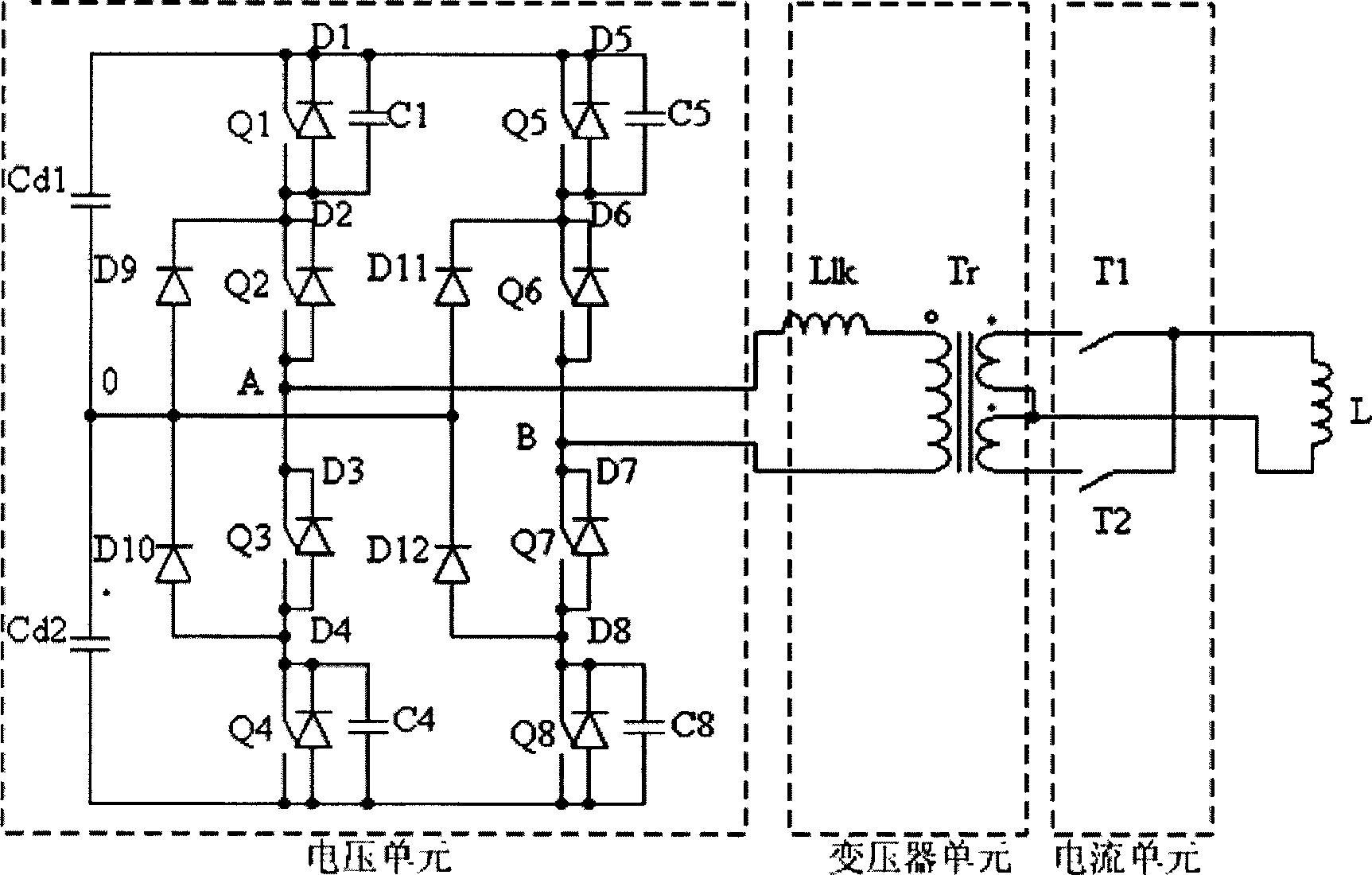
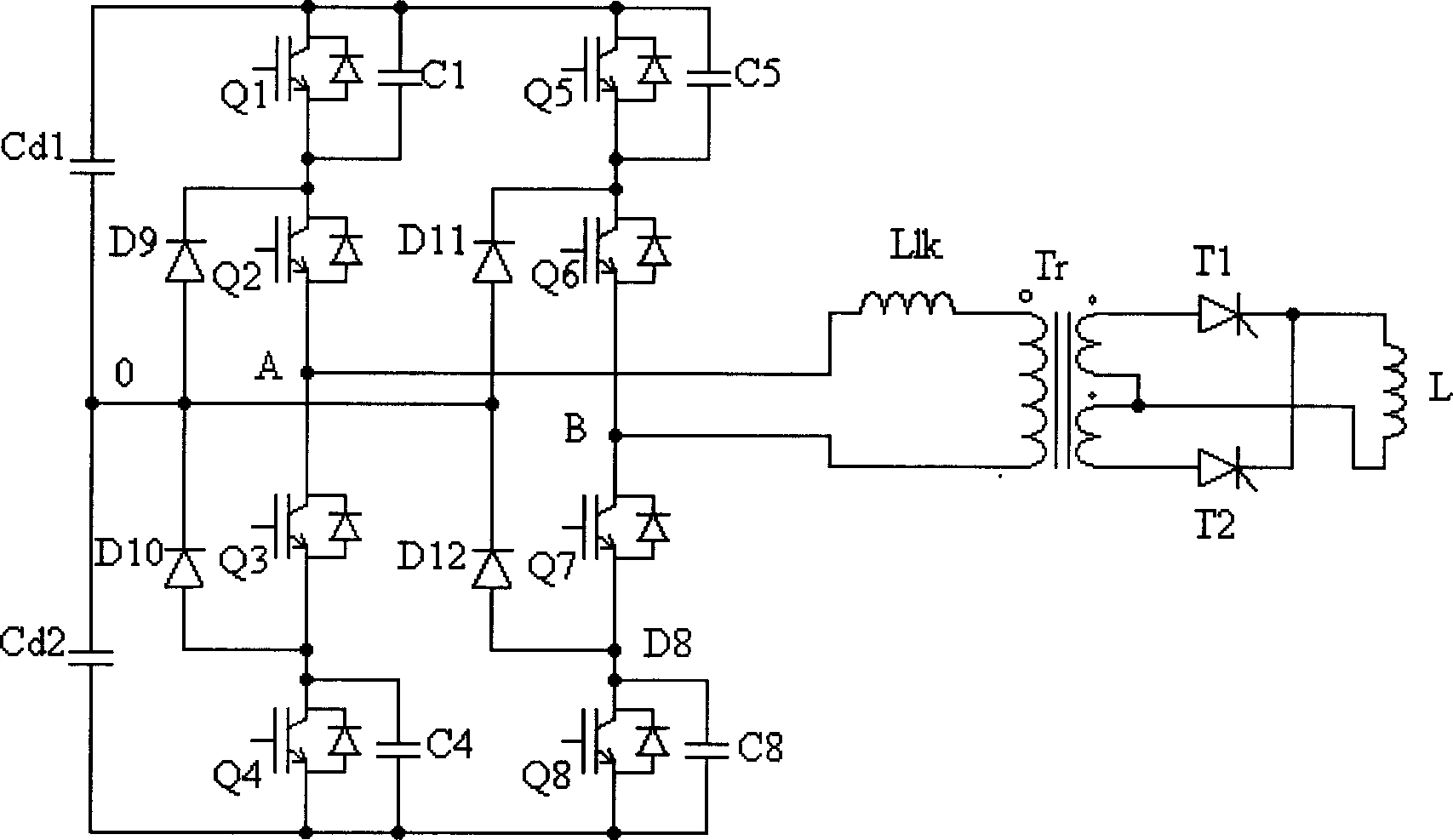
[0020] figure 2 It is a schematic diagram of a typical topology structure of the present invention. It consists of three parts: voltage unit, transformer unit and current unit. Its voltage unit consists of two three-level bridge arms. Switch tubes Q1-Q4 and clamping diodes D9 and D10 form one of the three-level bridge arms. The switch tubes Q1-Q4 are connected end to end, the switch tube Q1 is connected in antiparallel with the diode D1, and connected in parallel with the capacitor C1, and the switch tube Q4 is connected in antiparallel with the diode D4, and connected in parallel with the capacitor C4. The switch tube Q2 is connected in anti-parallel with the diode D2, and the switch tube Q3 is connected in anti-parallel with the diode D3. The midpoints of the switching tubes Q1 and Q2 are connected to the cathode of the clamping diode D9, and the midpoints of the switching tubes Q3 and Q4 are connected to the anode of the clamping diode D10. The anode of D9 is connected...
PUM
 Login to View More
 Abstract
Description
Claims
Application Information
 Login to View More