Supercharge Your Innovation With Domain-Expert AI Agents!

Battery cathodes for improved stability

a battery cathode and stability technology, applied in the direction of cell electrodes, electrical equipment, cell components, etc., can solve the problems of poor recyclability, low round-trip efficiency, low rate capability, etc., and achieve the effect of increasing the stability of the electroly

Active Publication Date: 2020-08-04
FLORIDA INTERNATIONAL UNIVERSITY
View PDF5 Cites 0 Cited by
  • Summary
  • Abstract
  • Description
  • Claims
  • Application Information

AI Technical Summary

Benefits of technology

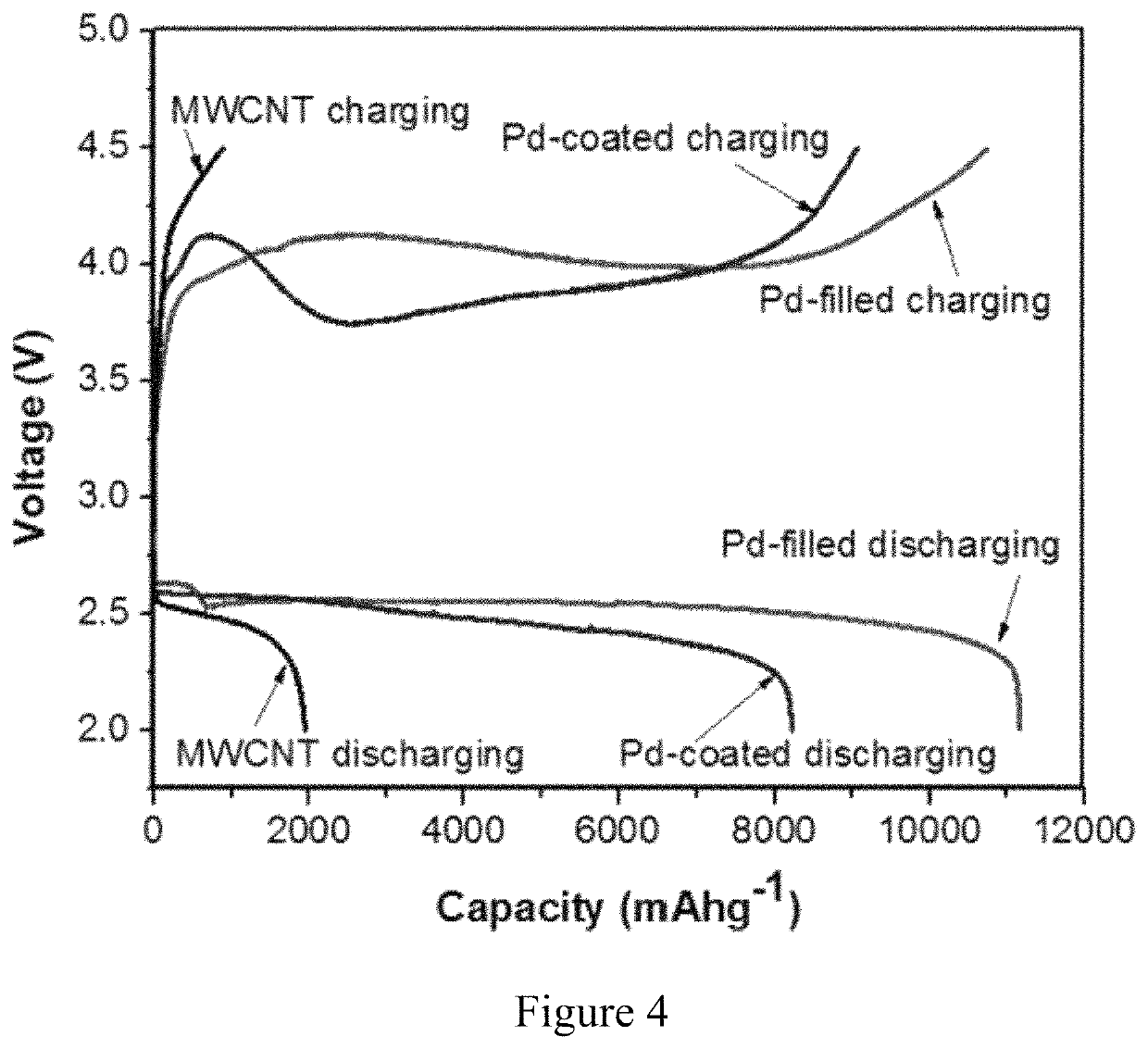
This approach results in a significant increase in discharge capacity and cyclability, with Pd-filled CNTs demonstrating a 6-fold increase in first discharge cycle capacity and 58 cycles at 500 mAh·g−1 compared to pristine and Pd-coated CNTs, while maintaining electrolyte stability and reducing unwanted discharge products like Li2CO3.

Problems solved by technology

Although many research studies have been done to improve the performance metrics of Li—O2 batteries, they are still in their early stages and many technical challenges have to be addressed before their practical applications.
The most common problems impeding the development of Li—O2 batteries have been low rate capability, poor recyclability, and low round-trip efficiency.
All of these issues are originally stemmed from sluggish kinetics and the irreversible characteristic of the OER and ORR reactions which causes high overpotentials in the discharging / charging process.
However, it has been recently shown that the catalyst on the oxygen cathode in Li—O2 batteries is easily deactivated due to continuous accumulation of discharge and charge products upon cycling.
It also has been reported that coarsening and agglomeration of catalyst upon charging / discharging reduces the efficiency of catalyst in Li—O2 batteries.
Platinum (Pt) and palladium (Pd) catalysts have been reported to promote Li2O2 oxidation at low potentials but also cause electrolyte decomposition resulting in the formation of Li2CO3 and thus deactivating the catalysts.

Method used

the structure of the environmentally friendly knitted fabric provided by the present invention; figure 2 Flow chart of the yarn wrapping machine for environmentally friendly knitted fabrics and storage devices; image 3 Is the parameter map of the yarn covering machine
View more

Image

Smart Image Click on the blue labels to locate them in the text.
Viewing Examples
Smart Image
  • Battery cathodes for improved stability
  • Battery cathodes for improved stability
  • Battery cathodes for improved stability

Examples

Experimental program
Comparison scheme
Effect test

Embodiment Construction

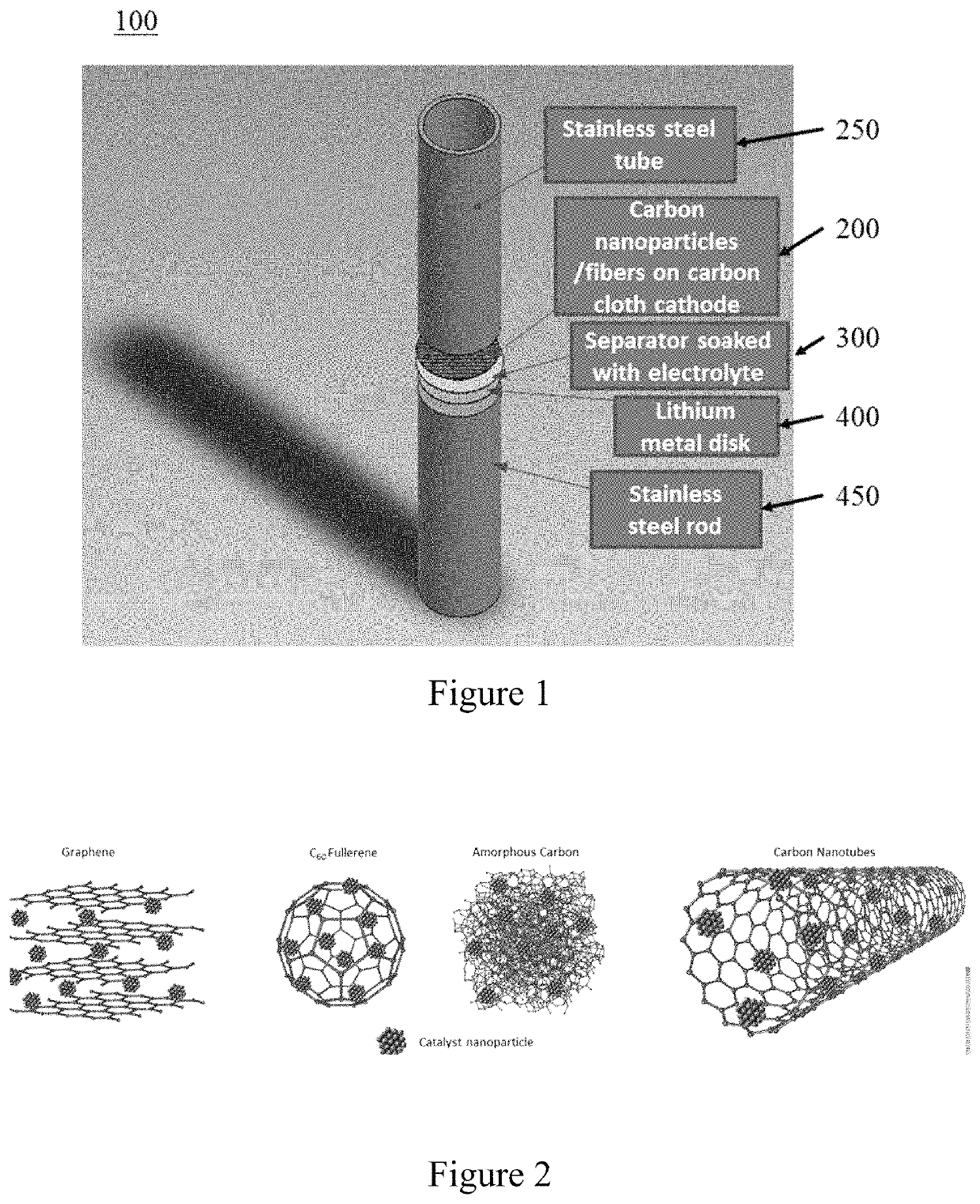
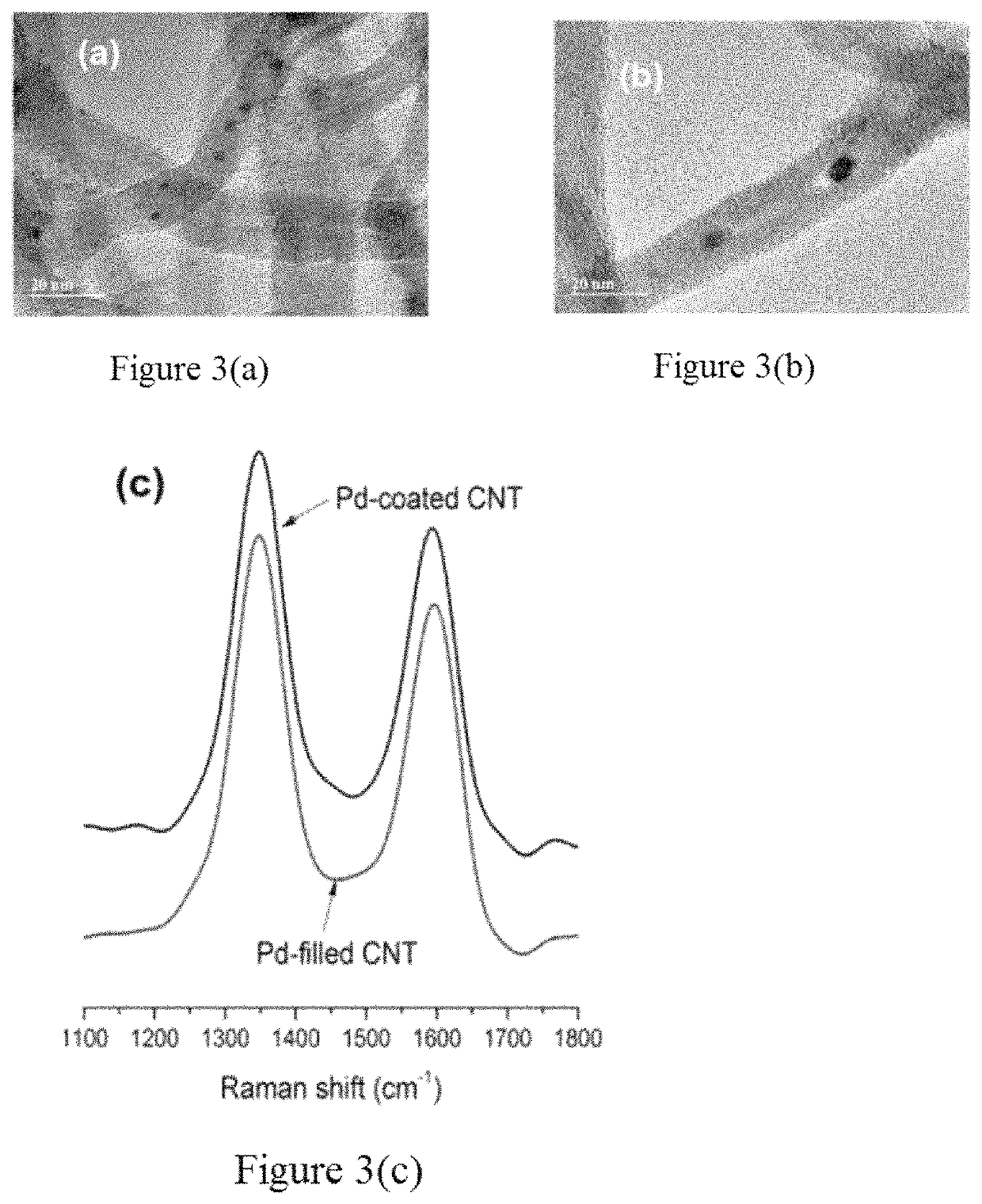
[0026]Embodiments of the subject invention provide Li-oxygen (Li—O2) cathodes using palladium-coated and palladium-filled carbon nanotubes (CNTs). It should be appreciated by one of ordinary skill in the art that the CNTs can be replaced with various catalysts (for example, ruthenium, or platinum-based catalysts) filled carbon structures, (for example fullerenes, buckminsterfullerenes, or graphenes). Empirical data shows that the full discharge of batteries in a 2-4.5 V range shows 6-fold increase in the first discharge cycle of the Pd-filled over the pristine CNTs and 35% increase over their Pd-coated counterparts. The Pd-filled also exhibits improved cyclability with 58 full cycles of 500 mAh·g−1 at current density of 250 mA·g−1 versus 35 and 43 cycles for pristine and Pd-coated CNTs, respectively. The effect of encapsulating the Pd catalysts inside the CNTs leads to increased stability of the electrolyte during both discharging and charging of the battery. Voltammetry, Raman spec...

the structure of the environmentally friendly knitted fabric provided by the present invention; figure 2 Flow chart of the yarn wrapping machine for environmentally friendly knitted fabrics and storage devices; image 3 Is the parameter map of the yarn covering machine
Login to View More

PUM

PropertyMeasurementUnit
discharge current densityaaaaaaaaaa
temperatureaaaaaaaaaa
Login to View More

Abstract

A Li—O2 battery and method for fabricating the same are provided herein. The battery cathode comprises a carbon structure filled with a palladium nanoparticle catalyst, including palladium-filled carbon nanotubes (CNTs). The carbon structure provides a barrier between the catalyst and the electrolyte providing an increased stability of the electrolyte during both discharging and charging of a battery.

Description

CROSS-REFERENCE TO A RELATED APPLICATION[0001]This application claims the benefit of U.S. Provisional Application Ser. No. 62 / 612,036, filed Dec. 29, 2017, the disclosure of which is hereby incorporated by reference in its entirety, including all figures, tables and drawings.BACKGROUND[0002]The search for high energy density batteries has motivated research in lithium-air batteries. Catalysts have been shown to improve both the battery capacity and the recyclability of these batteries when used in cathodes.[0003]High energy density batteries have garnered much attention in recent years due to their demand in electric vehicles. Lithium oxygen (Li—O2) batteries have nearly 10 times the theoretical specific energy of common lithium-ion batteries and in that respect have been regarded as the batteries of the future. A typical Li—O2 battery comprises a Li anode, a porous cathode open to oxygen, and a Li+ ion conducting electrolyte separating the electrodes. A Li—O2 battery stores energy ...

Claims

the structure of the environmentally friendly knitted fabric provided by the present invention; figure 2 Flow chart of the yarn wrapping machine for environmentally friendly knitted fabrics and storage devices; image 3 Is the parameter map of the yarn covering machine
Login to View More

Application Information

Patent Timeline
no application Login to View More
Patent Type & Authority Patents(United States)
IPC IPC(8): H01M4/133H01M10/0525H01M4/1393H01M4/62H01M4/76
CPCH01M4/625H01M4/133H01M4/1393H01M4/76H01M10/0525H01M4/926H01M12/08Y02E60/10
Inventor EL-ZAHAB, BILALCHAMAANI, AMIRCHAWLA, NEHASAFA, MEER
Owner FLORIDA INTERNATIONAL UNIVERSITY
Features
  • R&D
  • Intellectual Property
  • Life Sciences
  • Materials
  • Tech Scout
Why Patsnap Eureka
  • Unparalleled Data Quality
  • Higher Quality Content
  • 60% Fewer Hallucinations
Social media
Patsnap Eureka Blog
Learn More