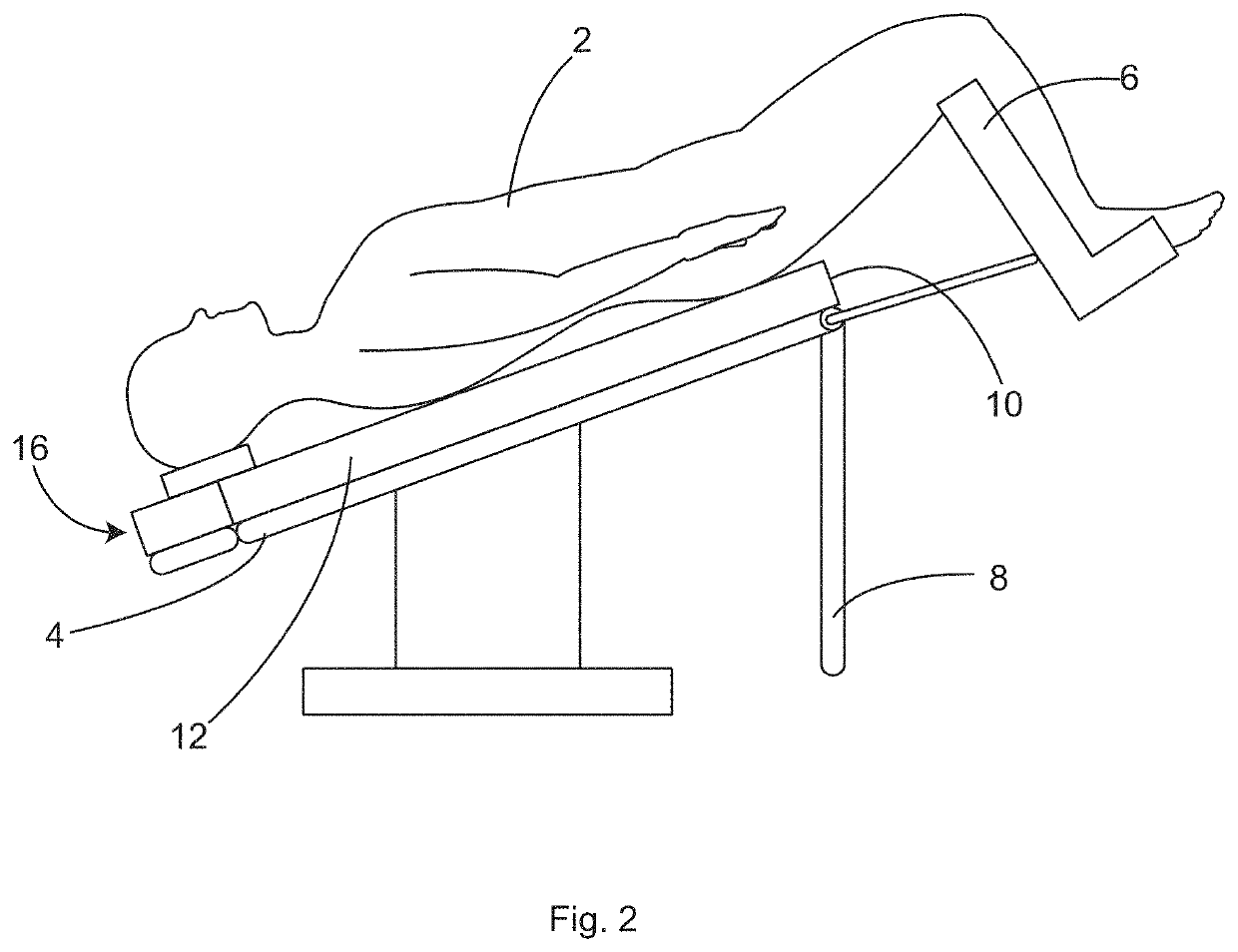
Keeping the patient from sliding off of a surgical table when the table is tilted into a steep, head-down (Trendelenburg) position, is a constant challenge for surgical personnel and a danger for the patient.
Depending on the angle or steepness of the head-down Trendelenburg positioning, the patient's weight, and the make-up of the
support surface (e.g.,
bed sheets), patients can be at risk of sliding off of the head end of the surgical table in the Trendelenburg position.
Straps and tape across the chest have proven to not be secure.
Straps over the shoulders have resulted in stretch injuries to the nerves of the brachial
plexus.
Similarly, bolsters of foam or bean bags at the patient's shoulders that are secured to the side rails of the
bed have also resulted in stretch injuries to the nerves of the brachial
plexus and are not recommended by the Association for Operating Room Nurses.
Gel pads are cold and messy because everything sticks to them.
Therefore, unwanted slipping is most likely to occur between the mattress and the foam surgical table
overlay.
However, tape sticking to a foam surgical table
overlay or straps glued to a foam surgical table overlay as described in U.S. Pat. No. 8,464,720, for example, have a
significant risk of becoming unattached when the weight of a 400 pound patient is applied at a 45° head-down angle.
Either the
adhesive fails or the top layer of foam pulls away from the foam surgical table overlay while still being adhered to the tape.
In the present disclosure, we refer to the formation of a depression having a depth sufficient to assist in holding a patient on the pad as a “
bolster effect.” The
disadvantage of any securement device relying wholly or in part on a
bolster effect is that
bolster-type securement can be overpowered by
excessive weight and rounded shaped shoulders that are common with
obesity.
Certain conventional arm protection and securing devices are cumbersome, bulky, expensive, and prevent heating of the arms.
The tucked ends of the draw sheet can easily become un-tucked, simply pulling out from under the patient and allowing the arm to fall toward the floor, which may cause nerve injuries.
Robotic surgeries can usually take longer to perform than open surgeries and thus the patients frequently get more hypothermic in the cold operating rooms.
With the patient's arm tucked at their sides, the only
skin surface area available for conventional forced-air warming, is the top of the shoulders and the head and thus forced-air warming is ineffective.
As a result, most patients operated in either the Trendelenburg position or the
supine position with their arms tucked and warmed with forced-air warming, become very hypothermic.
The same
increased risk of
hypothermia is experienced by other patients positioned with their arms tucked but not in the Trendelenburg (head down) position.


 Login to View More