

Flexible spinal disc
a flexible, disc-like technology, applied in the direction of prosthesis, joint implants, spinal implants, etc., can solve the problems of not providing any shock-absorbing elasticity or flexibility in multiple planes, difficult to fabricate and install multiple components required in the previous designs of stubstad et al. and lee, and achieve the effect of allowing flexibility of motion, shock absorption and flexibility
- Summary
- Abstract
- Description
- Claims
- Application Information
AI Technical Summary
Benefits of technology
Problems solved by technology
Method used
Image

Examples
example 1
[0045] Elastomers useful in the practice of the invention include silicone rubber, polyurethane, polyvinyl alcohol hydrogels, polyvinyl pyrrolidone, poly HEMA, HYPAN™ and Salubria™ biomaterial. Methods for preparation of these polymers and copolymers are well known to the art. The device described in this example is made from an elastomeric cryogel material disclosed in U.S. Pat. Nos. 5,981,826 and 6,231,605, hereby incorporated by reference, that has a mechanical compressive modulus of elasticity of about 1.0 MPa, ultimate stretch of greater than 15%, and ultimate strength of about 5 MPa. The device can support over 1200 N of force.
[0046] A preferred hydrogel for use in the practice of this invention is highly hydrolyzed crystalline poly (vinyl alcohol) (PVA). PVA cryogels may be prepared, from commercially available PVA powders, by any of the methods known to the art. Preferably, they are prepared by the method disclosed in U.S. Pat. Nos. 5,981,826 and 6,231,605, the teachings of...
example 2
[0047] The prosthetic disc can be made from a variety of elastomers provided the shape, elasticity, biocompatibility, and strength requirements are met. These implantable medical devices can be made from materials such as polyurethane, silicone, hydrogels, collagens, hyalurons, proteins and other synthetic polymers can be used to achieve the desired range of elastomeric mechanical properties. Polymers such as silicone and polyurethane are generally known to have mechanical elasticity values of less than 100 MPa. Hydrogels and collagens can also be made with mechanical elasticity values less than 20 MPa and greater than 1.0 MPa. Silicone, polyurethane and some cryogels typically have ultimate tensile strength greater than 100 or 200 kiloPascals. Materials of this type can typically withstand torsions greater than 0.01 N-m without failing.
[0048] The body of the prosthesis may be further reinforced with fibers of polyethylene, polyglycolic acid, poly-paraphenylene terephthalamide, or ...
example 3
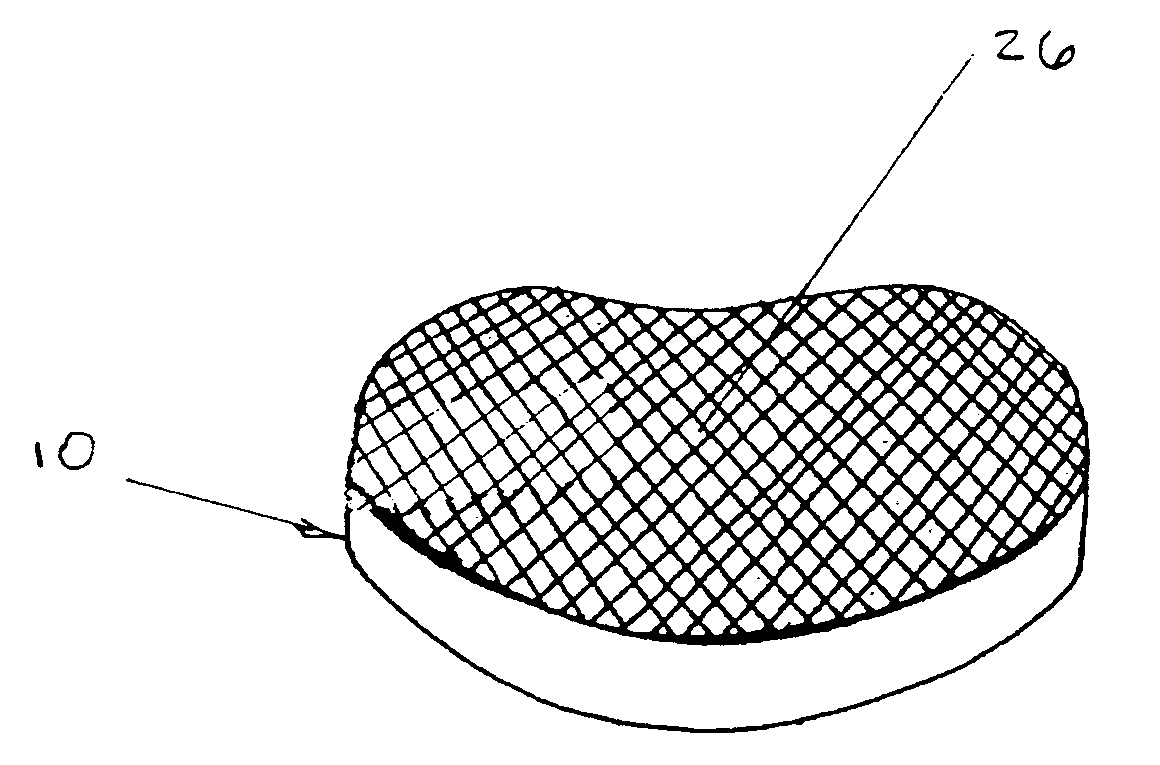
[0050] The device may be fabricated with different percentage weights of PVA at different stages of the molding process to yield a range of mechanical modulus of elasticity within the prosthetic spinal disc such that the elasticity is not constant. Similarly, two elastomers may be combined to yield elasticities that are not constant. Another approach can be to combine fibers or meshes within the device to yield anisotropic elasticity.
PUM
| Property | Measurement | Unit |
|---|---|---|
| Fraction | aaaaa | aaaaa |
| Fraction | aaaaa | aaaaa |
| Fraction | aaaaa | aaaaa |
Abstract
Description
Claims
Application Information
 Login to View More