4-(2-Methyl-5,6,7,8-tetrahydro-quinolin-7-ylmethyl)-1,3-dihydro-imidazole-2-thione as specific alpha2B agonist and methods of using the same
Inactive Publication Date: 2005-04-07
ALLERGAN INC
View PDF7 Cites 53 Cited by
Summary
Abstract
Description
Claims
Application Information
AI Technical Summary
This helps you quickly interpret patents by identifying the three key elements:
Problems solved by technology
Method used
Benefits of technology
Benefits of technology
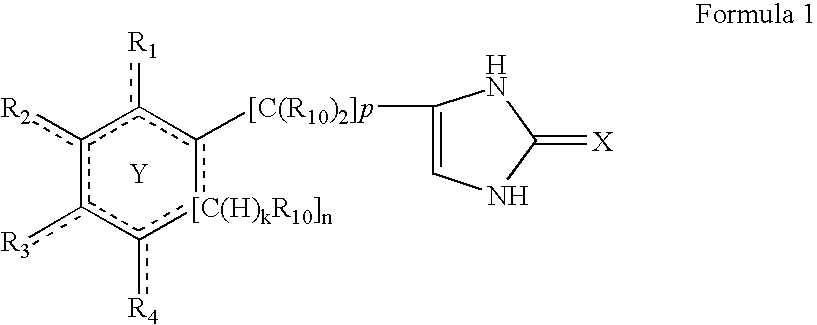
In a second aspect the present invention is directed to pharmaceutical compositions containing as the active ingredient one or more compounds of Formula 1, the compositions being utilized as medicaments in mammals, including humans, for treatment of diseases and or alleviations of conditions which are responsive to treatment by agonists of alpha2B adrenergic receptors. The compositions containing the compounds of the invention are primarily, but not exclusively, used for alleviation o
Problems solved by technology
Thus, the use of non-selective alpha-adrenergic blockers, such as phenoxybenzamine and phentolamine, was said to be limited by their α2 adrenergic receptor mediated induction of increased plasmacatecholamine concentration and the attendant physiological sequelae (increased heart rate and smooth muscle contraction).
However, many compounds having such activity do not provide the activity and specificity desirable when treating disorders modulated by alpha-2 adrenoreceptors.
For example, many compounds found to be effective agents in the treatment of pain are frequently found to have undesirable side effects, such as causing hypotension and sedation at systemically effective doses.
Method used
the structure of the environmentally friendly knitted fabric provided by the present invention; figure 2 Flow chart of the yarn wrapping machine for environmentally friendly knitted fabrics and storage devices; image 3 Is the parameter map of the yarn covering machine
View more
Image
Smart Image Click on the blue labels to locate them in the text.
Viewing Examples
Smart Image
Click on the blue label to locate the original text in one second.
Reading with bidirectional positioning of images and text.
Smart Image
Examples
Experimental program
Comparison scheme
Effect test
example a
Method A: Procedure for the Preparation 4-(1,2,3,4,5,6-hexahydro-pentallen-1-ylmethyl)-1,3-dihydro imidazole-2-thione (Compound 1)
A solution of 3,4,5,6-tetrahydro-2H-pentalen-1-one (Intermediate A1) (prepared in accordance with Cooke et al. J. Org Chem. 1980, 45, 1046, incorporated herein by reference) (1.5 g, 12.3 mmol) in MeOH (30 mL) and CeCl3-7H2O (3.6 g, 14.6 mmol) at 0° C. was treated with NaBH4 (494 mg, 14.6 mmol). The solution was allowed to warm to rt and stirring was continued for 30 min. Water (100 mL) and diethyl ether (150 mL) were added. The organic layer was dried over MgSO4, filtered and evaporated to dryness. The alcohol (Intermediate A2) was used in the next step without further purification.
A solution of the alcohol (Intermediate A2) (0.85 g, 6.9 mmol) in ethyl vinylether (50 mL) at rt was treated with Hg(OAc)2 (1.75 g, 5.5 mmol) at rt for 18 h. The mixture was quenched with 5-10% KOH solution (80 mL) and the product was extracted with 50% ether:hexane (3×80 ...
example a-1
Compound 2
Use of 3-methyl-cyclopent-2-enone (commercially available from Aldrich) in Method A produced 4-(3-methyl-cyclopent-2-enylmethyl) 1,3-dihydro-imidazole-2-thione (Compound 2).
Use of 3-ethyl-cyclopent-2-enone (available in accordance with the publication of Woods et. al., J. Amer. Chem. Soc. 1949, 71, 2020, incorporated herein by reference) in Method A produced 4-(3-ethyl-cyclopent-2-enylmethyl)-1,3-dihydroimidazole-2-thione. 1H NMR (500 MHz, CD3OD-d4): δ 6.53 (s, 1), 5.26 (s, 1H), 2.91 (brs, 1H), 2.51-2.37 (m, 2H), 2.26-2.22 (m, 2H), 2.08-2.02 (m, 3H) 1.52-1.48 (m, 1H), 1.03 (t, J=8.0 Hx, 3H).
the structure of the environmentally friendly knitted fabric provided by the present invention; figure 2 Flow chart of the yarn wrapping machine for environmentally friendly knitted fabrics and storage devices; image 3 Is the parameter map of the yarn covering machine
Login to View More
PUM
Property
Measurement
Unit
Composition
aaaaa
aaaaa
Enantiomer
aaaaa
aaaaa
Login to View More
Abstract
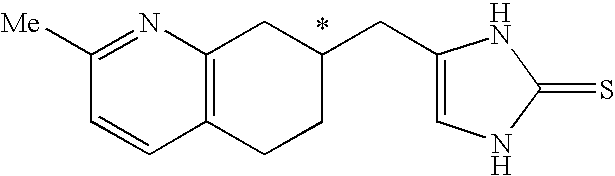
The compound of the formula wherein the * indicates an asymmetric carbon, is specific to alpha2B adrenergic receptors in preference over alpha2A and alpha2C adrenergic receptors, and as such has no or only minimal cardivascular and / or sedatory activity. The compound is useful as medicament in mammals, including humans, for treatment of diseases and or alleviations of conditions which are responsive to treatment by agonists of alpha2B adrenergic receptors.
Description
BACKGROUND OF THE INVENTION 1. Field of the Invention The present invention relates to 4-(substituted cycloalkylmethyl)imidazole-2-thiones, 4-(substituted cycloalkenylmethyl)imidazole-2-thiones and related compounds and to their use as specific or selective agonists of alpha2B and / or alpha2C adrenergic receptors. More specifically the present invention relates to the above-noted compounds, pharmaceutical compositions containing these compounds as active ingredient for modulating the alpha2B and / or alpha2C adrenergic receptors, and even more specifically for utilizing these compounds and pharmaceutical compositions to alleviate chronic pain, allodynia, musclespasticity, diarrhea, neuropathic pain and other diseases and conditions. The present invention also relates to, 4-(substituted cycloalkylmethyl) imidazol-2-ones and 4-(substituted cycloalkenylmethyl)imidazol-2-ones and to pharmaceutical compositions containing these compounds alleviate chronic pain, allodynia, muscle spastic...
Claims
the structure of the environmentally friendly knitted fabric provided by the present invention; figure 2 Flow chart of the yarn wrapping machine for environmentally friendly knitted fabrics and storage devices; image 3 Is the parameter map of the yarn covering machine
Login to View More
Application Information
Patent Timeline
Application Date:The date an application was filed.
Publication Date:The date a patent or application was officially published.
First Publication Date:The earliest publication date of a patent with the same application number.
Issue Date:Publication date of the patent grant document.
PCT Entry Date:The Entry date of PCT National Phase.
Estimated Expiry Date:The statutory expiry date of a patent right according to the Patent Law, and it is the longest term of protection that the patent right can achieve without the termination of the patent right due to other reasons(Term extension factor has been taken into account ).
Invalid Date:Actual expiry date is based on effective date or publication date of legal transaction data of invalid patent.



 Login to View More