
Relaxed SiGe platform for high speed CMOS electronics and high speed analog circuits
a technology of analog circuits and sige platforms, applied in the direction of semiconductors, electrical devices, transistors, etc., can solve the problems of serious economic and technological problems that will confront the progress of digital integrated circuits, new bottlenecks in data flow, and analog circuitry has barely advanced at all, so as to achieve the effect of minimal surface roughness
- Summary
- Abstract
- Description
- Claims
- Application Information
AI Technical Summary
Benefits of technology
Problems solved by technology
Method used
Image

Examples
Embodiment Construction
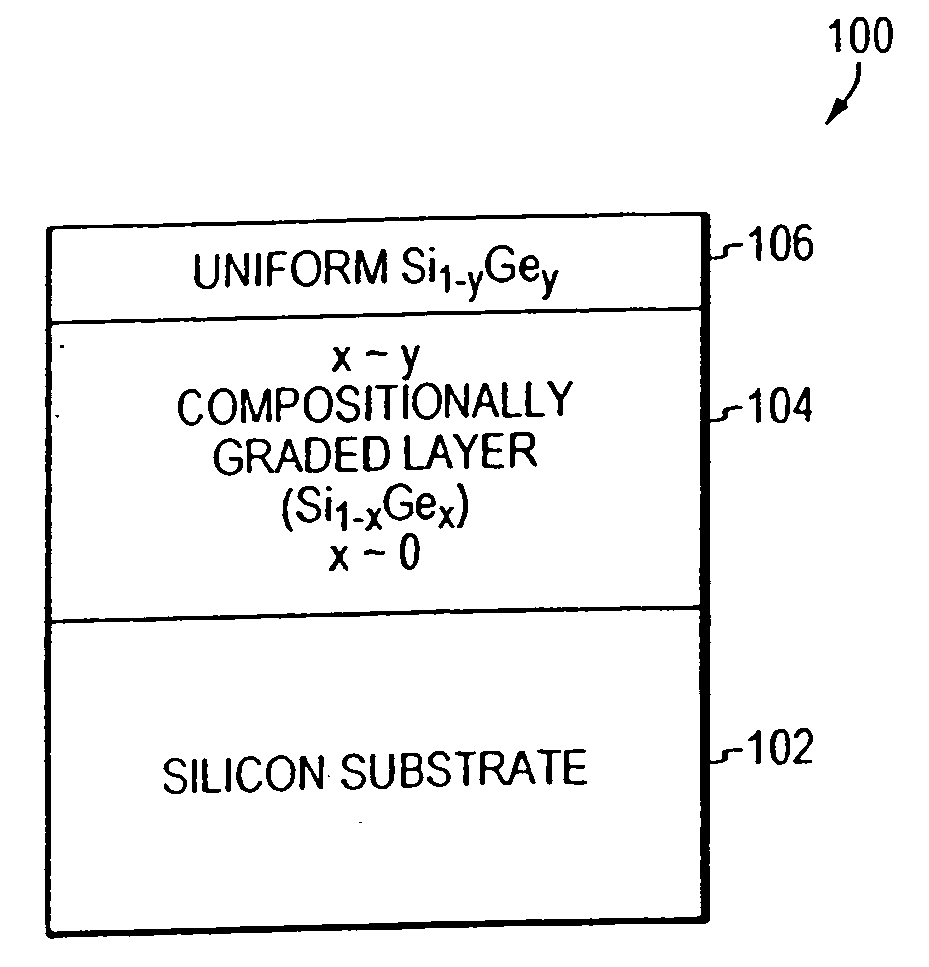
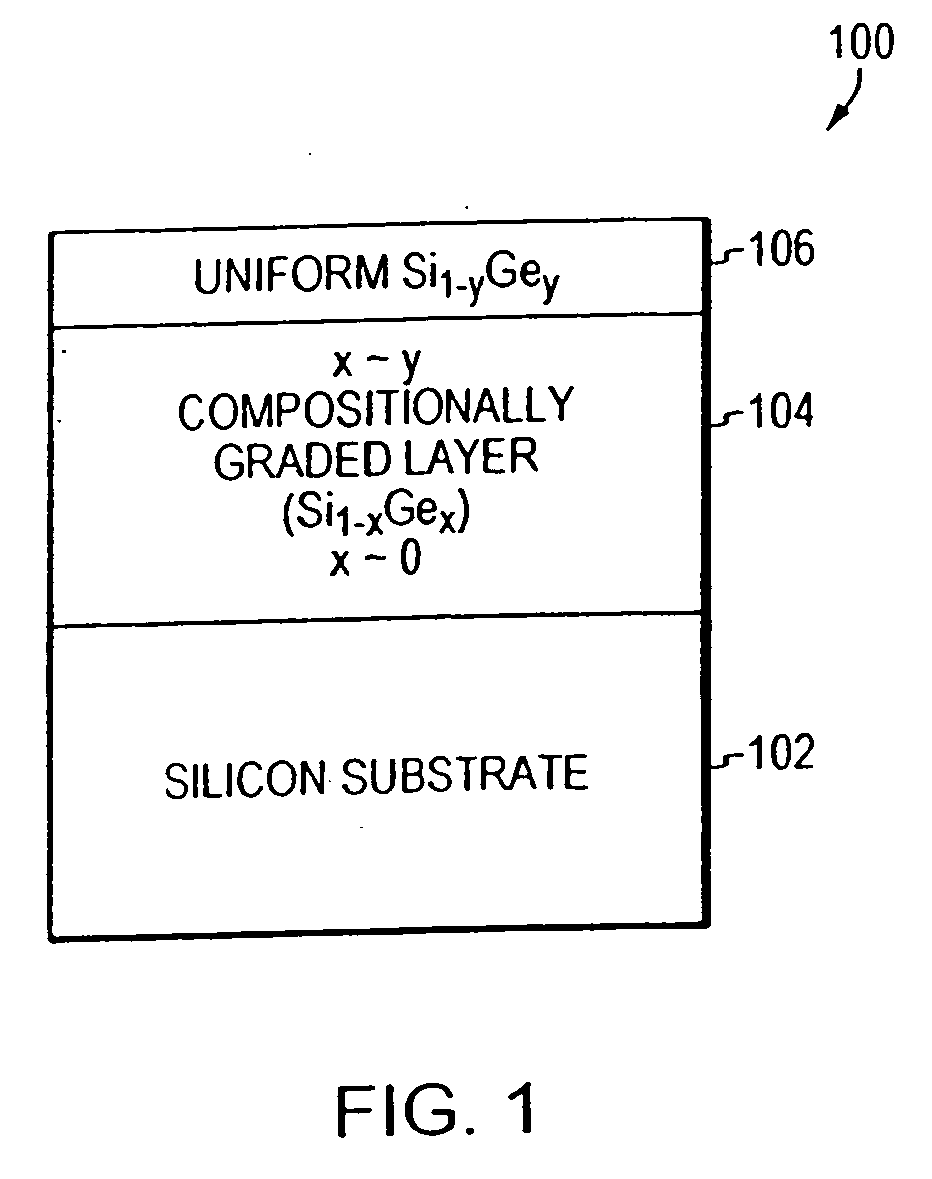
[0024]FIG. 1 is a schematic block diagram of a structure 100 including a relaxed SiGe layer epitaxially grown on a Si substrate 102. In this structure, a compositionally graded buffer layer 104 is used to accommodate the lattice mismatch between the uniform SiGe layer 106 and the Si substrate. By spreading the lattice mismatch over a distance, the graded buffer minimizes the number of dislocations reaching the surface and thus provides a method for growing high-quality relaxed SiGe films on Si.
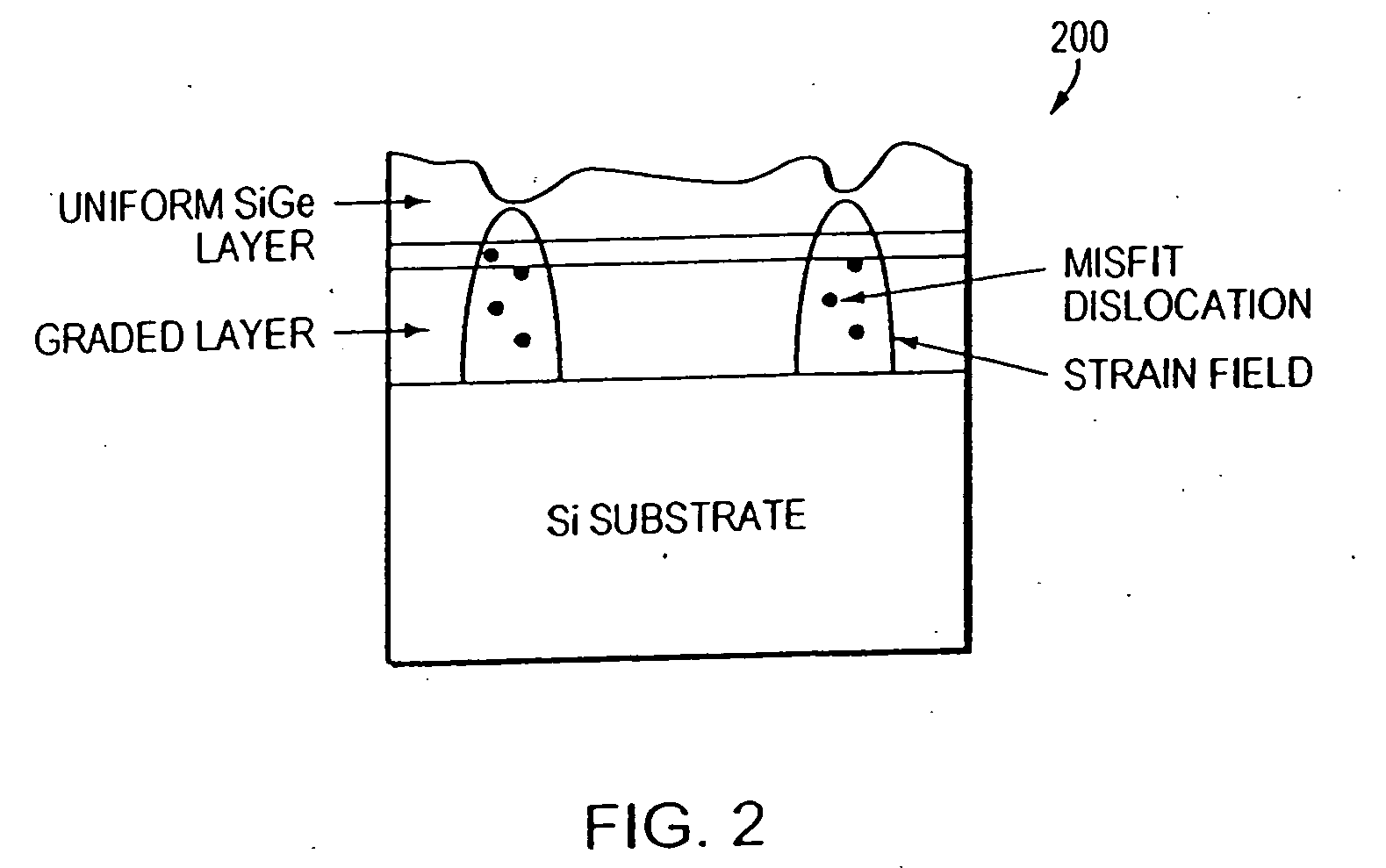
[0025] Any method of growing a high-quality, relaxed SiGe layer on Si will produce roughness on the surface of the SiGe layer in a well-known crosshatch pattern. This crosshatch pattern is typically a few hundred angstroms thickness over distances of microns. Thus, the crosshatch pattern is a mild, undulating surface morphology with respect to the size of the electron or hole. For that reason, it is possible to create individual devices that achieve enhancements over their control Si device c...
PUM
 Login to View More
 Abstract
Description
Claims
Application Information
 Login to View More