
Steroids as agonists for fxr
- Summary
- Abstract
- Description
- Claims
- Application Information
AI Technical Summary
Benefits of technology
Problems solved by technology
Method used
Image

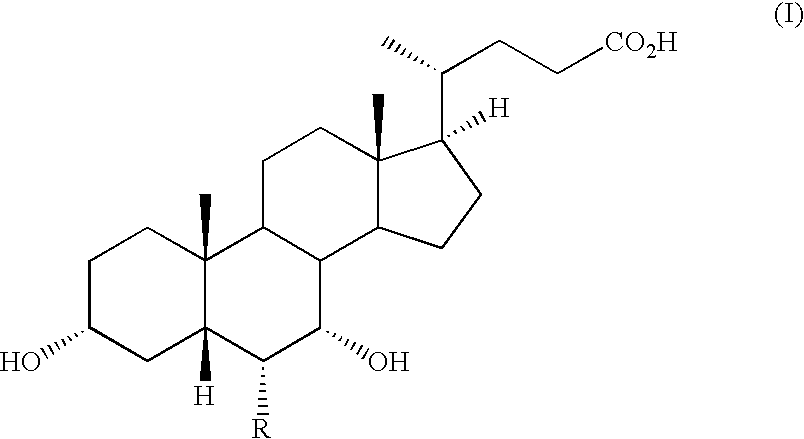
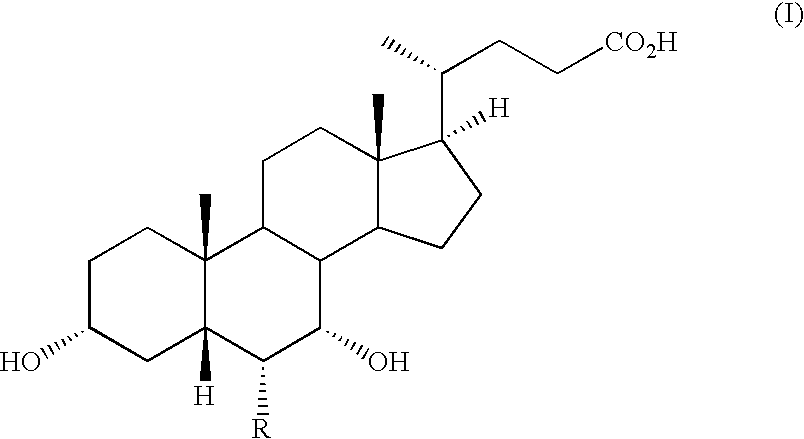
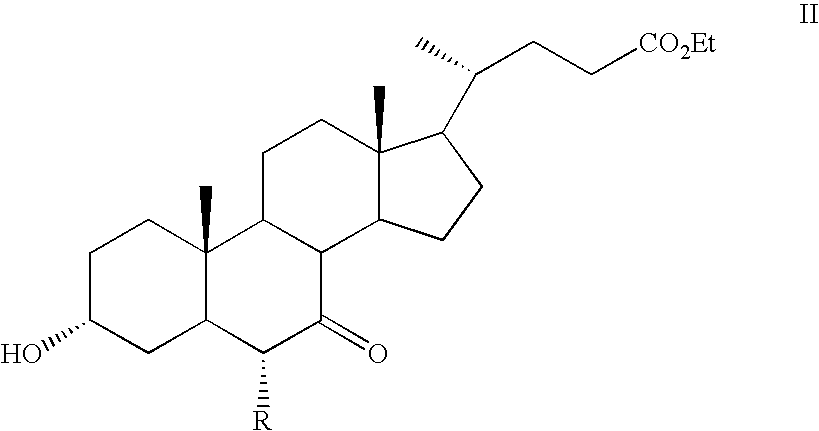
Examples
example
Synthesis of 3α7α-Dihydroxy-6α-ethyl-5β-cholan-24-oic Acid (6αEt-CDCA)
3α-Tetrahydropyranyloxy-7-keto-5β-cholan-24-oic acid
[0067] p-Toluensulfonic acid (6.0 g, 3.2 mmol) and 3,4-dihydro-2H-pyrane (4.6 g, 54 mmol) were added to a solution of 3α-hydroxy-7-keto-5β-cholan-24-oic acid (1) (6.0 g, 14.4 mmol) in 120 ml of dioxane. The reaction mixture was stirred at room temperature for 15 min and then was treated with methanol saturated with ammonia until it reached pH of about 8-9. The solvents were removed under vacuum and the residue was extracted with chloroform (200 ml) and washed with a saturated NaHCO3 solution (2 ×50 ml). After drying over anhydrous Na2SO4 and evaporation under vacuum, the residue was purified by silica gel chromatography. Elution by CHCl3:MeOH (90:10) yielded 5.4 g (10.4 mmol, 74% yield) of compound 2 as a white solid (mp: 157-159° C.).
[0068]1H-NMR (CDCl3) δ:0.58 (s, 3H, CH3-18); 0.88 (d, J=6.1 Hz, 3H, CH3-21); 1.14 (s, 3H, CH3-19); 3.3-3.7 (m, 3H, pyr); 3.75-3...
PUM
| Property | Measurement | Unit |
|---|---|---|
| Pharmaceutically acceptable | aaaaa | aaaaa |
Abstract
Description
Claims
Application Information
 Login to View More