Compositions and treatments of bacterial vaginosis

US20050090564A1Inactive Publication Date: 2005-04-28EPITOME PHARM INC +1

Image

Smart Image Click on the blue labels to locate them in the text.
Viewing Examples
Smart Image
  • Compositions and treatments of bacterial vaginosis

Examples

Experimental program
Comparison scheme
Effect test

Embodiment Construction

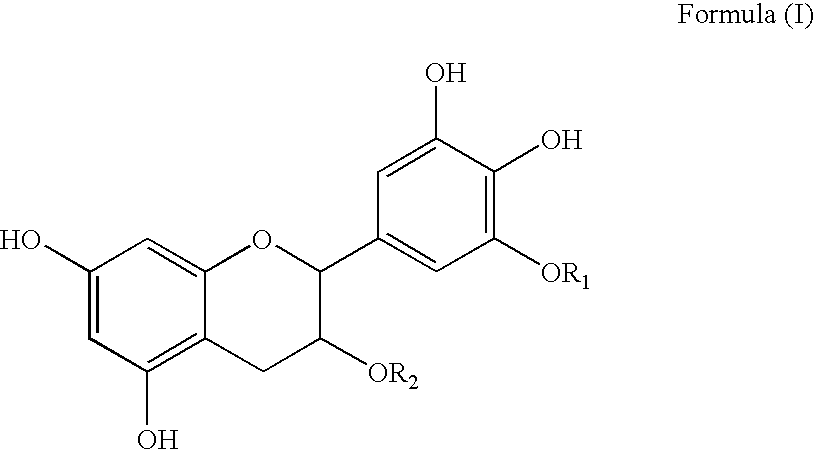
[0011] The inventors discovered that bacterial vaginosis can be treated by topic and / or systemic administration of a plant polyphenol or mixture of various plant polyphenols. Most preferably, the plant polyphenols are isolated from green tea (Camellia sinensis) or grape seeds, and even more preferably comprise a mixture of plant polyphenols (e.g., Polyphenon E, commercially available from Mitsui Norin).

[0012] The term “plant polyphenol” as used herein refers to any naturally occurring or synthetic polyphenol that is commonly found in a plant. Therefore, particularly preferred plant polyphenols include flavan-3-ol compounds (e.g., (−)-epigallocatechin gallate (EGCG), (−)-epicatechin gallate (ECG), (−)-epigallocatechin (EGC), or (−)-epicatechin (EC)). As also used herein, the term “treat” or “treatment” refers to administration of contemplated compounds or compositions, typically in response to a diagnosis of bacterial vaginosis, which may result in complete or partial resolution of ...

the structure of the environmentally friendly knitted fabric provided by the present invention; figure 2 Flow chart of the yarn wrapping machine for environmentally friendly knitted fabrics and storage devices; image 3 Is the parameter map of the yarn covering machine
Login to View More

PUM

PropertyMeasurementUnit
Massaaaaaaaaaa
Massaaaaaaaaaa
Massaaaaaaaaaa
Login to View More

Abstract

Bacterial vaginosis is treated using methods and compositions that include one or more plant polyphenols as active ingredients. Preferred routes of administration of contemplated plant polyphenols include topical and oral administration, and particularly preferred plant polyphenols are prepared from green tea (e.g., Polyphenon E) and / or may include (−)-epigallocatechin gallate, (−)-epicatechin gallate, (−)-epigallocatechin, and (−)-epicatechin.

Description

[0001] This application claims the benefit of U.S. provisional patent application with the Ser. No. 60 / 515,485, which was filed Oct. 28, 2003, and which is incorporated by reference herein.FIELD OF THE INVENTION [0002] Treatment of bacterial infections, and especially of bacterial vaginosis. BACKGROUND OF THE INVENTION [0003] Bacterial vaginosis (BV) is a genito-urinary tract infection that is typically caused by anaerobic bacteria, including Gardnerella vaginalis, Mobiluncus sp., Bacteroides sp. and Mycoplasma homini, and various compositions and methods for treatment of BV are known in the art. For example, metronidazole (1-(2-Hydroxy-1-ethyl)-2-methyl-5-nitroimidazole) is among the most effective and commonly prescribed drugs (see e.g., Ferris, D. G, Litaker, M. S, Woodward, L., Mathis, D., Hendrich, J. in J. Fam. Pract. 1995 November; 41(5):443-9). However, metronidazole has also been shown to be carcinogenic in mice and rats, and the potential risks may therefore outweigh the b...

Claims

the structure of the environmentally friendly knitted fabric provided by the present invention; figure 2 Flow chart of the yarn wrapping machine for environmentally friendly knitted fabrics and storage devices; image 3 Is the parameter map of the yarn covering machine
Login to View More

Application Information

Patent Timeline
28 Apr 2005
Publication
US20050090564A1
IPC
A01N25/00; A61K9/00; A61K31/353; A61K36/82
CPC
A61K31/353; A61K9/0034; A61K36/82; A61K36/00
Inventors
WEGENER, PAUL T.; HARA, YUKIHIKO