
Method and apparatus for recording/reproducing optical information
- Summary
- Abstract
- Description
- Claims
- Application Information
AI Technical Summary
Benefits of technology
Problems solved by technology
Method used
Image

Examples
example 1
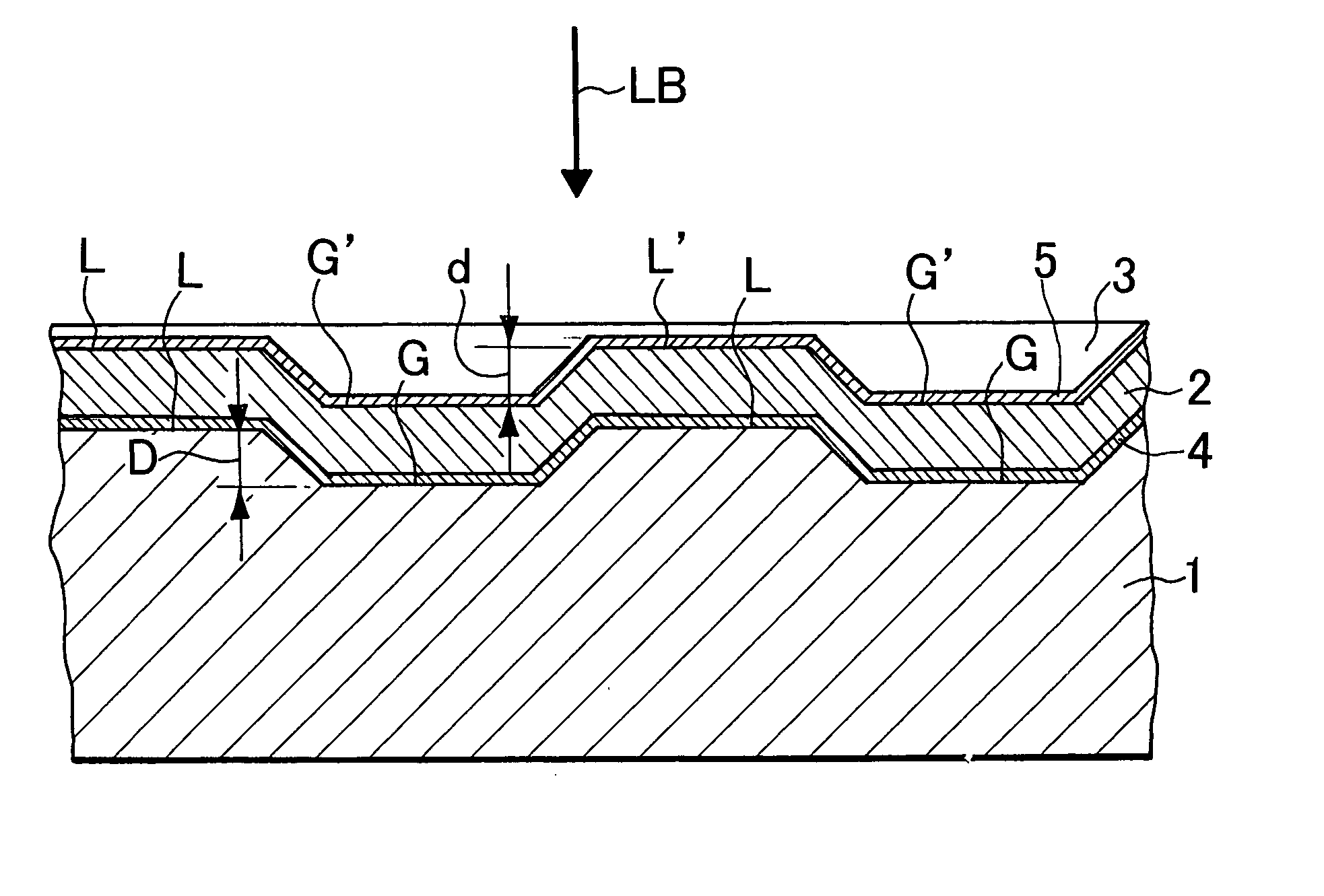
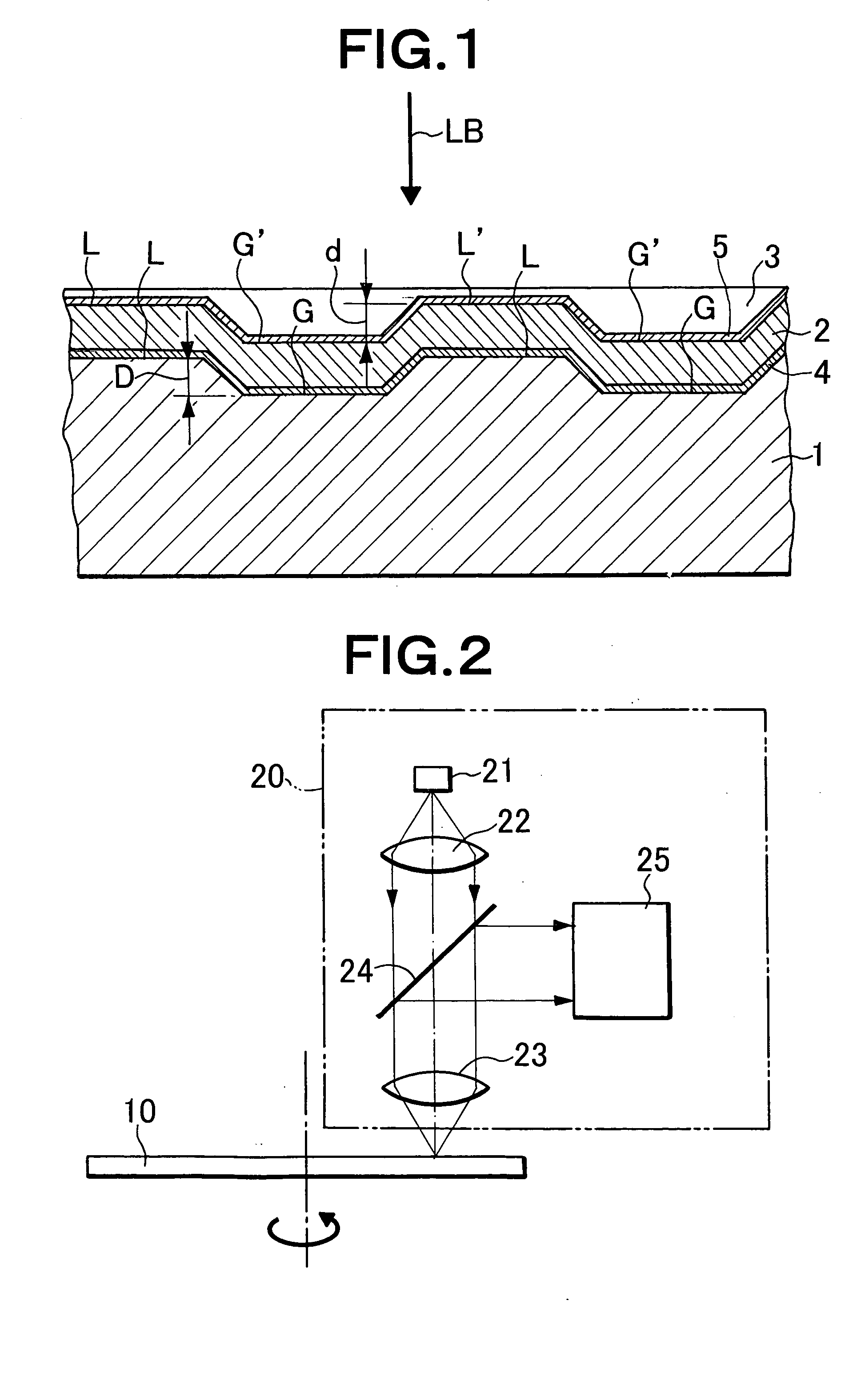
[0059] A disc-shaped PC substrate having a thickness of 1.1 mm was used as a substrate, and a 100 nm thick Al reflective film, a 15 nm thick ZnS—SiO2 dielectric layer, a 15 nm thick GeSbTe recording layer, and a 40 to 85 nm thick ZnS—SiO2 dielectric layer were stacked / formed on a land / groove formed surface of the substrate by sputtering. On the layers, a 0.1 mm thick PC film was bonded as a light-transmitting layer by an ultraviolet cured resin.
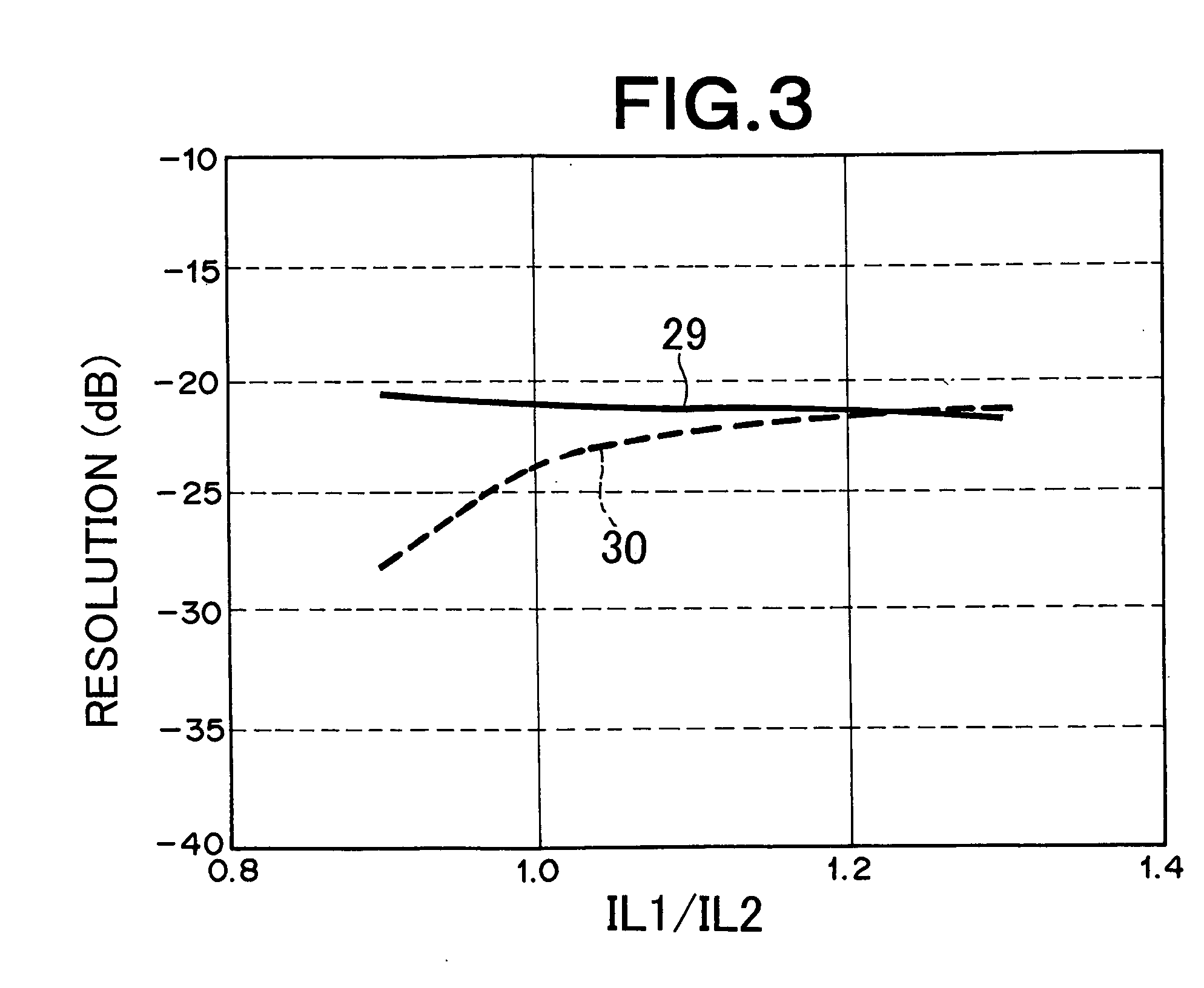
[0060] After initializing (crystallizing) the above-described disk (recording medium), the disk was rotated at a linear speed of 5.1 m / s, laser light was applied from a light-transmitting layer side using an optical head having a wavelength of 405 nm, NA=0.85, recording was performed into both a portion L′ corresponding to a land and a portion G′ corresponding to a groove on a linear density condition of 0.116 μm / bit, and reproduction characteristics were measured. Since (1-7) modulation was used as a modulation system, a mark length of a lo...
example 2
[0064] A disc-shaped PC substrate having a thickness of 1.1 mm was used as a substrate, and a 100 nm thick Al reflective film, a 25 nm thick ZnS—SiO2 dielectric layer, a 15 nm thick GeSbTe recording layer, a 25 nm thick ZnS—SiO2 dielectric layer, a 30 nm thick SiO2 dielectric layer, and a 50 to 75 nm thick ZnS—SiO2 dielectric layer were successively stacked / formed on a land / groove formed surface of the substrate by sputtering. On the layers, a 0.1 mm thick PC film was bonded as a light-transmitting layer by an ultraviolet cured resin.
[0065] After initializing (crystallizing) the above-described disk, the dark was rotated at a linear speed of 5.1 m / s, laser light was applied from a light-transmitting layer side using an optical head having a wavelength of 405 nm, NA=0.85, recording was performed into both a portion L′ corresponding to a land and a portion G′ corresponding to a groove on a linear density condition of 0.116 μm / bit, and reproduction characteristics were measured. Since...
example 3
[0069] A disc-shaped PC substrate having a thickness of 0.6 mm was used as a substrate, and a 40 to 85 nm thick ZnS—SiO2 dielectric layer, a 15 nm thick GeSbTe recording layer, a 15 nm thick ZnS—SiO2 dielectric layer, and a 100 nm thick Al reflective film were successively stacked / formed on a land / groove formed surface of the substrate by sputtering. On the layers, a 0.6 mm thick glass substrate was bonded by an ultraviolet cured resin.
[0070] After initializing (crystallizing) the above-described disk (recording medium), the disk was rotated at a linear speed of 3.5 m / s, laser light was applied from the back surface of the PC substrate using an optical head having a wavelength of 405 nm, NA=0.65, recording was performed into both a portion L′ corresponding to a land and a portion G′ corresponding to a groove on a linear density condition of 0.16 μm / bit, and reproduction characteristics were measured. Since (1-7) modulation was used as a modulation system, a mark length of a longest...
PUM
 Login to View More
 Abstract
Description
Claims
Application Information
 Login to View More