Image recompressing apparatus and image recompressing method
Inactive Publication Date: 2005-07-28
NEC CORP
View PDF4 Cites 20 Cited by
Summary
Abstract
Description
Claims
Application Information
AI Technical Summary
This helps you quickly interpret patents by identifying the three key elements:
Problems solved by technology
Method used
Benefits of technology
Benefits of technology
[0006] In view of the foregoing problems, it is an object of the present invention to provide an image recompressing apparatus and an image recompressing method, which can implement the function of preventing degradation in image quality while reducing an amount of code in a high speed in transformation of the amount of code of compressed / encoded time-varying image data stored in a home server, a hard disk recorder, and so forth, resulting in a more significant advantage for a user.
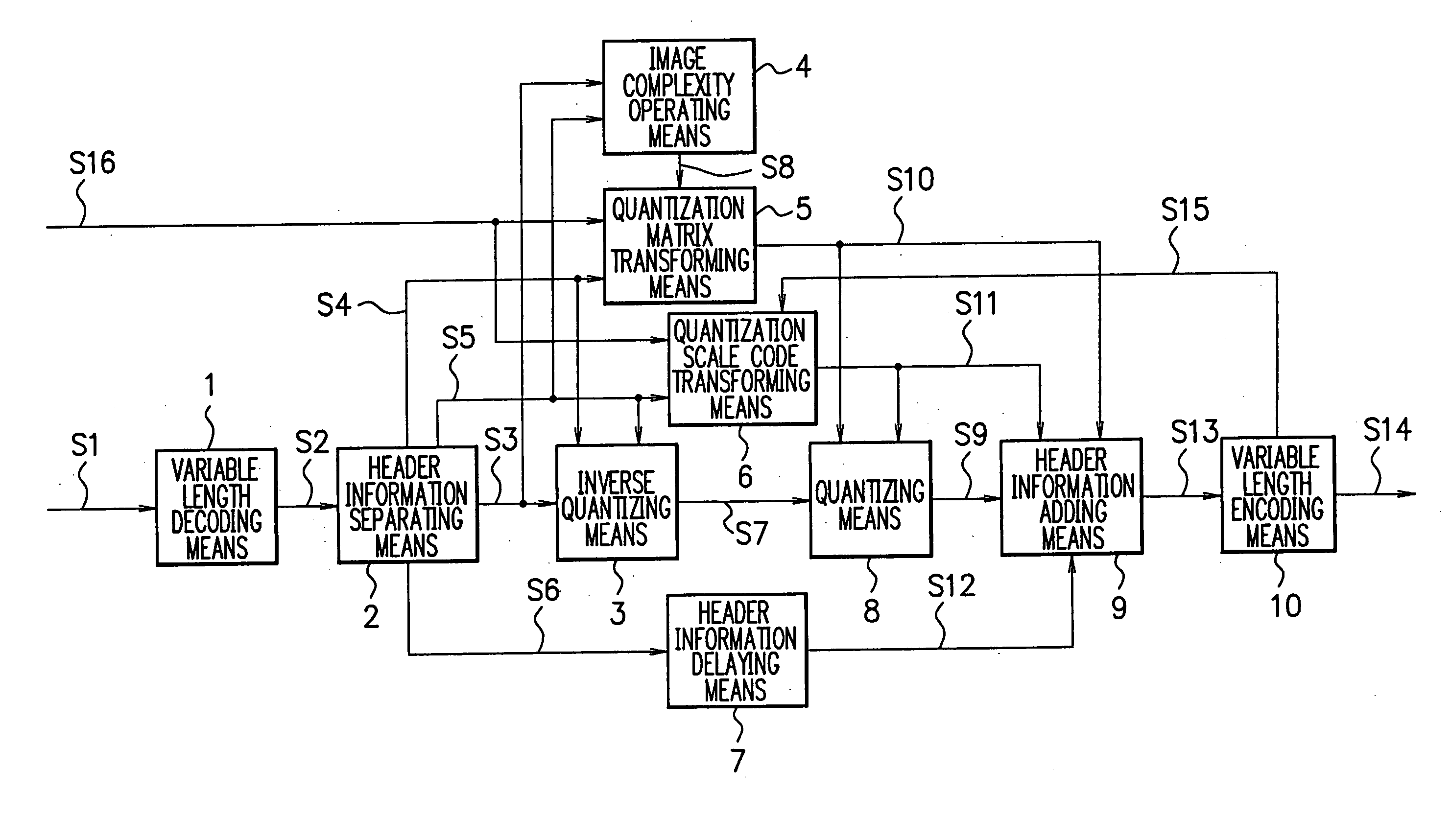
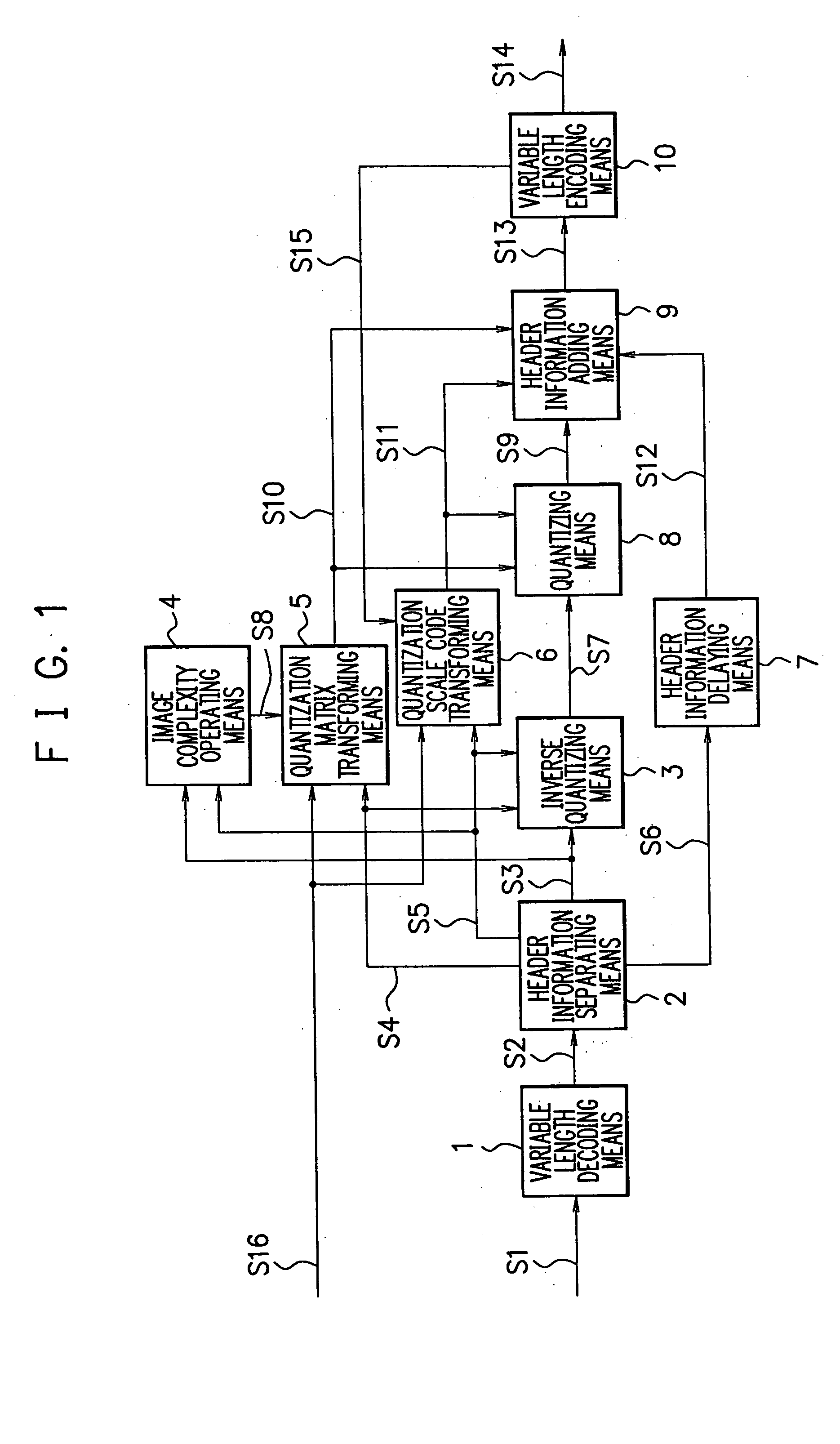
[0007] According to the present invention, for achieving the above-mentioned objects, there is provided an image recompressing apparatus including variable length decoding and header information separating means for separating compressed / encoded image data into DCT coefficient (compressed image information) and other parameters such as header information, inverse quantizing means for performing inverse quantization of the separated DCT coefficient depending upon a quantization matrix and a quantization scale code extracted from the header information, image complexity operating means for finding image complexity (X value) without expansion into base band image data, quantization matrix transforming means for extracting the quantization matrix from the compressed / encoded data, and properly performing weighting to reduce higher frequency components in the DCT coefficient according to complexity of the encoded input image, quantization scale code transforming means for making a control to obtain a desired amount of code according to the input quantization scale, quantizing means for requantizing the inverse-quantized DCT coefficient, header information adding means for adding the header information to the requantized DCT coefficient in the order defined in a compressing / coding method, and variable length encoding means for performing variable length encoding such as Huffman coding. In the apparatus, it is possible to carry out recompressing / coding in a high speed, and simultaneously control an amount of code by utilizing a feature of image data, thereby preventing degradation in image quality. Thus, according to the present invention, in order to reduce the amount of code of compressed time-varying image data, recompression is made to the compressed time-varying image data with the original DCT coefficient. In this operation, complexity of the image is calculated, and weighting is made to the quantization matrix according to the complexity. It is thereby possible to transform the amount of code at a high speed, and reduce degradation in image quality.
[0008] Consequently, according to the present invention, in transformation of a bit rate of the compressed image, re-encoding can be made before the encoded data is completely decoded, thereby enhancing a bit rate transforming speed. Further, the quantization matrix can be selected according to the complexity of image, and the quantization scale weighted according to the picture type can be selected, resulting in reduction of error propagation. Furthermore, redundant header or data is deleted to provide the effect of preventing deterioration in image quality.
Problems solved by technology
However, the main purpose of the method is limited to the reduction of the amount of code.
Method used
the structure of the environmentally friendly knitted fabric provided by the present invention; figure 2 Flow chart of the yarn wrapping machine for environmentally friendly knitted fabrics and storage devices; image 3 Is the parameter map of the yarn covering machine
View more
Image
Smart Image Click on the blue labels to locate them in the text.
Viewing Examples
Smart Image
Click on the blue label to locate the original text in one second.
Reading with bidirectional positioning of images and text.
Smart Image
Examples
Experimental program
Comparison scheme
Effect test
embodiment 1
[0013] Preferred embodiments of the invention will now be described in detail referring to the accompanying drawings.
[0014]FIG. 1 is a block diagram showing a configuration of an image recompressing apparatus according to the first embodiment of the present invention. In the configuration of FIG. 1, a compressed / encoded image data S1 is, for example, image data obtained by compressing / coding according to MPEG 2 (Moving Picture Expert Group Phase 2) Coding defined in ISO / IEC13818-2, and is input into a variable length decoding means 1. The variable length decoding means 1 decodes the variable length encoded data to output a result as decoded data S2 to a header information separating means 2.
[0015] The header information separating means 2 separates from the decoded data S2 DCT coefficient data S3, quantization matrix data S4, quantization scale code data S5, and other header information data S6, thereafter outputting those data respectively to an inverse quantizing means 3, an ima...
embodiment 2
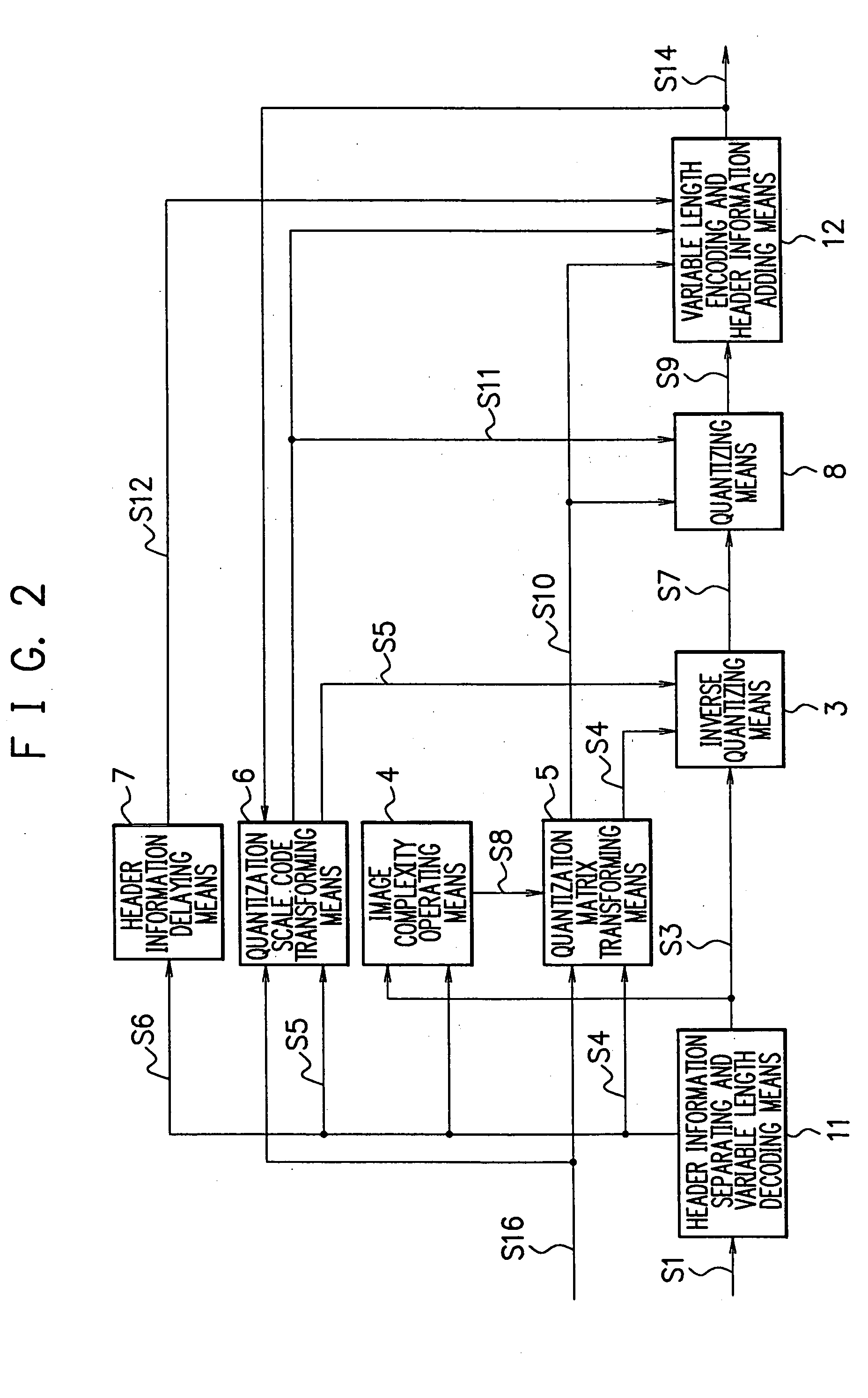
[0038] A description will now be given of the second embodiment of the present invention referring to FIG. 2. In FIG. 2, the same reference numerals are used for component parts identical with those shown in FIG. 1. In the second embodiment, header information separating and variable length decoding means 11 separates compressed / encoded image data S1 into a DCT coefficient S3, and other header information S4, S5, and S6.
[0039] An inverse quantizing means 3 calculates a quantization scale depending upon quantization matrix data S4 output from the quantization matrix transforming means 5 and quantization scale code data S5 output from the quantization scale code transforming means 6. Thus, DCT coefficient data S3 is requantized (multiplied) by the quantization scale so that the DCT coefficient data S7 is produced and output. In this case, the inverse quantizing means 3 has 64 preset DCT coefficients. However, since no processing is required when no image data is input, it is not esse...
embodiment 3
[0045] A description will now be given of the third embodiment of the present invention referring to FIG. 3. In the configuration, several functions are added to the configuration of the second embodiment. Specifically, a motion vector reoperating means 13 is additionally mounted, and a header information separating and variable length decoding means 11 is provided with the two functions of separating motion vector data S17, and of detecting redundant header information. In FIG. 3, the same reference numerals are used for component parts identical with those shown in FIGS. 1 and 2.
[0046] In the third embodiment, the header information separating and variable length decoding means 11 separates compressed / encoded image data S1 into a quantized DCT coefficient S3, quantization matrix data S4, quantization scale code S5, motion vector data S17, and other header information data S6. Further, the header information separating and variable length decoding means 11 has the function of dele...
the structure of the environmentally friendly knitted fabric provided by the present invention; figure 2 Flow chart of the yarn wrapping machine for environmentally friendly knitted fabrics and storage devices; image 3 Is the parameter map of the yarn covering machine
Login to View More
PUM
Login to View More
Abstract
An image recompressing apparatus includes header information separating means for separating header information and compressed image information from compressed image data obtained by decoding, inverse quantizing means for performing inverse quantization of compressed image information depending upon a quantization matrix and a quantization scale code in the separated header information, quantization matrix transforming means for changing the quantization matrix according to a predetermined compressibility factor, quantization scale code transforming means for changing the quantization scale code according to the compressibility factor, and quantizing means for requantizing the inverse quantized image information depending upon the post-transformation matrix and the post-transformation quantization scale code. Thus, in the transformation of an amount of code of compressed / encoded time-varying image data, it is possible to realize the function of preventing degradation in image quality while reducing an amount of code in a high speed.
Description
BACKGROUND OF THE INVENTION [0001] 1. Field of the Invention [0002] The present invention relates to an image recompressing apparatus and an image recompressing method for transforming an amount of code in a compressed image stream. [0003] 2. Description of the Related Art [0004] As disclosed in the cited references, two methods are conventionally known for transforming an amount of code of compressed / encoded time-varying image data. In the cited reference 1 (see paragraph 0009 and FIG. 1 of Japanese Patent No. 3085024), variable length decoding is made to the compressed / encoded time-varying image data. After the inverse quantization, the time-varying image data is subsequently requantized with a changed quantization coefficient so as to obtain a desired amount of code. Thus, the amount of code can be transformed after the second variable length encoding. On the other hand, in the cited reference 2 (see paragraphs 0011 to 0014 of Japanese Patent Application Laid-Open No. 2003-87796)...
Claims
the structure of the environmentally friendly knitted fabric provided by the present invention; figure 2 Flow chart of the yarn wrapping machine for environmentally friendly knitted fabrics and storage devices; image 3 Is the parameter map of the yarn covering machine
Login to View More
Application Information
Patent Timeline
Application Date:The date an application was filed.
Publication Date:The date a patent or application was officially published.
First Publication Date:The earliest publication date of a patent with the same application number.
Issue Date:Publication date of the patent grant document.
PCT Entry Date:The Entry date of PCT National Phase.
Estimated Expiry Date:The statutory expiry date of a patent right according to the Patent Law, and it is the longest term of protection that the patent right can achieve without the termination of the patent right due to other reasons(Term extension factor has been taken into account ).
Invalid Date:Actual expiry date is based on effective date or publication date of legal transaction data of invalid patent.



 Login to View More
  Login to View More