
Calcium-containing tissue strengthening agents and use thereof
a calcium-containing tissue and agent technology, applied in the direction of biocide, heterocyclic compound active ingredients, drug compositions, etc., can solve the problems of affecting so as to increase bone mass, and accelerate the deposition of calcium
- Summary
- Abstract
- Description
- Claims
- Application Information
AI Technical Summary
Benefits of technology
Problems solved by technology
Method used
Image

Examples
experiment 1
Searching from Variety of Organic Compounds by Measuring Alkaline Phosphatase Activity
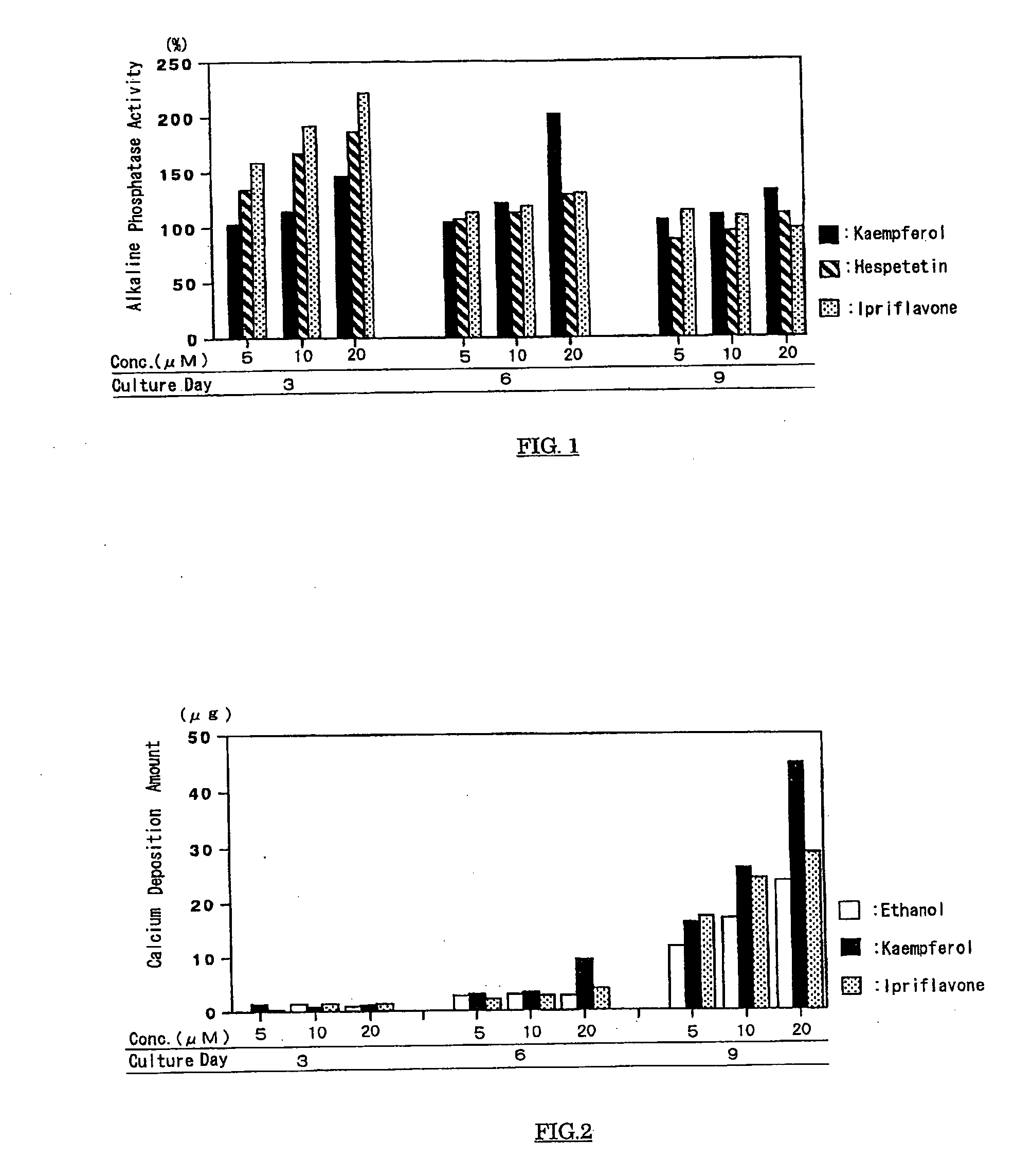
[0039] To increase number of osteoblastic cells having calcium-deposition activity is important for increasing bone mass. The compounds inducing the differentiation of mouse pre-osteoblastic cell MC3T3-E1 (RCB1126, Riken Gene Bank, Tokyo, Japan) were searched from variety of organic compounds known as plant ingredients by measuring alkaline phosphatase activity. The activity is at low level in pre-osteoblastic cells and at high level in osteoblastic cells differentiated form the pre-osteoblastic cells.
Culturing Mouse Pre-Osteoblastic Cells
[0040] Mouse pre-osteoblastic cell line MC3T3-E1 was suspended in α-MEM medium (pH6.8) supplemented with 10 mM HEPES and 10(v / v) % calf serum albumin (produced by Gibco BRL Company), which contains the ingredients listed in Table 7 to be concentration of 5×10⁴ cells / ml, placed into 24 hole plate (Commercialized by Falcon Becton Dickinson and Company) by each ...
experiment 2
Selecting from Variety of Organic Compounds by Measuring Calcium Deposition Activity
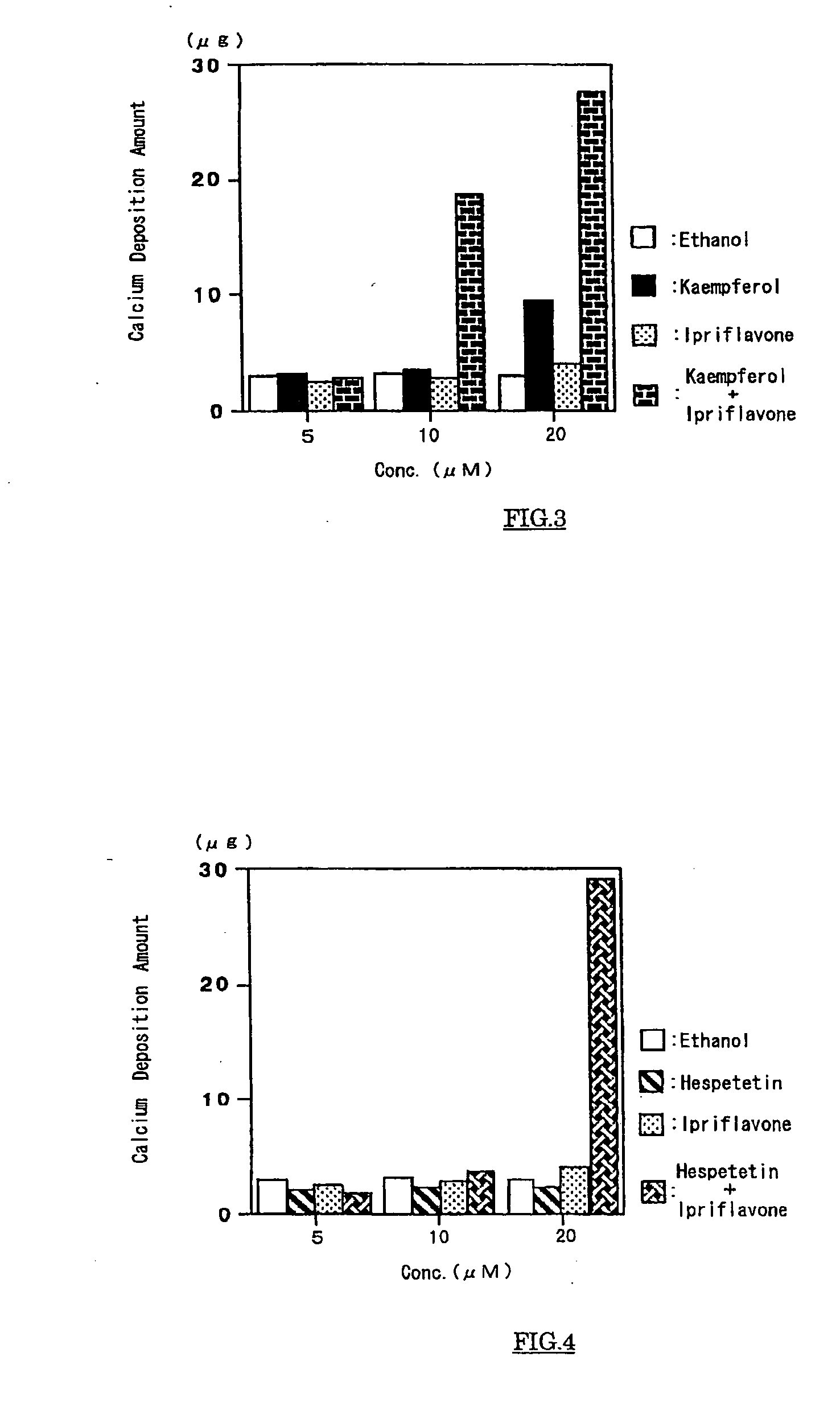
[0043] Following Experiment 1 which investigates differentiating pre-osteoblastic cells into osteoblastic cells, some of organic compounds were investigated whether they actually enhance calcium deposition or not. Indomethacin (commercialized by Funakoshi, Co., Ltd., Tokyo, Japan) (positive control), kaempferol (commercialized by Funakoshi, Co., Ltd., Tokyo, Japan), hesperetin (commercialized by Funakoshi, Co., Ltd., Tokyo, Japan), gallic acid (commercialized by Nacalai Tesque, Kyoto, Japan), and coffeic acid (commercialized by Wako Pure Chemical Industries, Osaka, Japan) were selected as organic compounds. Mouse MC3T3-E1 cells were treated with 20 mM each above compound dissolved in 1 ml of α-MEM medium supplemented with 10% (v / v) fetal calf serum and containing 10 mM β-glycerophosphate. Since final ethanol concentration in the medium is 0.2% (v / v), α-MEM medium containing 0.2% (v / v) ethanol was p...
experiment 3
Comparing Between Flavonoids
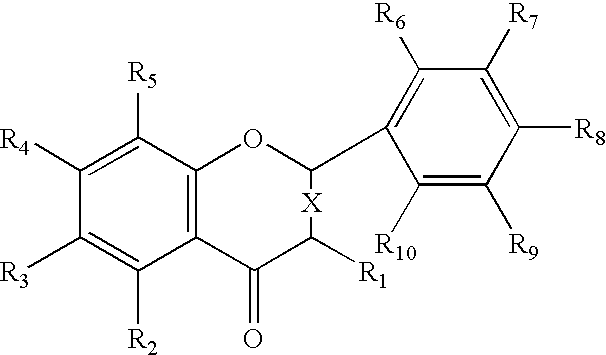
[0046] Other flavonoid compounds than kaempferol or hesperetin were investigated where they have the same effect or not. Flavone (commercialized by Kanto Kagaku, Tokyo, Japan), apigenin (commercialized by Funakoshi, Co., Ltd., Tokyo, Japan), flavonol (commercialized by Tokyo Kasei Kogyo, Co., Ltd., Tokyo, Japan), quercetin (commercialized by Kanto Kagaku, Tokyo, Japan), kaempferol (commercialized by Funakoshi, Co., Ltd., Tokyo, Japan), rutin (commercialized by Kanto Kagaku, Tokyo, Japan), flavanone (commercialized by Kanto Kagaku, Tokyo, Japan), naringenin (commercialized by Ardrich Corporation), hesperetin (commercialized by Funakoshi, Co., Ltd., Tokyo, Japan), hesperidin (commercialized by Kanto Kagaku, Tokyo, Japan), chalcone (commercialized by Merk Corporation), fuloretin (commercialized by Sigma Corporation), catechin (commercialized by Sigma Corporation), ipriflavone (commercialized by Daito Corporation, Toyama, Japan), taxifolin (commercialized b...
PUM
 Login to View More
 Abstract
Description
Claims
Application Information
 Login to View More