
Method for establishing a radio channel in a wireless cdma network wherein the preamble signal increases in power during transmission
- Summary
- Abstract
- Description
- Claims
- Application Information
AI Technical Summary
Benefits of technology
Problems solved by technology
Method used
Image

Examples
Embodiment Construction
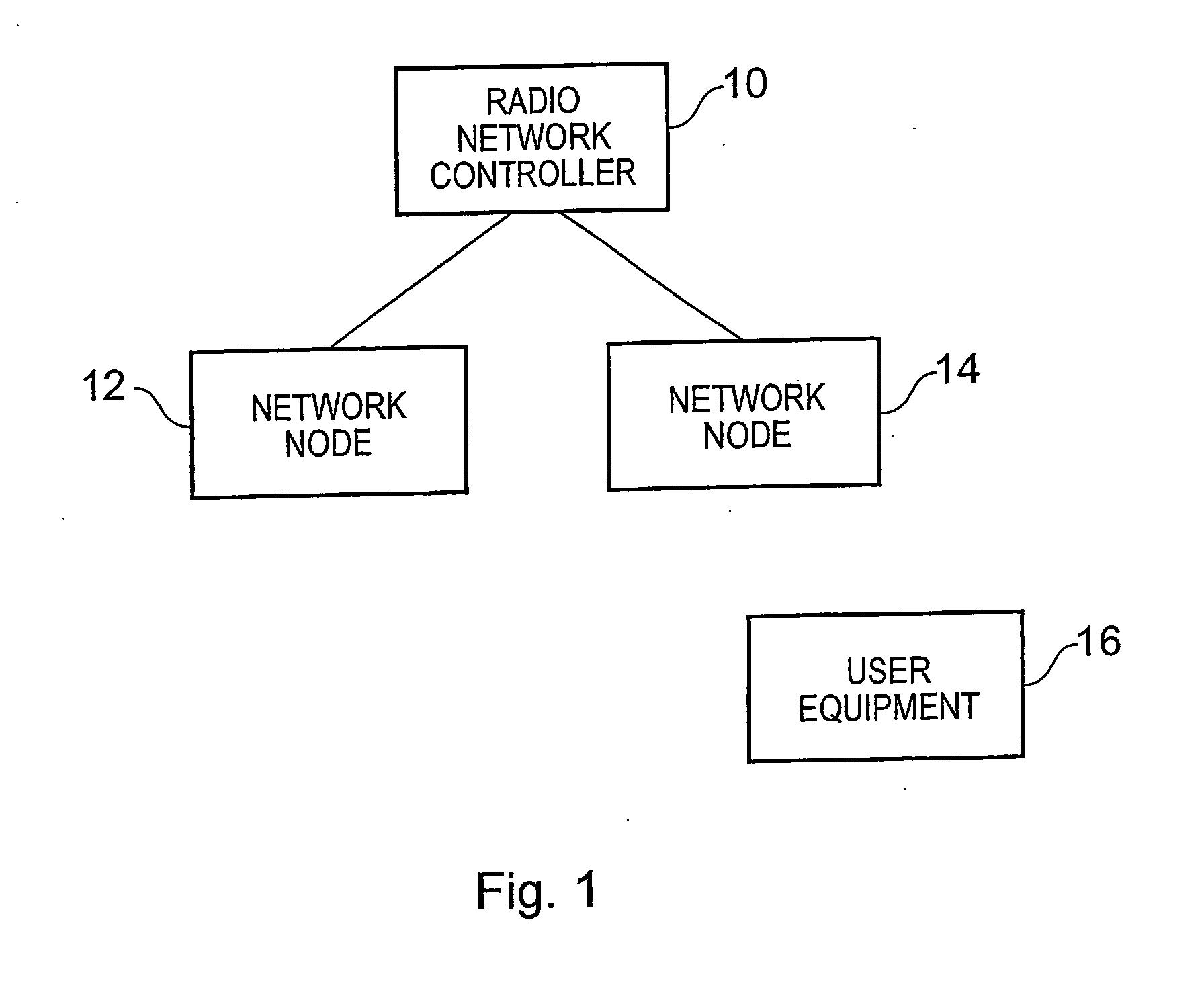
[0049]FIG. 1 shows a small part of a radio communications network operating in accordance with the present invention. Thus, FIG. 1 shows a radio network controller 10, which serves network nodes 12, 14 which are located in respective cells of the system. In the illustrated embodiment of the invention, the system is a digital wideband code division multiple access (WCDMA) wireless communications network, for example a UMTS network.
[0050] In particular, the network node includes an uplink signal power detector, which is based on peak detection in long-term delay power spectrum (LT-DPS) estimations, which for instance can be calculated with a matched filter.
[0051]FIG. 1 also shows a user equipment 16, which may for example be a mobile phone, or any other device which can establish a connection to the network.
[0052] The network nodes 12, 14 and user equipment 16, are generally conventional, in the sense that they comply with existing versions of the UMTS standards. They will therefor...
PUM
 Login to View More
 Abstract
Description
Claims
Application Information
 Login to View More