
Amido compounds and their use as pharmaceuticals
a technology of amido compounds and amido amine, which is applied in the field of modulators of 11 hydroxyl steroid dehydrogenase, and achieves the effects of reducing the number of adipose tissue,
- Summary
- Abstract
- Description
- Claims
- Application Information
AI Technical Summary
Benefits of technology
Problems solved by technology
Method used
Image

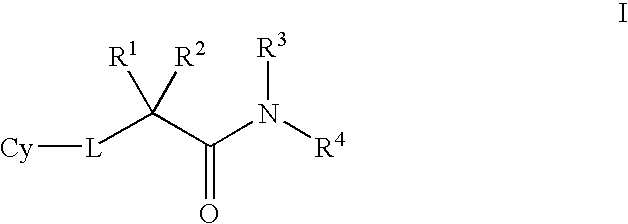
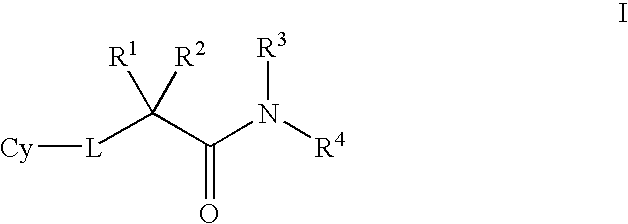
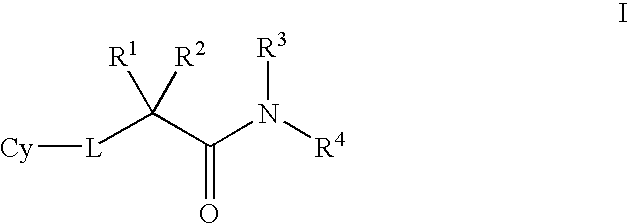
Examples
example 1
[0313]
1-(4-Chlorophenyl)-N-cyclohexyl-N-cyclopropylcyclopropanecarboxamide
Step 1. N-cyclopropylcyclohexanamine
[0314] 1.21 mL of cyclopropylamine was mixed with 1.82 mL of cyclohexanone in 5.0 mL 1,2-dichloroethane, the reaction mixture was stirred at room temperature for 15 min, followed by the addition of 4.45 g of sodium triacetoxyborohydride. The reaction mixture was stirred overnight. The reaction mixture was then diluted with ethyl acetate. The organic layer was washed with saturated NaHCO3, brine, dried and concentrated under vacuum to afford a residue, which was used directly in the next step. LCMS: (M+H)+=140.1.
Step 2. 1-(4-Chlorophenyl)-N-cyclohexyl-N-cyclopropylcyclopropanecarboxamide
[0315] To a solution of 1-(4-chlorophenyl)cyclopropanecarboxylic acid (20 mg) and N-cyclopropylcyclohexanamine (17 mg) in 0.3 mL DMF was added 49.5 mg BOP coupling reagent. The pH of the reaction mixture was adjusted to about 9, and the resulting solution was stirred at room temperature fo...
example 2
[0316]
1-(4-Chlorophenyl)-N-cyclohexylcyclopropanecarboxamide
[0317] This compound was prepared using procedures analogous to those for example 1. LCMS: (M+H)+=278.0 / 280.0.
example 3
[0318]
Ethyl 4-(([1-(4-chlorophenyl)cyclopropyl]carbonyl}amino)piperidine-1-carboxylate
[0319] This compound was prepared using procedures analogous to those for example 1. LCMS: (M+H)+=351.1 / 353.1.
PUM
| Property | Measurement | Unit |
|---|---|---|
| Electric charge | aaaaa | aaaaa |
| Electric charge | aaaaa | aaaaa |
| Electric charge | aaaaa | aaaaa |
Abstract
Description
Claims
Application Information
 Login to View More