Check patentability & draft patents in minutes with Patsnap Eureka AI!

Monitoring semiconductor wafer defects below one nanometer

a technology of semiconductor wafers and defects, applied in the field of semiconductor processing, can solve the problems of the introduction of surface defects in the manufacturing process, and achieve the effects of reducing the cost of monitoring for defects, facilitating the use of low-sensitivity monitoring equipment, and efficiently and conveniently enlarge the defect siz

Active Publication Date: 2006-02-23
MACRONIX INT CO LTD
View PDF5 Cites 15 Cited by
  • Summary
  • Abstract
  • Description
  • Claims
  • Application Information

AI Technical Summary

Benefits of technology

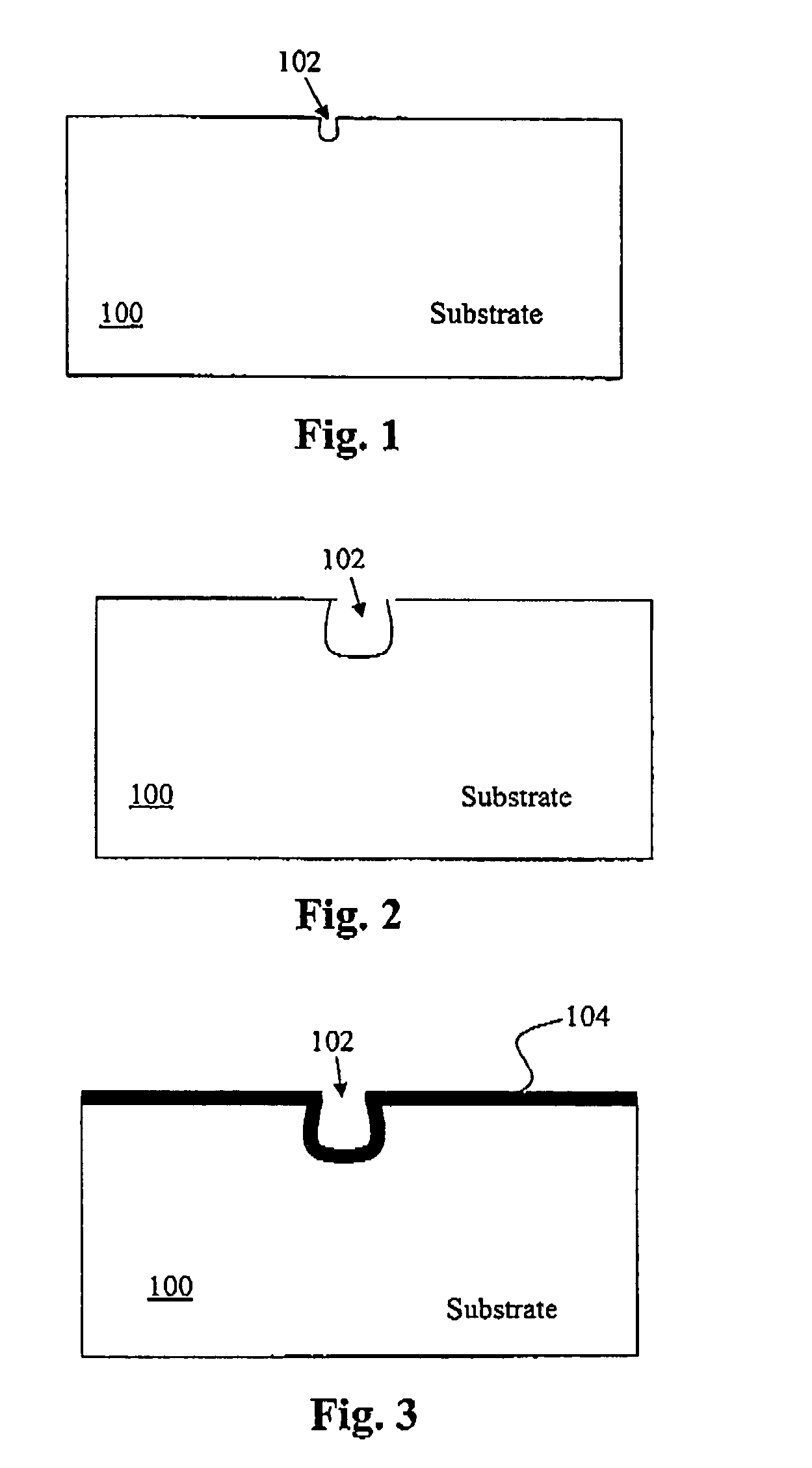
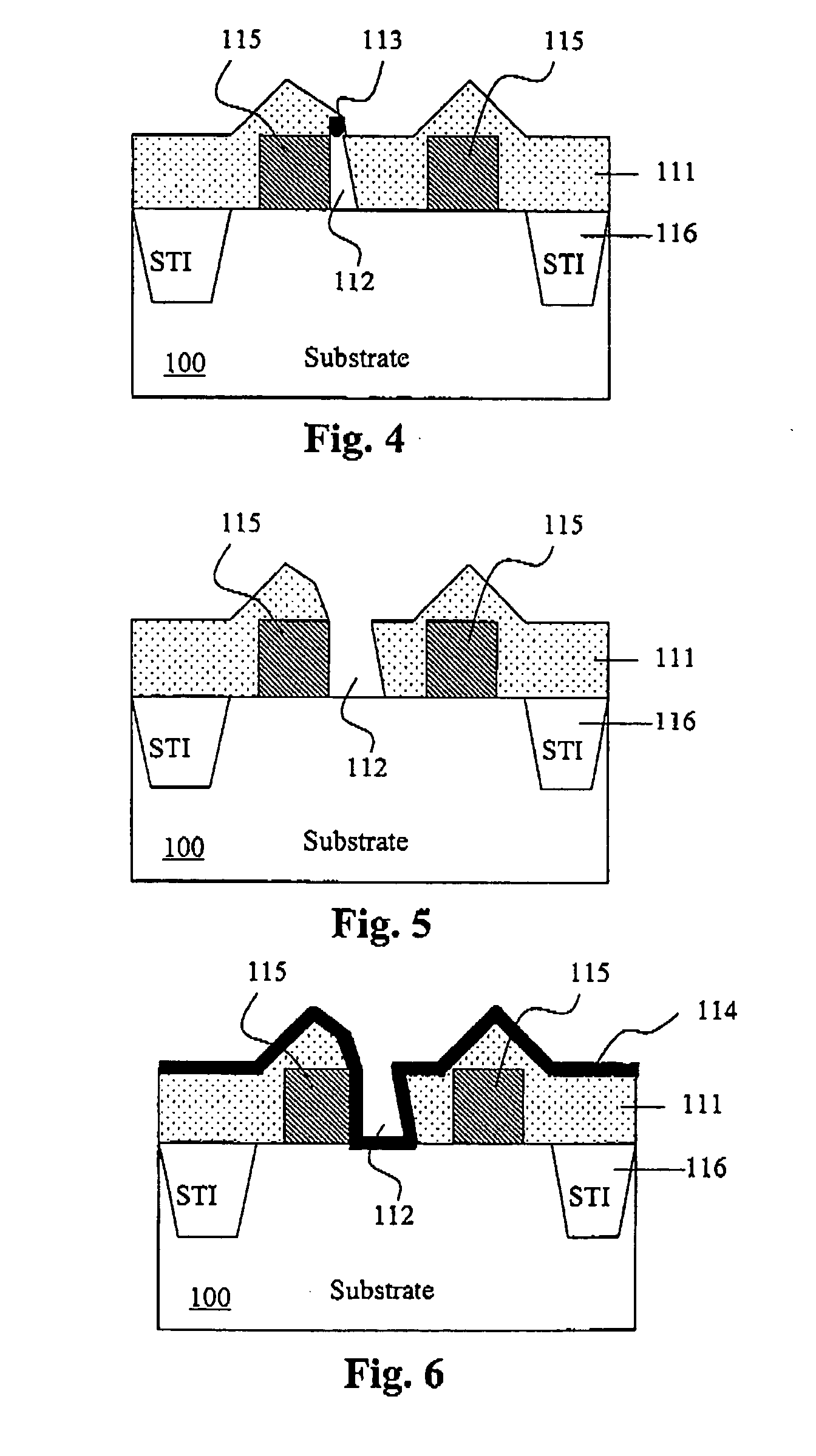
[0006] The present invention addresses and tends to alleviates the above mentioned deficiencies associated with the prior art. In order to facilitate the use of low-sensitivity monitoring equipment, thus lowering the cost of monitoring for defects, the present invention proposes to efficiently and conveniently enlarge the defect size above the threshold of 0.1 nanometer. This is accomplished by etching for which a hydrofluoric acid solution may be used and a subsequent deposition of a thin-film layer for which titanium may be used, which enhances the appearance of the defect above the 0.1 nanometer threshold of the monitoring capability of low-sensitivity monitoring equipment, thus providing easier and more economical monitoring for semiconductor material defects.

Problems solved by technology

Another factor is the number of surface defects introduced by the manufacturing process (including chemical and mechanical polishing).

Method used

the structure of the environmentally friendly knitted fabric provided by the present invention; figure 2 Flow chart of the yarn wrapping machine for environmentally friendly knitted fabrics and storage devices; image 3 Is the parameter map of the yarn covering machine
View more

Image

Smart Image Click on the blue labels to locate them in the text.
Viewing Examples
Smart Image
  • Monitoring semiconductor wafer defects below one nanometer
  • Monitoring semiconductor wafer defects below one nanometer

Examples

Experimental program
Comparison scheme
Effect test

Embodiment Construction

[0015] Reference will now be made in detail to the presently preferred embodiments of the invention, examples of which are illustrated in the accompanying drawings. Wherever possible, the same or similar reference numbers are used in the drawings and the description to refer to the same or like parts. It should be noted that the drawings are in simplified form and are not to precise scale. In reference to the disclosure herein, for purposes of convenience and clarity only, directional terms, such as, top, bottom, left, right, up, down, over, above, below, beneath, rear, and front, are used with respect to the accompanying drawings. Such directional terms should not be construed to limit the scope of the invention in any manner.

[0016] Although the disclosure herein refers to certain illustrated embodiments, it is to be understood that these embodiments are presented by way of example and not by way of limitation. The intent of the following detailed description, although discussing ...

the structure of the environmentally friendly knitted fabric provided by the present invention; figure 2 Flow chart of the yarn wrapping machine for environmentally friendly knitted fabrics and storage devices; image 3 Is the parameter map of the yarn covering machine
Login to View More

PUM

PropertyMeasurementUnit
thicknessaaaaaaaaaa
sizesaaaaaaaaaa
sizesaaaaaaaaaa
Login to View More

Abstract

The invention describes a method to facilitate the use of low-sensitivity monitoring equipment for detecting and monitoring defects on the surface of semiconductor wafers. The method includes the use of a hydrofluoric acid solution for increasing the dimensions of a defect and the application of a thin-film layer of a metal, such as titanium, for improving the appearance of the defect such that the defect dimensions increase to above 0.1 nanometer, the detection threshold for economical low-sensitivity monitoring equipment.

Description

BACKGROUND OF THE INVENTION [0001] 1. Field of the Invention [0002] The present invention relates generally to the field of semiconductor processing and, more particularly, to the monitoring and detection of defects in connection with the fabrication of semiconductor devices. [0003] 2. Description of the Prior Art [0004] In the semiconductor industry an important consideration is the yield as a percentage of tested acceptable chips per wafer. This percentage is directly related to the profitability of the manufacturer. One factor influencing the yield is the quality of the raw material, including the density of surface defects (number per cm2). Another factor is the number of surface defects introduced by the manufacturing process (including chemical and mechanical polishing). [0005] Surface defects need to be made visible to assess further treatment for ideally eliminating the defects. The sizes of these defects can be in the range below 0.1 nanometer or 1,000 angstroms (Å). For th...

Claims

the structure of the environmentally friendly knitted fabric provided by the present invention; figure 2 Flow chart of the yarn wrapping machine for environmentally friendly knitted fabrics and storage devices; image 3 Is the parameter map of the yarn covering machine
Login to View More

Application Information

Patent Timeline
no application Login to View More
Patent Type & Authority Applications(United States)
IPC IPC(8): C03C15/00
CPCG01N21/9501G01N21/01
Inventor WENG, WU-ANHSU, WANG-TSAILIU, KUN-YULAI, YI-CHIEH
Owner MACRONIX INT CO LTD
Features
  • R&D
  • Intellectual Property
  • Life Sciences
  • Materials
  • Tech Scout
Why Patsnap Eureka
  • Unparalleled Data Quality
  • Higher Quality Content
  • 60% Fewer Hallucinations
Social media
Patsnap Eureka Blog
Learn More