
(Hydrazido)(amino)thiophene compounds
a technology of thiophene and aminothiophene, which is applied in the field of disubstituted thiophenes, can solve the problems of not being effective against all mutant isoforms of kit kinase, the mechanism of action of compound compounds is to be toxic to cells, and the broad toxicity can be a problem for the subject patien
- Summary
- Abstract
- Description
- Claims
- Application Information
AI Technical Summary
Problems solved by technology
Method used
Image

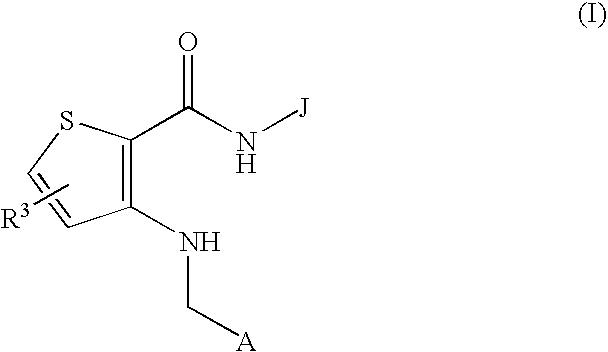
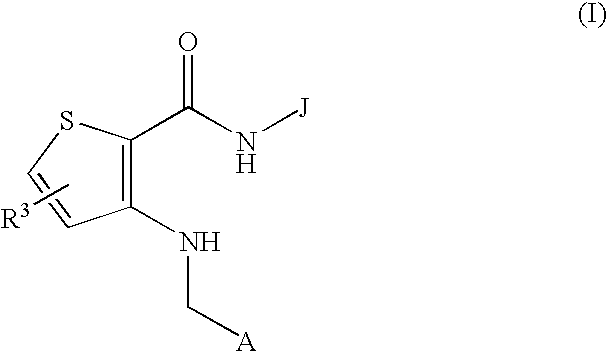
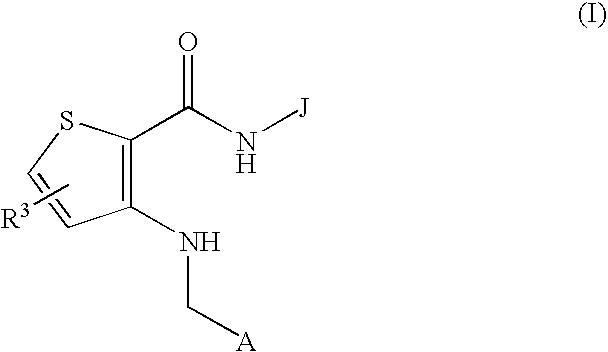
Examples
example 1
N′-(3,4-dichlorophenyl)-3-[(quinolin-4-ylmethyl)amino]thiophene-2-carbohydrazide
[0137]
[0138] EXAMPLE 1 was prepared by the following procedure:
[0139] Part 1
[0140] Methyl 3-[(quinolin-4-ylmethyl)amino]thiophene-2-carboxylate (2): A mixture of 3-amino-thiophene-2-carboxylic acid methyl ester (5 g, 31.8 mmol) and 4-quinoline-carboxaldehyde (5.25 g, 33.4 mmol) in TFA / CH2Cl2 (75 mL, 75 mL) was heated at 50° C. for 3.5 h. The solution was cooled in an ice bath and triethylsilane (10.2 mL, 63.6 mmol) was added drop-wise over 5 min. The reaction mixture was stirred at 50° C. for 3.5 h, cooled to rt, and 500 mL of CH2Cl2 was added. The reaction mixture was basified with 10N NaOH (pH 6-7) followed by sat. NaHCO3 (pH 8). The CH2Cl2 layer was separated and the aqueous layer was extracted with CH2Cl2 (2×100 mL). The organic extracts were combined, washed with brine, dried over anhydrous sodium sulfate, filtered, and concentrated in vacuo to yield the crude product, which was triturated with ...
example 2
N′-(4-chlorophenyl)-3-[(quinolin-4-ylmethyl)amino]thiophene-2-carbohydrazide: MS (ES+) 409 [MH+]
[0146]
example 3
N-(tert-butoxy)-3-[(quinolin-4-ylmethyl)amino]thiophene-2-carboxamide: MS (ES+) 356 [MH+]
[0147]
PUM
| Property | Measurement | Unit |
|---|---|---|
| Cytotoxicity | aaaaa | aaaaa |
| Chemotherapeutic properties | aaaaa | aaaaa |
| Hyperproliferative | aaaaa | aaaaa |
Abstract
Description
Claims
Application Information
 Login to View More