Fiscal security concerns are extraordinarily high due to the levels of money changing hands.
Gaming is a political issue.
Requiring cash is inefficient, unsanitary and to a certain extent unsafe for players, cash being the ultimate bearer instrument.
In many jurisdictions there is no regulatory approval for using a card at a
slot machine, however.
Approval has been withheld because permitting players to obtain playing credit directly at a gaming
machine by EFT has generated fears of encouraging compulsive gamblers, (even though there has been no
documentation of this.)
Unfortunately, ATM machines are expensive to own and maintain.
Dealing in cash as they do, they entail
high security and handling costs.
And the third system still involves handling cash, with its inconvenience and security concerns.
All the above “cashless gaming” systems have problems.
The first two systems entail what turns out to be an excessive cost of installing POS / EFT hardware and
software on each and every gaming machine.
This hardware and
software must satisfy stringent security standards associated with any equipment that directly interfaces with slot machines, thereby further increasing the cost of the
hardware software, and regulatory approval.
And the equipment ends up being under-utilized.
Furthermore, promoting obtaining gaming funds from commercial card accounts directly at a gaming machine is viewed by some as exhibiting insensitivity to a casino's social responsibility.
In regard to the third system discussed above, it is inconvenient and inefficient from the player's standpoint to require a player to visit remote ATM machines, possibly standing in line.
Rather, securing more playing credit requires interrupting
game play.
While the ultimate in funds dispensing convenience for slot players might be an ATM / POS / debit terminal that interfaces directly with a particular gaming machine, deployment of such a product has been a slow process, inhibited its inherent disadvantages.
Political and regulatory challenges have surrounded a “one-on-one” relationship with a gaming machine, as well as cost effective concerns.
This indicates that such one-on-one equipment is being not cost effectively utilized when attached to individual machines.
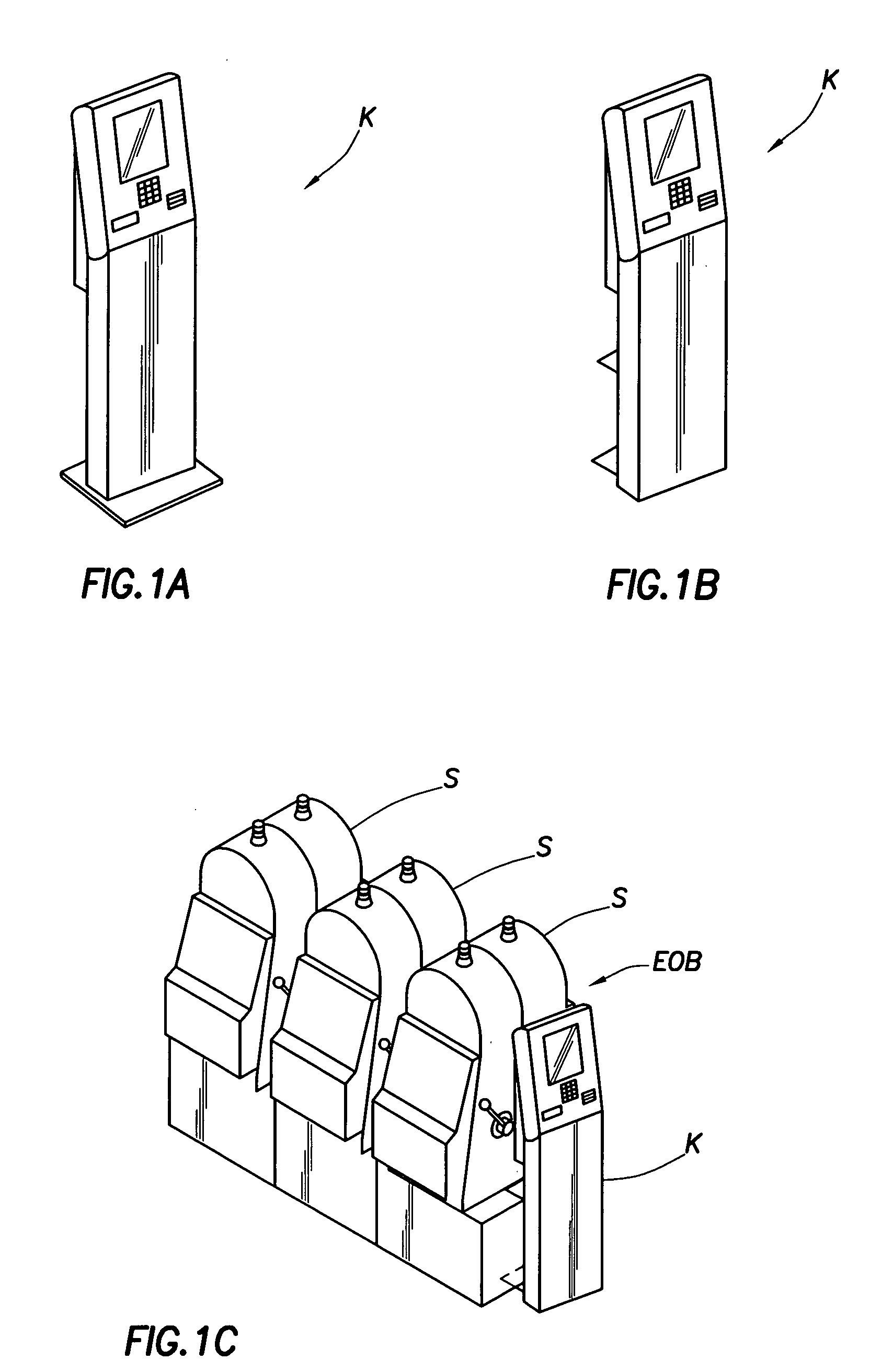
Providing this service in proximity to slot machines addresses the following challenges and concerns: a) Casino operator concern about public
perception (appearing predatory) b) Casino operator concern about regulatory scrutiny (state level, NIGA) c) Opposition from problem gambling support groups d)
Regulator apprehension and concern about public
perception e) Regulatory scrutiny because of interface to gaming machine f) Dependence on game hardware and
firmware, adding time and cost to installation g) Capital costs too high to install on 100% of games on most casino floors
EOB kiosks make further financial sense because it is not likely cost effective to install EFT equipment in particular on low denomination games (or low occupancy multi-denomination games) given the current cost of game-level hardware.
This creates scheduling challenges and adds time to the installation process.


 Login to View More
  Login to View More