Unlock instant, AI-driven research and patent intelligence for your innovation.

Zirconia support and zirconia supported catalyst

a zirconia and catalyst technology, applied in the direction of catalyst activation/preparation, metal/metal-oxide/metal-hydroxide catalyst, inorganic chemistry, etc., can solve the problems of reducing the catalyst effectiveness, e.g., tetragonal stabilized zirconia, atypical washcoat materials tend to fail

Inactive Publication Date: 2006-05-11
UMICORE AG & CO KG
View PDF11 Cites 9 Cited by
  • Summary
  • Abstract
  • Description
  • Claims
  • Application Information

AI Technical Summary

Problems solved by technology

Under these circumstances, typical washcoat materials (e.g., tetragonal stabilized zirconia) tend to fail.
In all of these cases, changes to the washcoat result in a reduction of the amount of active ingredients available for the reaction, thus reducing the effectiveness of the catalyst.

Method used

the structure of the environmentally friendly knitted fabric provided by the present invention; figure 2 Flow chart of the yarn wrapping machine for environmentally friendly knitted fabrics and storage devices; image 3 Is the parameter map of the yarn covering machine
View more

Image

Smart Image Click on the blue labels to locate them in the text.
Viewing Examples
Smart Image
  • Zirconia support and zirconia supported catalyst
  • Zirconia support and zirconia supported catalyst
  • Zirconia support and zirconia supported catalyst

Examples

Experimental program
Comparison scheme
Effect test

examples

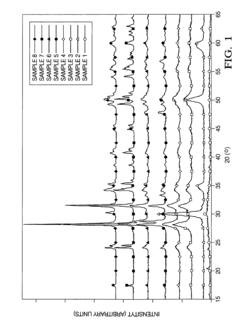
[0029] Table 1 sets for the composition of the various Samples tested. Samples 1-3, 6 used a zirconium hydroxide powder containing about 6 wt % lanthinum oxide (La2O3) and heat treated at 900° C. (“XZO681 / 01” obtained from MEI, Flemington, N.J.) as the support. Samples 4, 5, 7-9 used a zirconium oxide powder (“FZO936” obtained from MEI, Flemington, N.J.) as the support. The substrate for all of the samples was a reticulated foam zirconia-toughened alumina (ZTA) substrate, 1″ diameter by 1″ high and having approximately 20 pores per linear inch (20 ppi). In each case, a portion of the mixture was dried, heat treated in air at about 90° C. for 30 minutes, then at about 120° C. for 30 minutes, followed by about 200° C. for 45 minutes, and finally at about 540° C. for 60 minutes, and the surface area, as well as the monoclinic and tetragonal relative heights, were measured.

TABLE 1Sample No.Composition1zirconium oxide containing 6 wt % lanthanum oxide2Sample 1 heat treated to 900° C.3S...

the structure of the environmentally friendly knitted fabric provided by the present invention; figure 2 Flow chart of the yarn wrapping machine for environmentally friendly knitted fabrics and storage devices; image 3 Is the parameter map of the yarn covering machine
Login to View More

PUM

PropertyMeasurementUnit
temperaturesaaaaaaaaaa
surface areaaaaaaaaaaa
Login to View More

Abstract

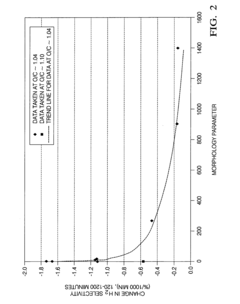
A catalyst can comprise rhodium and zirconia. The zirconia can have a morphology parameter of greater than or equal to about 800. The method for making the catalyst can comprise: combining rhodium and a zirconium compound, wherein the zirconium compound has a morphology parameter of greater than or equal to about 800, to form a mixture, and disposing the mixture onto a substrate.

Description

BACKGROUND [0001] Stabilized zirconia (i.e., stabilized zirconium oxide), e.g., yttria stabilized zirconia and lanthana stabilized zirconia, is commonly employed as a catalyst support, particularly for partial oxidation fuel reforming. Generally, rhodium supported stabilized tetragonal zirconia's are exclusively preferred. [0002] The tetragonal stabilized zirconia is typically used to form a washcoat for supporting catalytic active metals or metal oxides. This washcoat has been used to increase dispersion of the active ingredients, and therefore to increase their utilization and stability. The washcoat is placed onto a substrate, such as a monolith, foam, or the like, which is then disposed in a housing. [0003] Partial oxidation fuel reforming reactions typically proceed at very high temperatures, usually in excess of 1,000° C. The highest temperatures (even exceeding 1,100° C.) can be reached due to heat released during transient operations, system upsets, or deliberately when high...

Claims

the structure of the environmentally friendly knitted fabric provided by the present invention; figure 2 Flow chart of the yarn wrapping machine for environmentally friendly knitted fabrics and storage devices; image 3 Is the parameter map of the yarn covering machine
Login to View More

Application Information

Patent Timeline
no application Login to View More
Patent Type & Authority Applications(United States)
IPC IPC(8): B01J23/46
CPCB01J21/066B01J23/464B01J23/58B01J23/63B01J35/002B01J35/1014B01J35/1019B01J37/0215C01B3/386C01B3/40C01B2203/0261C01B2203/1047C01B2203/1082Y02P20/52B01J35/30B01J35/613B01J35/647B01J35/615
Inventor WEISSMAN, JEFFREY G.
Owner UMICORE AG & CO KG