Unlock instant, AI-driven research and patent intelligence for your innovation.

Semiconductor memory device

a memory device and semiconductor technology, applied in the field of semiconductor memory devices, can solve the problems of improving the speed of the nand-type and the difficulty of high-speed data sens

Active Publication Date: 2006-10-26
KIOXIA CORP
View PDF8 Cites 47 Cited by
  • Summary
  • Abstract
  • Description
  • Claims
  • Application Information

AI Technical Summary

Benefits of technology

The present invention provides a semiconductor device with a memory cell array and a sense amplifier circuit for reading data from the array. The memory cell array includes multiple information cells and at least one reference cell, each cell containing a different physical quantity level. The sense amplifier circuit detects a cell current difference between the information cell and the reference cell to sense the data defined by the physical quantity levels. This technology allows for faster and more efficient sensing of data from the memory cell array.

Problems solved by technology

Recently, however, a mobile apparatus tends to deal with an image data and the like with a large quantity of data.
Even the above-described method is used, there is a limit for improving the speed of the NAND-type flash memory because cell current thereof is one several tenth of that of a NOR-type flash memory, so that it is difficult to sense data at a high rate as in the NOR-type flash memory with a reference level.

Method used

the structure of the environmentally friendly knitted fabric provided by the present invention; figure 2 Flow chart of the yarn wrapping machine for environmentally friendly knitted fabrics and storage devices; image 3 Is the parameter map of the yarn covering machine
View more

Image

Smart Image Click on the blue labels to locate them in the text.
Viewing Examples
Smart Image
  • Semiconductor memory device
  • Semiconductor memory device
  • Semiconductor memory device

Examples

Experimental program
Comparison scheme
Effect test

Embodiment Construction

[0064] Illustrative embodiments of this invention will be explained with reference to the accompanying drawings below.

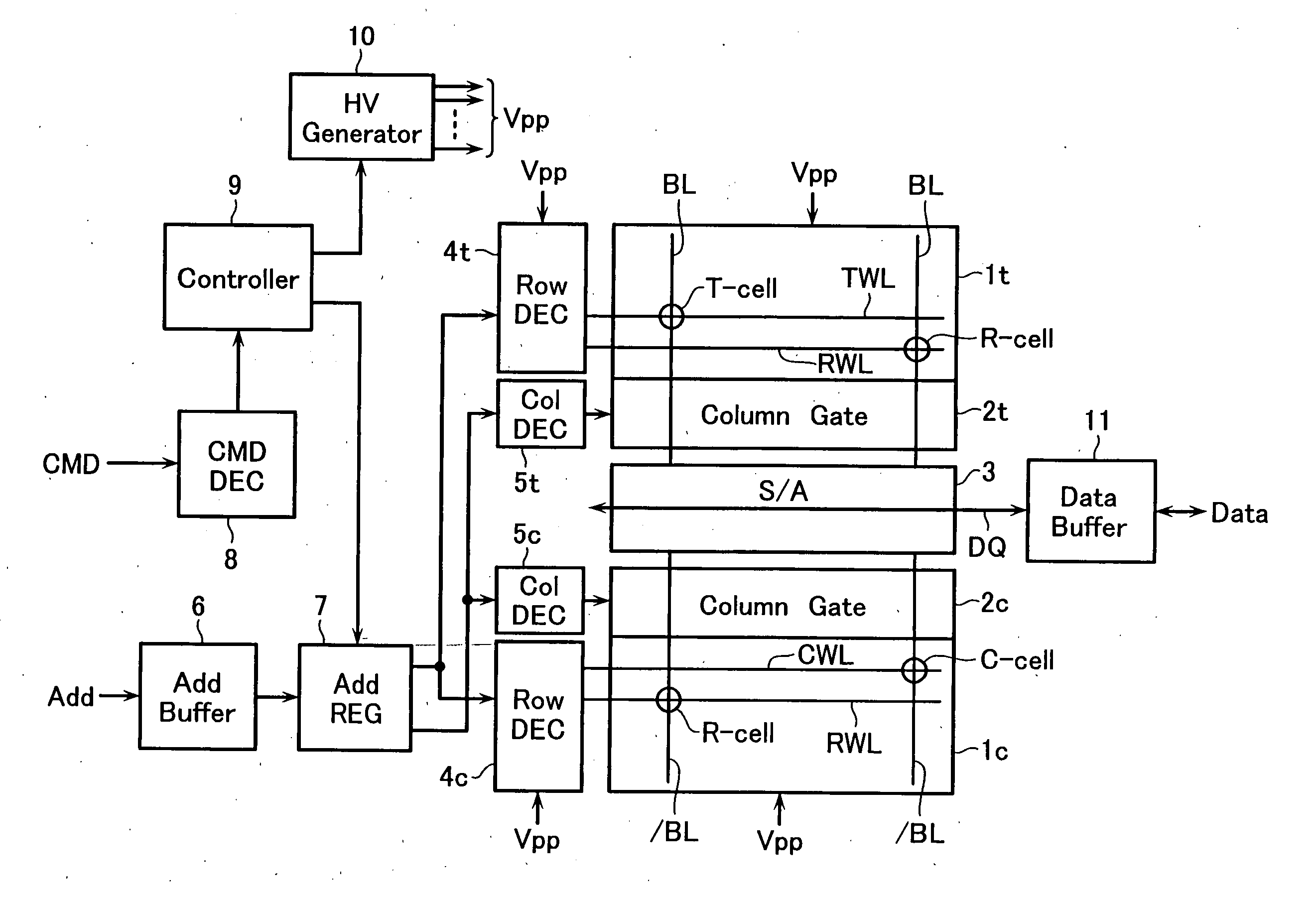
[0065] In a semiconductor memory device in accordance with this embodiment, the main portion of the memory cell array is set as an area of “information cells”, into each of which one of plural physical quantity levels (i.e., data levels) is written while the remaining portion is set as an area of “reference cell(s)”, into which a fixed reference physical quantity level (i.e., reference level) is written for serving for detecting the data levels. In other words, for plural information cells, there is prepared a common reference cell, which constitutes a pair with each of the plural information cells.

[0066] As a result, the semiconductor memory in accordance with this embodiment generally stores M-value data (where, M≧2) on the assumption that an information cell is set to be in a state selected in M levels. That is, in case of M=2, binary data storage is achieved; a...

the structure of the environmentally friendly knitted fabric provided by the present invention; figure 2 Flow chart of the yarn wrapping machine for environmentally friendly knitted fabrics and storage devices; image 3 Is the parameter map of the yarn covering machine
Login to View More

PUM

No PUM Login to View More

Abstract

A semiconductor memory device includes: a memory cell array with electrically rewritable and non-volatile memory cells arranged therein; and a sense amplifier circuit configured to read out data of the memory cell array, wherein a plurality of information cells, in each of which one of M(M>2) physical quantity levels is written, and at least one reference cell, in which a reference physical quantity level is written, are defined in the memory cell array, and the sense amplifier circuit detects a cell current difference between the information cell and the reference cell selected simultaneously in the memory cell array to sense data defined by the M physical quantity levels of the information cell.

Description

CROSS-REFERENCE TO RELATED APPLICATION [0001] This application is based on and claims the benefit of priority from the prior Japanese Patent Application No. 2005-118535, filed on Apr. 15, 2005, the entire contents of which are incorporated herein by reference. BACKGROUND OF THE INVENTION [0002] 1. Field of the Invention [0003] This invention relates to a semiconductor memory device, in which electrically rewritable and non-volatile memory cells are arranged. [0004] 2. Description of Related Art [0005] EEPROM flash memories are generally classified into NAND-type and-NOR-type ones. A NAND-type flash memory is formed of NAND strings (i.e., NAND cell units) each having plural memory cells connected in series in such a way that adjacent cells share source / drain diffusion layers. Therefore, the cell density is higher than that of a NOR-type one. Besides the NAND-type flash memory has a feature with low power consumption because plural memory cells may be written in a lump by use of FN tu...

Claims

the structure of the environmentally friendly knitted fabric provided by the present invention; figure 2 Flow chart of the yarn wrapping machine for environmentally friendly knitted fabrics and storage devices; image 3 Is the parameter map of the yarn covering machine
Login to View More

Application Information

Patent Timeline
no application Login to View More
Patent Type & Authority Applications(United States)
IPC IPC(8): G11C16/04
CPCG11C7/06G11C11/5642G11C2211/5634G11C16/28G11C2211/5631G11C16/0483G11C7/065G11C16/3445G11C16/3459
Inventor TODA, HARUKI
Owner KIOXIA CORP