[0007] According to one aspect of the invention, a
system for enhancing automated speech interpretation is provided. The system may include a set of techniques for use in a speech-to-text engine to enhance accuracy and performance, for example, by reducing the search space of the speech engine. The problems with large-
list recognition for
embedded applications may also be improved by using phonetic
dictation, which may recognize a phoneme string by disregarding the notion of words. The system may also use one or more post-
processing techniques to sharpen an output of a preliminary speech interpretation made by a speech engine. The system may be modeled at least partially after one or more speech
pattern recognition techniques used by humans, such as interpreting speech using words, word sequences, word combinations, word positions, context, phonetic similarities between two or more words, parts of speech, or other techniques.
[0009] According to another aspect of the invention, the performance of the speech engine and the phonemic recognition may be improved by
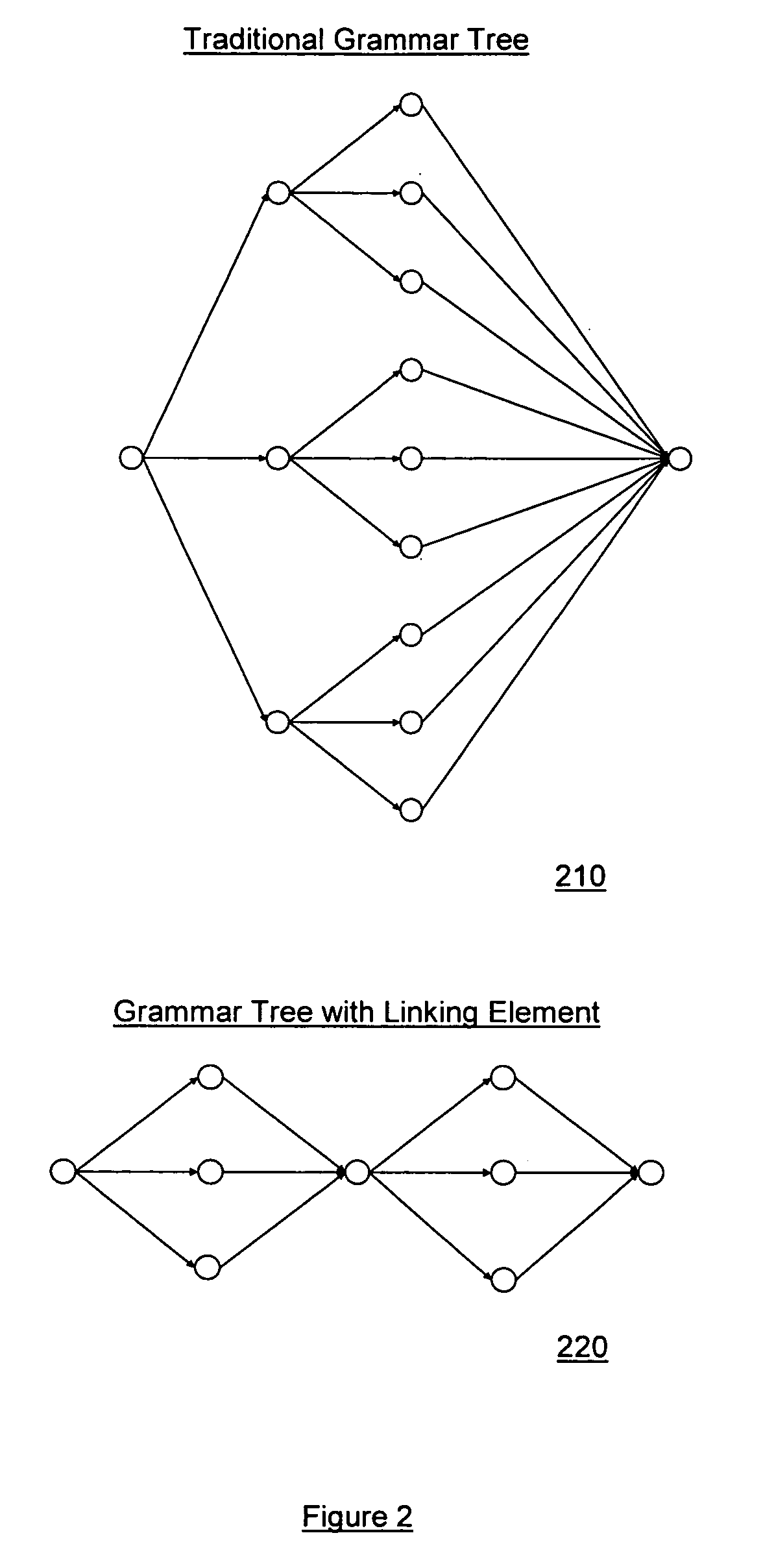
pruning the search space used by the speech engine using a common phonetic marker. In one implementation, the acoustic grammar may be represented entirely by a loop of phonemes. In another implementation, the speech engine may reduce the search space by reducing the number of transitions in a grammar tree, thereby speeding up the process of compiling, loading, and executing the speech engine. For example, the phoneme loop may include a linking element between transitions. This may reduce the number of grammar transitions, such that grammar paths merge after a first transition and diverge after the linking element. In one implementation of the invention, a common acoustic element that is part of a speech
signal may be used as the linking element. In one implementation of the invention, the acoustic element may be one that is very likely to be triggered even if it is unpronounced. For example, a schwa in the English language may be used as the linking element because schwa represents an unstressed, central
vowel that is likely to be spoken even if unintended. Those skilled in the art will appreciate that acoustic models for different languages may use other frequently elided phonemes as linking elements to reduce the search space used by the speech engine.
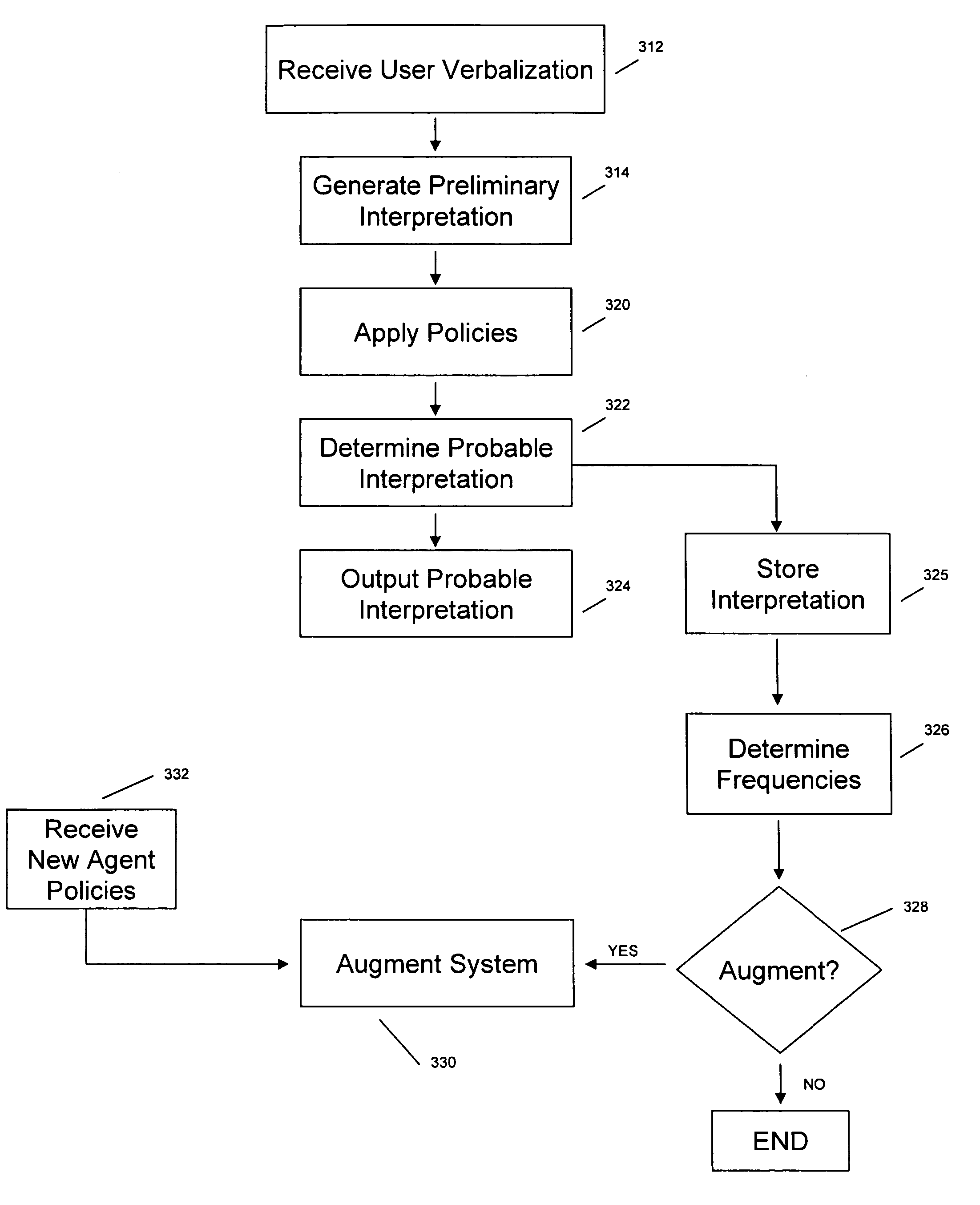
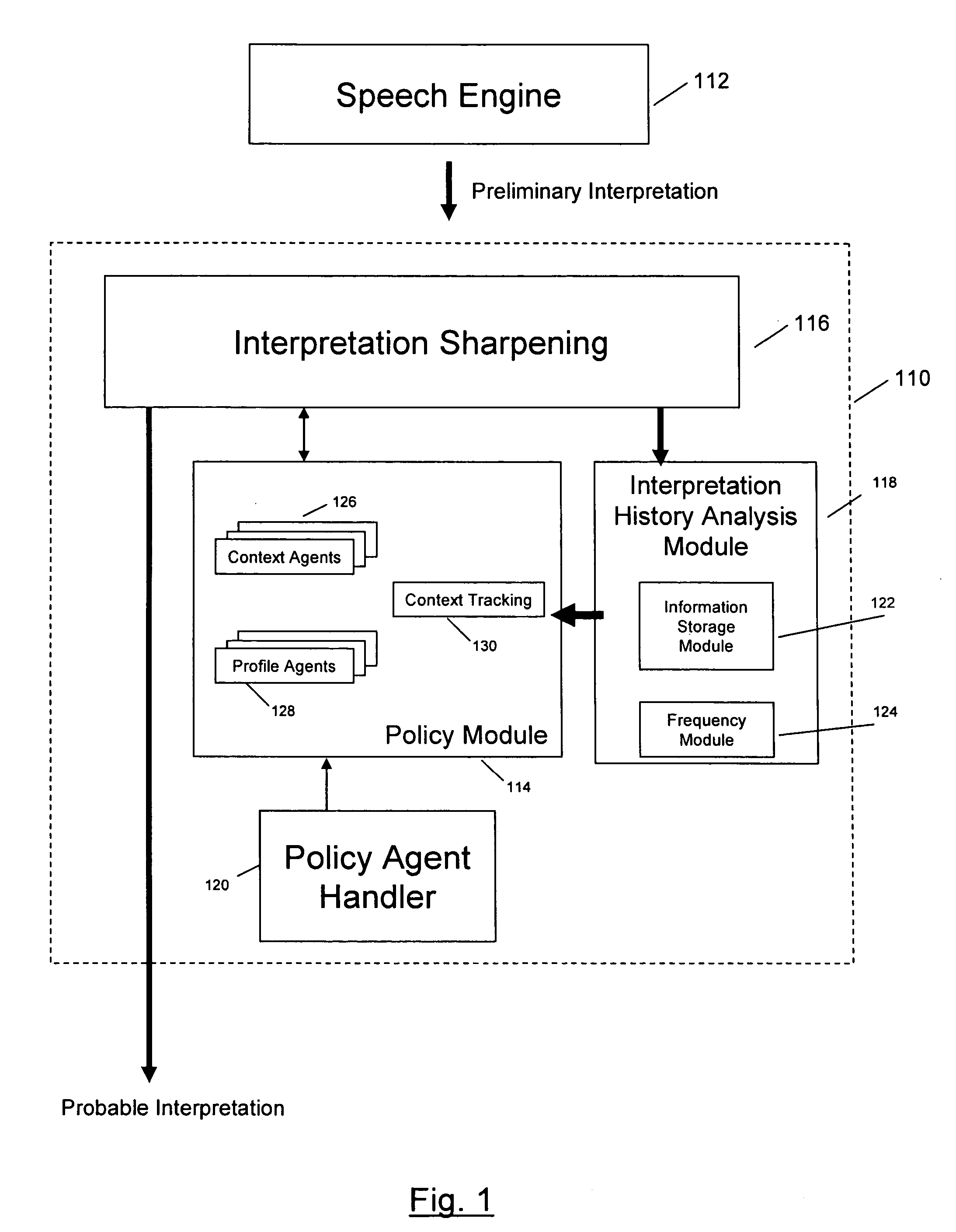
[0010] The speech engine may generate a plurality of preliminary interpretations representing a set of best guesses at the user verbalization. The preliminary interpretations may be stored in a matrix, array, or another form, and may be provided to an interpretation
sharpening module to determine a probable interpretation of a verbalization made by a user by applying
heuristic policies against the preliminary interpretation to identify dominant words and / or phrases. According to various aspects of the invention, the interpretation
sharpening module may include a policy module that may manage and / or provide one or more policies that enable the
sharpening module to generate a plurality of probable interpretations of the verbalization made by the user. For example, according to one aspect of the invention, the plurality of preliminary interpretations may be applied against one or more policies to generate a set of hypotheses as to a candidate recognition. Each
hypothesis may be reanalyzed to generate an interpretation
score that may relate to a likelihood of the probable interpretation being a correct interpretation of the verbalization, and the preliminary interpretation corresponding to the highest (or lowest) interpretation
score may then be designated as a probable interpretation of the verbalization. The designated probable interpretation may be stored and used for augmenting the policies to improve accuracy.
[0014] In another implementation of the invention, the domain agents in the policy module may include one or more context agents that may manage and / or provide one or more context policies for revising a preliminary interpretation of a phoneme
stream. For example, a context agent may correspond to a context, such as song titles, city and street names, movie titles, finance, or other contexts. A context agent may include one or more context parameters that may be tailored to a verbalization context. The context policy may enhance an ability of the system related to interpreting verbalizations made by the user in the verbalization context corresponding to the context agent. The context agents may be augmented to enable the system to provide more accurate interpretations of verbalizations made in a verbalization context corresponding to the context agent. The augmentation may include a user provided augmentation, a non-user provided augmentation, an automated augmentation, or other augmentations. The augmentation may be automated, such as adjusting a profile parameter-weighting scheme through an adaptive misrecognition model, as discussed above.


 Login to View More
  Login to View More