Semiconductor Memory Device
a memory device and semiconductor technology, applied in the field of semiconductor memory devices, can solve the problems of wasteful consumption of memory space, and achieve the effects of improving data reliability, high rate processing, and improving data reliability
- Summary
- Abstract
- Description
- Claims
- Application Information
AI Technical Summary
Benefits of technology
Problems solved by technology
Method used
Image



Examples
embodiment 1
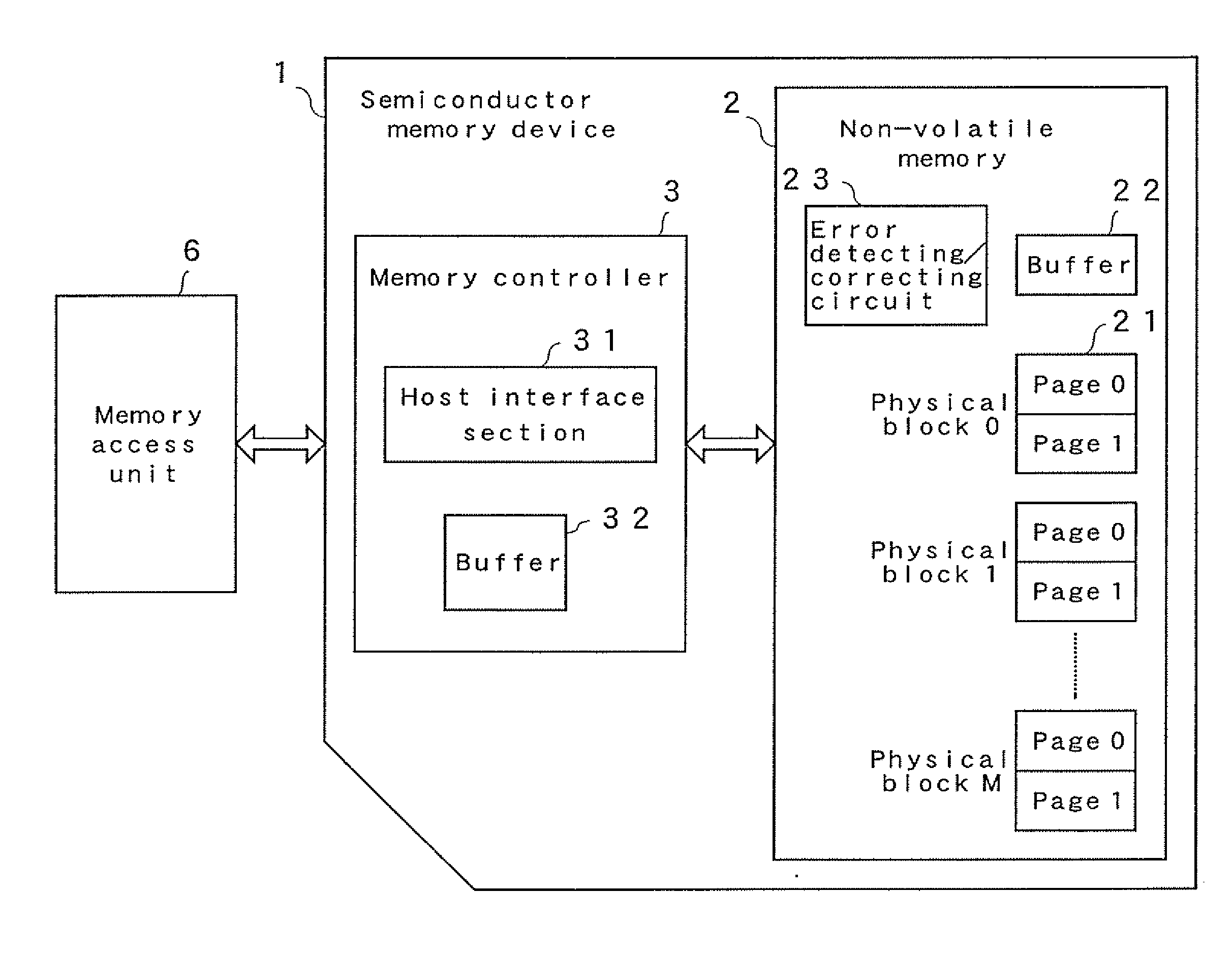
[0030] A configuration of a semiconductor memory device of Embodiment 1 is shown in FIG. 1. A semiconductor memory device 1 mainly includes a non-volatile memory 2 and memory controller 3. The non-volatile memory 2 consists of AND type flash memory. The non-volatile memory 2 includes a plurality of physical blocks 21 (physical block 0˜physical block M) that is a minimum unit of data erasing and that have a size of 4 kB. Each physical block is a minimum unit of data writing and consists of 2 pages (page 0, 1). A size of each page is 2 kB. In Embodiment 1, data is already written in page 0 and page 1 of the physical block 0 and other physical blocks are in an unwritten state, that is, in an erased state.
[0031] In addition, the non-volatile memory 2 includes a buffer 22 for temporarily retaining data at data reading and writing and error detecting / correcting circuit 23 for detecting and correcting error. A specification of the error detecting / correcting circuit 23 is set to have an ab...
embodiment 2
[0040] Next, a semiconductor memory device of Embodiment 2 will be described based on FIG. 4. A basic configuration of the semiconductor memory device in Embodiment 2 is the same as that shown in FIG. 1, but an error detecting / correcting circuit 24 whose error detecting ability is equivalent to and error correcting ability is inferior to those of Embodiment 1 is included in the non-volatile memory 2. In addition, an error correcting circuit 34 having an error correcting ability equivalent to that of Embodiment 1 is included in the memory controller 3. The error correcting circuit 34 may include an error detecting function. These points are different from Embodiment 1.
[0041] An internal processing flow will be described using FIG. 5. Since this flow is almost the same as that shown in FIG. 2, different points will be described. Points different from Embodiment 1 are as follows: when an error is detected in the error detecting / correcting circuit 24 in the non-volatile memory 2 at S11...
embodiment 3
[0042] Next, a semiconductor memory device of Embodiment 3 will be described based on FIG. 6. A basic configuration of the semiconductor memory device in Embodiment 3 is the same as that shown in Embodiment 2, but it is different from Embodiment 2 that only an error detecting circuit 25 is included in the non-volatile memory 2. An internal processing flow is almost the same as that shown in FIG. 2. Points different from Embodiment 2 are as follows: error data detected by the error detecting circuit 25 in the non-volatile memory 2 is all sent to the memory controller 3 via the buffer 22 in the non-volatile memory 2. And, after the data is corrected by the error correcting circuit 34 in the memory controller 3, the corrected data is written to page 1 of the physical block 1 in the non-volatile memory 2 at S113. As described above, the error correcting circuit 34 may include an error detecting function. By using these configurations, since only the error detecting circuit 25 is include...
PUM
 Login to View More
 Abstract
Description
Claims
Application Information
 Login to View More
 - R&D
- Intellectual Property
- Life Sciences
- Materials
- Tech Scout
- Unparalleled Data Quality
- Higher Quality Content
- 60% Fewer Hallucinations
Browse by: Latest US Patents, China's latest patents, Technical Efficacy Thesaurus, Application Domain, Technology Topic, Popular Technical Reports.
© 2025 PatSnap. All rights reserved.Legal|Privacy policy|Modern Slavery Act Transparency Statement|Sitemap|About US| Contact US: help@patsnap.com