Semiconductor device and manufacturing method thereof
a technology of semiconductors and semiconductors, applied in the direction of semiconductor devices, basic electric elements, electrical appliances, etc., can solve the problem of difficult to obtain s/d layer 310 with a good crystal condition, and achieve the effect of improving the crystal structure and reducing the difficulty of manufacturing
- Summary
- Abstract
- Description
- Claims
- Application Information
AI Technical Summary
Benefits of technology
Problems solved by technology
Method used
Image

Examples
first embodiment
[0071]First, a first embodiment will be described.
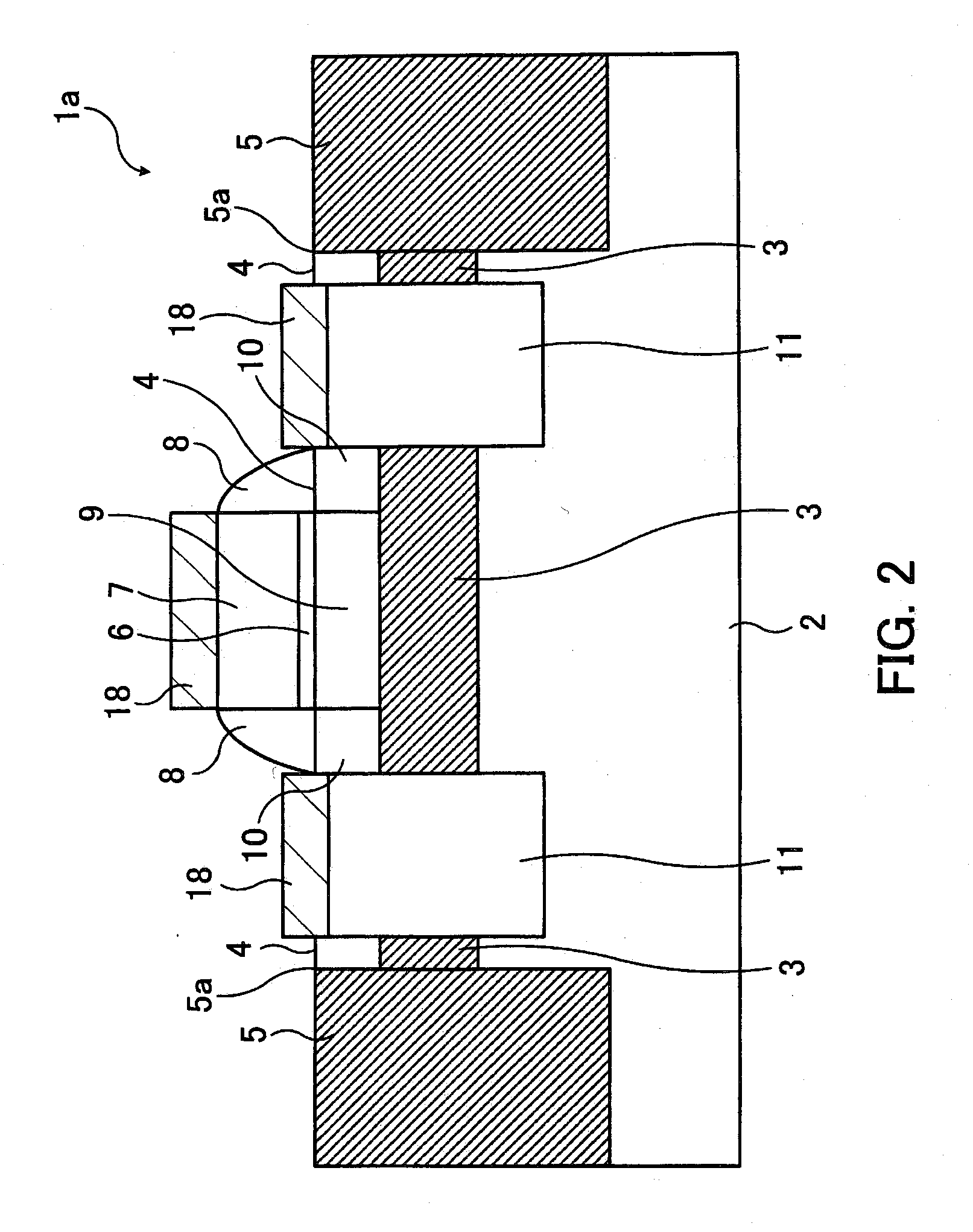
[0072]FIG. 2 is a schematic sectional view showing an essential part of a semiconductor device according to the first embodiment.
[0073]In a semiconductor device 1a according to the first embodiment, an SOI substrate including an Si substrate 2, a buried insulating film 3 and an Si layer 4 is used. Over the Si layer 4 in an element region delimited by an STI reaching the Si substrate 2 of the SOI substrate, a gate electrode 7 is formed through a gate insulating film 6 formed by thermal oxidation. Further, a sidewall spacer 8 is formed on a side wall of the gate electrode 7. Within the Si layer 4 immediately below the sidewall spacer 8, a p-type or n-type S / D extension region 10 with a predetermined impurity concentration is formed. Further, a p-type or n-type S / D layer 11 with an impurity concentration higher than that of the region 10 is formed outside the region 10.
[0074]In this semiconductor device 1a, the S / D layer 11 is formed in...
second embodiment
[0104]Next, a second embodiment will be described.
[0105]FIG. 14 is a schematic sectional view showing an essential part of a semiconductor device according to a second embodiment.
[0106]A semiconductor device 1b of the second embodiment differs from the semiconductor device 1a of the first embodiment mainly in that a top of the STI 5 is lower than that of the S / D layer 11.
[0107]In formation of the semiconductor device 1b according to the second embodiment having such a structure, first to third forming steps according to the second embodiment are the same as the first to third forming steps (FIG. 3 to 8) described in the first embodiment. Here, a forming method of the semiconductor device 1b according to the second embodiment will be described with respect to a fourth forming step and subsequent steps, with reference to FIG. 14 and FIGS. 15 to 19.
[0108]FIG. 15 is a schematic plan view showing an essential part of a fourth forming step of the semiconductor device according to the seco...
third embodiment
[0118]Next, a third embodiment will be described.
[0119]FIG. 20 is a schematic sectional view showing an essential part of a semiconductor device according to a third embodiment.
[0120]A semiconductor device 1c of the third embodiment differs from the semiconductor device 1a of the first embodiment in that a punch-through stopper layer 20 for preventing punch-through from occurring between the S / D layers 11 is formed under the buried insulating film 3 immediately below the gate electrode 7 between the S / D layers 11.
[0121]This punch-through stopper layer 20 functions as a potential barrier between the S / D layers 11. As a result, even when the channel length is reduced or even when the S / D layer 11 penetrating somewhat deeply into the Si substrate 2 is formed, punch-through can be prevented from occurring between the S / D layers 11.
[0122]A forming method of the semiconductor device 1c according to the third embodiment having this structure will be described with reference to FIGS. 20 and...
PUM
 Login to View More
 Abstract
Description
Claims
Application Information
 Login to View More