
Memory management device and method, program, and memory management system
a memory management and memory management technology, applied in the field of memory management devices and methods, can solve the problems of complex control of multi-value value processing, limited address for data storage, and low access speed
- Summary
- Abstract
- Description
- Claims
- Application Information
AI Technical Summary
Benefits of technology
Problems solved by technology
Method used
Image

Examples
first embodiment
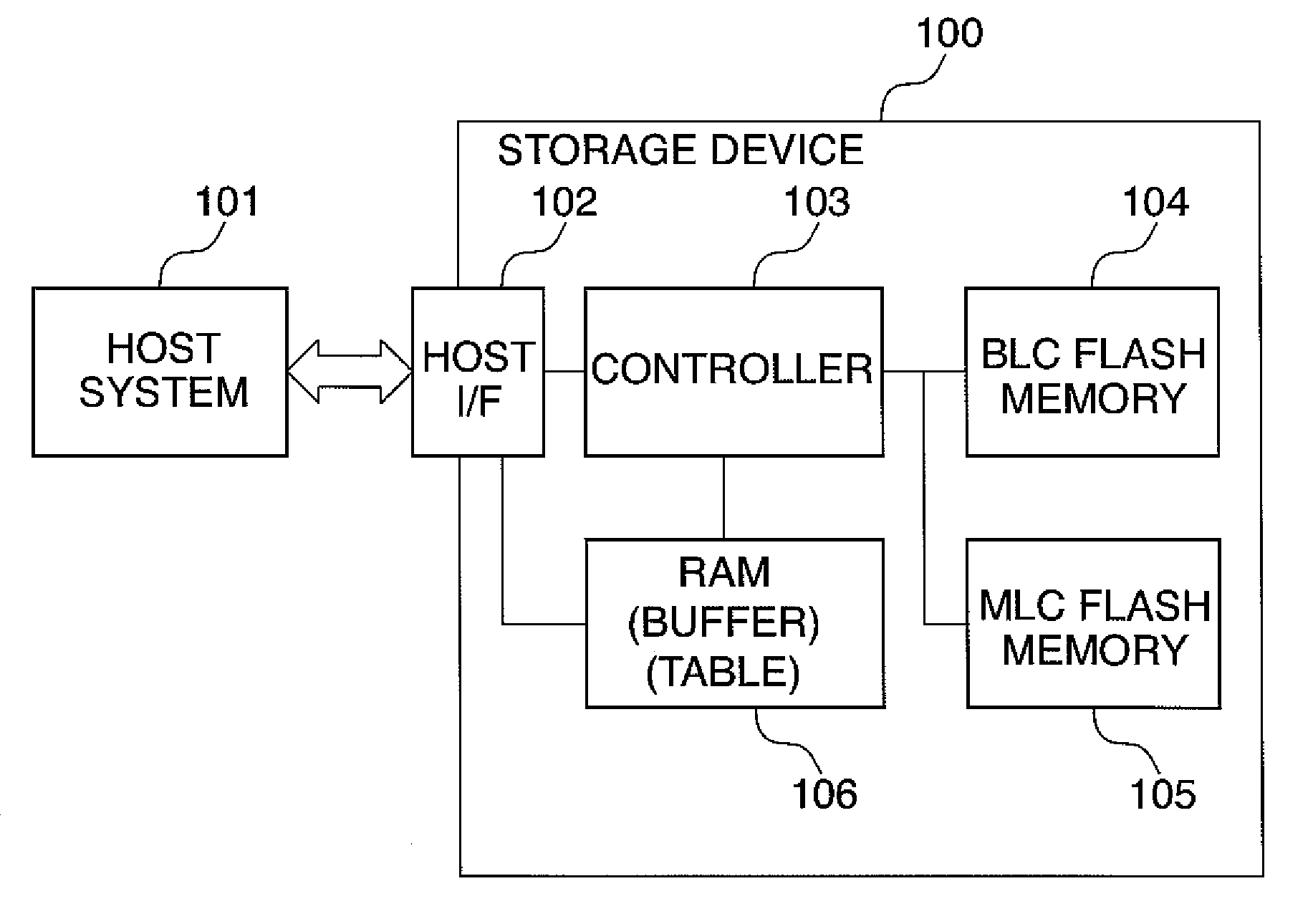
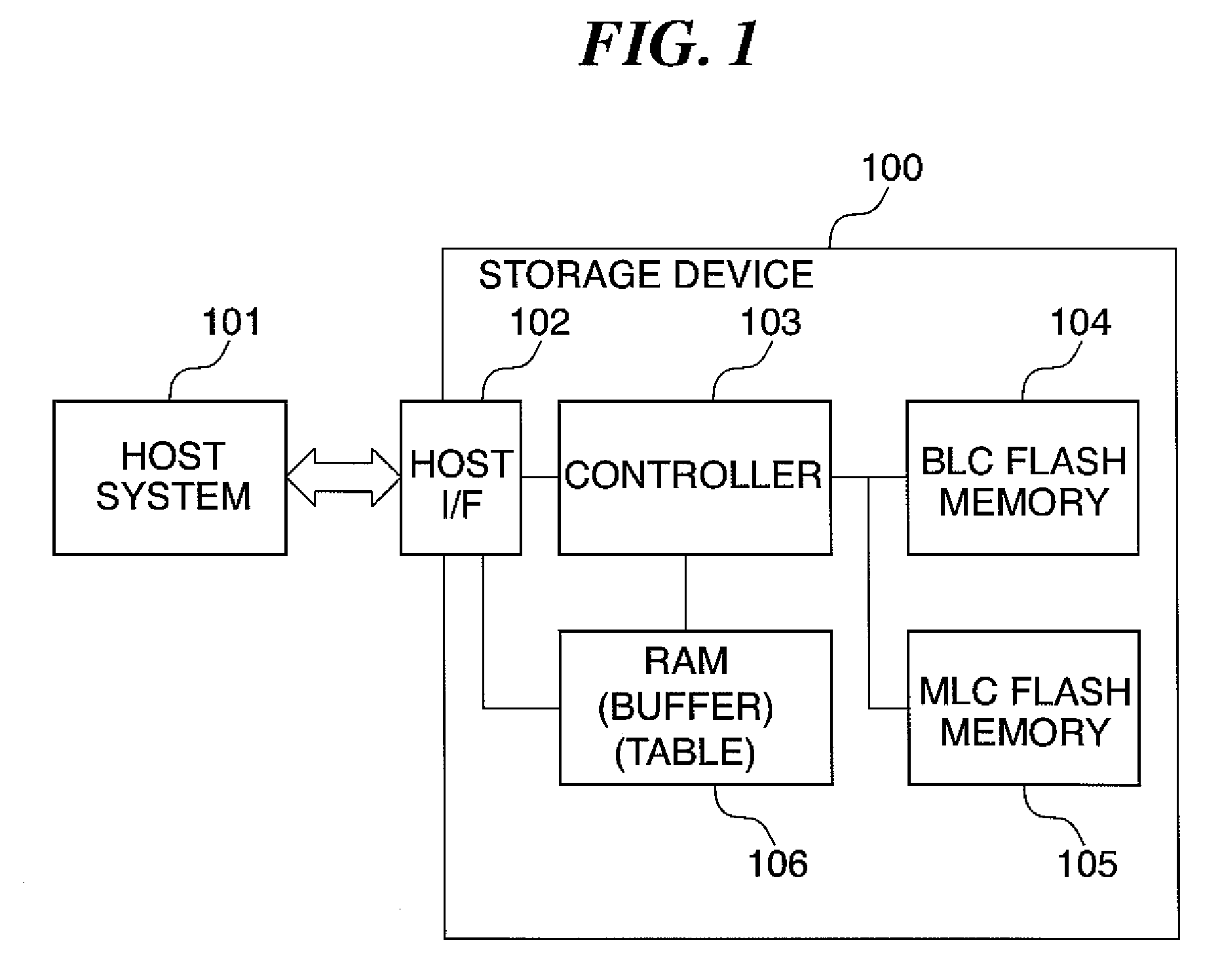
[0054]FIG. 1 is a block diagram of a memory management system including a memory management device according to the present invention.
[0055]As shown in FIG. 1, the memory management system is comprised of a host system 101, and a storage device 100, for example. The host system 101 incorporates a file system, not shown, and a block device driver, not shown,
[0056]The host system 101 is implemented e.g. by a CPU (Central Processing Unit) of an apparatus, such as a digital camera which the storage device 100 can be incorporated in or attached to. The storage device 100 serves as a block device for the host system 101. A block device is a storage medium into which is input data blocks each formed by a plurality of bytes as units, and is implemented e.g. by a flash memory.
[0057]The storage device 100 is comprised of a host interface (interface) 102, a controller 103, a BLC (Binary Level Cell: binary type) flash memory 104, an MLC (Multi-Level Cell: multi-value type) flash memory 105, and...
second embodiment
[0171]Next, a description will be given of the present invention.
[0172]A memory management device according to the second embodiment is identical in configuration (FIGS. 1 to 5) to the memory management device according to the first embodiment. Therefore, a description will be given of only different points from the first embodiment while designating identical elements by the same reference numerals, and omitting detailed description thereof.
[0173]As shown in FIG. 10, in the above described first embodiment, the garbage collection process is executed in timing synchronous with execution of the data writing process by the storage device 100. In the present second embodiment, the garbage collection process is executed not during data writing, but executed as a background process asynchronously with the data writing process. This makes it possible to reduce processing for data writing, thereby relatively shortening processing time for data writing.
[0174]Now, a description will be given...
third embodiment
[0181]Next, a description will be given of the present invention.
[0182]A memory management device according to the third embodiment is identical in configuration (FIGS. 1 to 5) to the memory management device according to the first embodiment. Therefore, a description will be given of only different points from the first embodiment while designating identical elements by the same reference numerals, and omitting detailed description thereof.
[0183]In the above described first embodiment, as shown in FIG. 17, when the host system 101 designates a page speed using the “Page rate” command, only processing for changing the bit value of the speed designation 312 of the page allocation information entry 310 of the associated page is performed.
[0184]In the third embodiment, when the host system 101 designates a page speed using the “Page rate” command, the bit value of the speed designation 312 of the page allocation information entry 310 of the associated page is changed, and at the same t...
PUM
 Login to View More
 Abstract
Description
Claims
Application Information
 Login to View More