Automated machines often have performance limitations caused by the vibration within the mechanisms and the stationary structure to which these mechanisms are attached within the machinery.
Often, no matter how much energy is applied to a mechanism it is unable to perform the assigned task faster than a certain rate because vibrations interfere with the
successful completion of the task.
In these machines, although the application of more energy typically allows the mechanism to operate faster, the increased energy causes the amplitude of the vibrations to increase.
The increased vibrations interfere with the machine's operation, especially the timely and precise stopping of an apparatus at a target point or value.
These methods can only solve the problem to a limited degree, tend to increase the assembled cost of the machine, and require additional design effort and
engineering cost to implement.
Sometimes the successful application of these mechanical solutions is not possible because of constraints imposed by the very task the machine is attempting to perform.
If the drumstick strikes a foam pad on a board the result is a dull thud because the pad is similar to well damped machine elements without
resonance so no frequencies are amplified or sustained.
If the drumstick strikes a gong or a
tuning fork the result is sustained vibration.
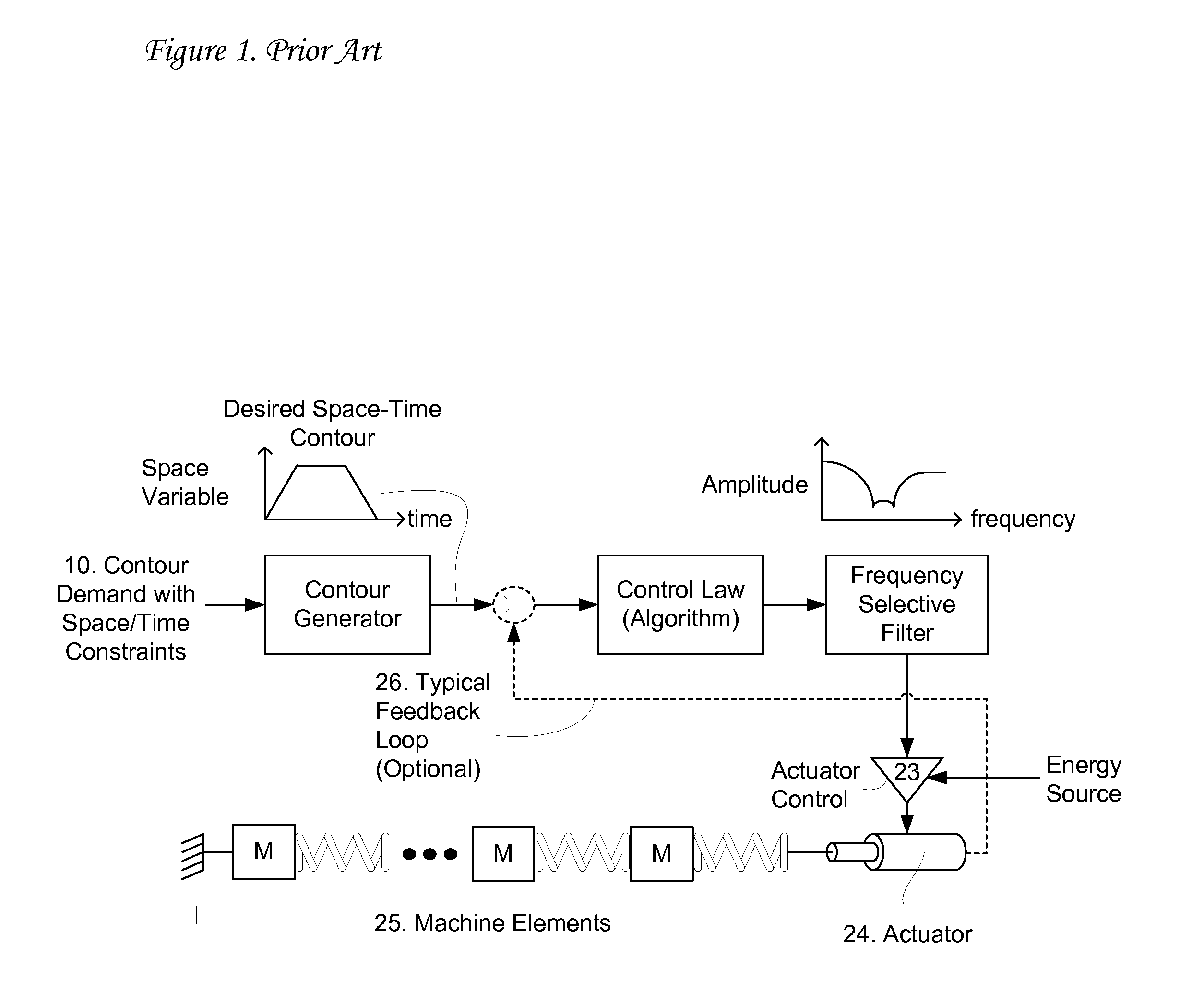
This control method has limitations in that the space-time contour command itself still likely has energy at frequencies that will cause vibration in the machine.
By removing the exciting frequencies from the
energy source driving the machine elements, errors are induced limiting the faithful following of the space-time contour, and often, these errors are unacceptable to the machine operation.
In many instances, if the filtering of the
energy source is not sufficient and / or robust, the
feedback control, attempting to follow the desired space-time contour will force energy back into the
system at the exciting frequencies, limiting the usefulness of this control solution.
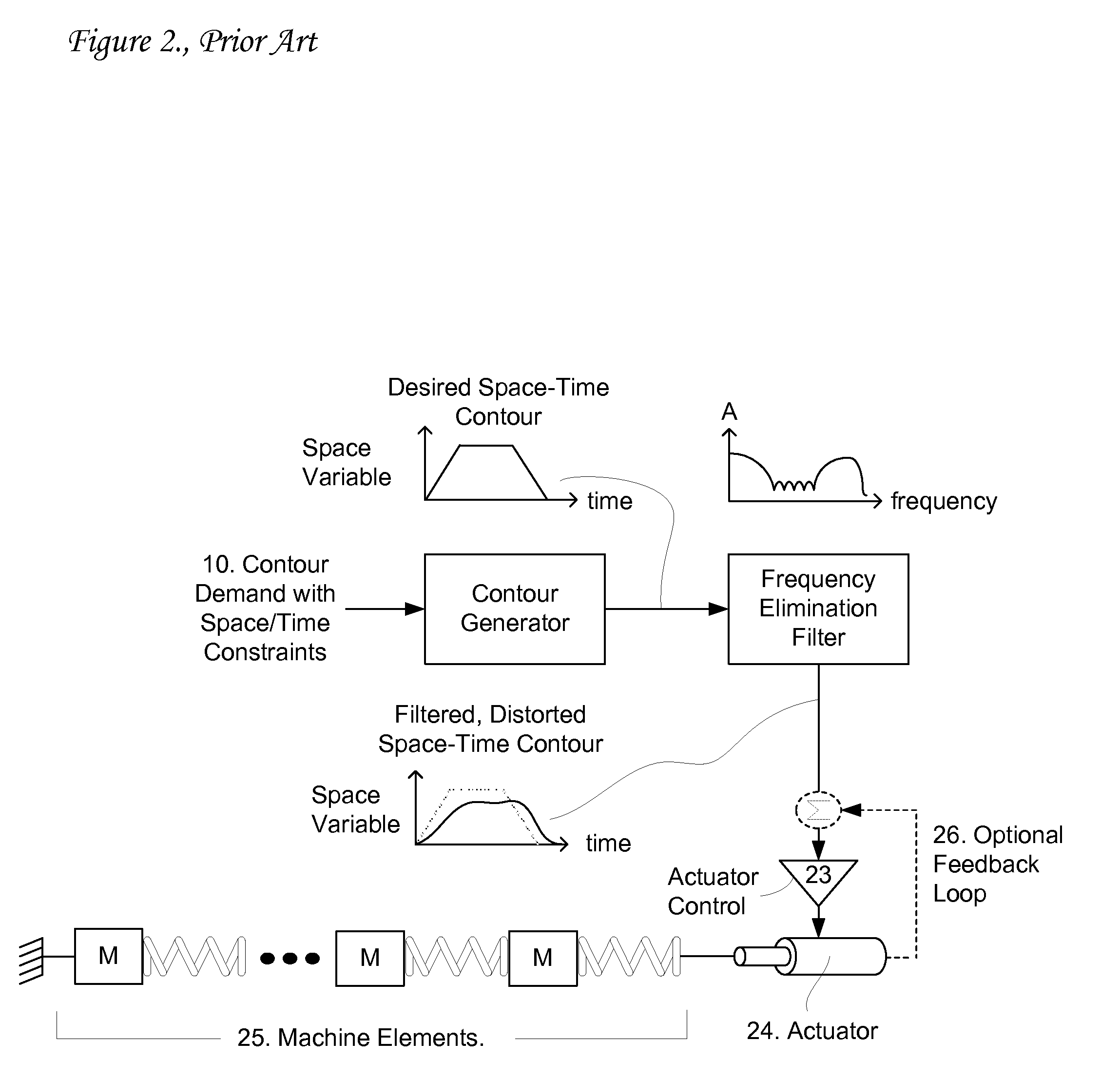
The unfortunate
side effect of this technique is
distortion of the “non-exciting” contour from the original desired space-time contour.
Space-time contour filtering produces, in any case, a contour that is distorted from the original designed space-time contour such that it usually degrades the performance of the machine, often causing it to not meet the design objectives.
In the case of a space-time contour that is intended to move a
mechanical load from one point to another and then stop, this method always increases the time between these points because
delay, inherent in the filter operation, necessarily lengthens the “non-exciting” contour.
This has the likely effect of slowing the overall machine, reducing its operating
throughput.



 Login to View More
  Login to View More