
Narrow-Spectrum Laser Device
a laser device and narrow-spectrum technology, applied in laser details, laser cooling arrangements, active medium materials, etc., can solve the problems of reduced resolving power and deterioration of the quality of an integrated circuit, and achieve the improvement of controllability, the synchronization allowable range is enlarged, and the control range of the spectral purity range e95 can be increased.
- Summary
- Abstract
- Description
- Claims
- Application Information
AI Technical Summary
Benefits of technology
Problems solved by technology
Method used
Image

Examples
first embodiment
[0210](Stabilization Control of Spectral Purity Range E95 by Controlling Discharge Timing (Control Means 1))
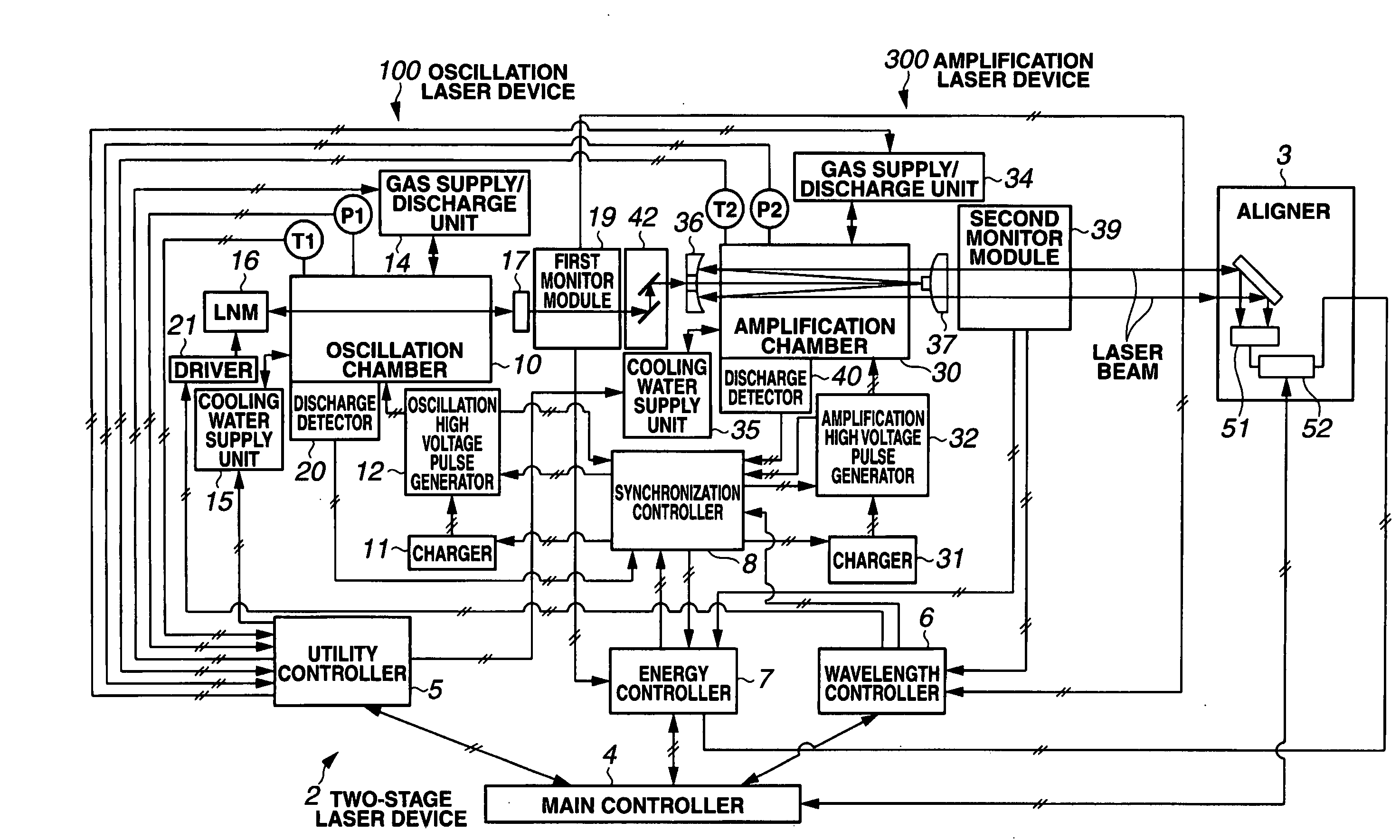
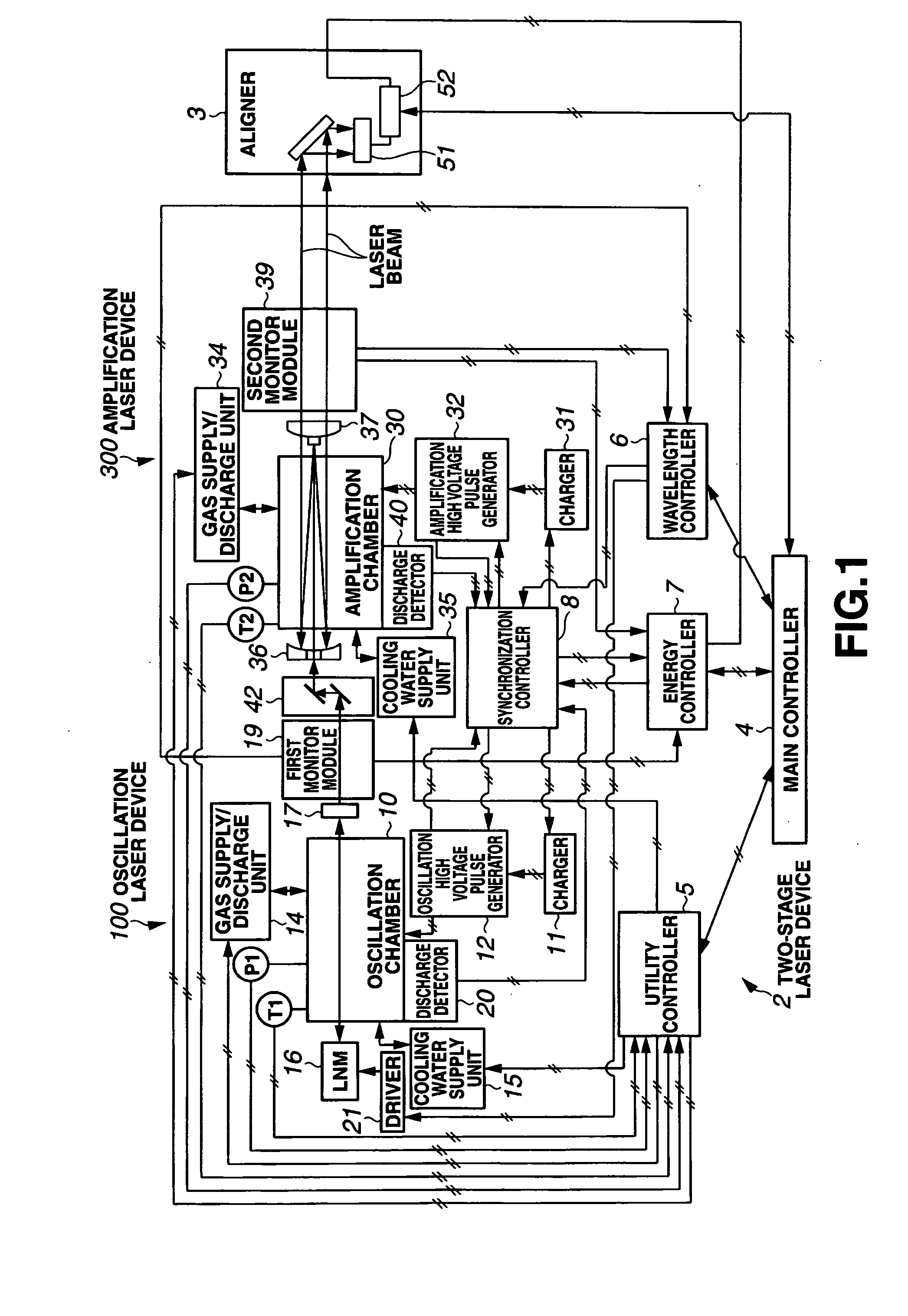
[0211]In this embodiment, the spectral purity range E95 of the laser beam output from the amplification laser device 300 is measured by the spectral purity range measuring means, and the spectral purity range E95 is subjected to stabilization control by controlling the discharge timing from the beginning of discharge by the oscillation laser device 100 to the beginning of discharge by the amplification laser device 300 such that the measured spectral purity range E95 is held within the allowable range E950±dE95 of the target spectral purity range E950.
[0212]In the case of the two-stage laser device 2 shown in FIG. 1, by varying the discharge timings of the two laser devices 100, 200 in the manner described above, the spectral characteristic can be altered. Reference Literature 1 (Japanese Patent Application No. 2002-046328) describes a technique in which this characteristic is...
second embodiment
[0246](Stabilization Control of Spectral Purity Range E95 Through Discharge Timing Control and Pulse Stretching Control (Control Means 1))
[0247]In this embodiment, pulse stretching means for extending the laser pulse waveform of the seed beam output from the oscillation laser device 100 are further provided. By extending the pulse waveform of the seed beam using these pulse stretching means, the synchronization allowable range at which the energy (output power) of the laser beam output from the amplification laser device 300 equals or exceeds an allowable level is enlarged, and in this state, similar discharge timing control to that of the first embodiment is performed, whereby the spectral purity range E95 is subjected to stabilization control.
[0248]Extending the laser pulse waveform by varying the laser discharge characteristic is known as (discharge) pulse stretching (control). By applying pulse stretching control to the oscillation laser device 100, the pulse length of the seed ...
third embodiment
[0259](Stabilization Control of Spectral Purity Range E95 Through Control of Rise of Seed Beam Pulse Waveform (Control Means (2)-1))
[0260]In the third and subsequent embodiments, the spectral purity range E95 of the laser beam output from the amplification laser device 300 is measured by the spectral purity range measuring means, and the spectral purity range E95 of the seed beam output from the oscillation laser device 100 is controlled such that the measured spectral purity range E95 is contained within the allowable range E950±dE95 of the target spectral purity range E950. Thus, the spectral purity range E95 of the laser beam output from the amplification laser device 300 is subjected to stabilization control.
[0261]In the third embodiment, the spectral purity range E95 of the seed beam is controlled by varying the time from the beginning of discharge by the oscillation laser device 100 to the rise of the laser pulse, and thus the spectral purity range E95 of the laser beam output...
PUM
 Login to View More
 Abstract
Description
Claims
Application Information
 Login to View More