
Thioester-ester-amide copolymers
a technology of thioester and amide, which is applied in the field of thioester-ester-amide copolymers, can solve the problems of stent thrombosis, low tsub>g/sub>, and continue to cause restenosis, and achieve the effect of short hydrolysis half-life time and tunable degradation ra
- Summary
- Abstract
- Description
- Claims
- Application Information
AI Technical Summary
Benefits of technology
Problems solved by technology
Method used
Image

Examples
example 1
Synthesis of PEA-Hexanedithiol
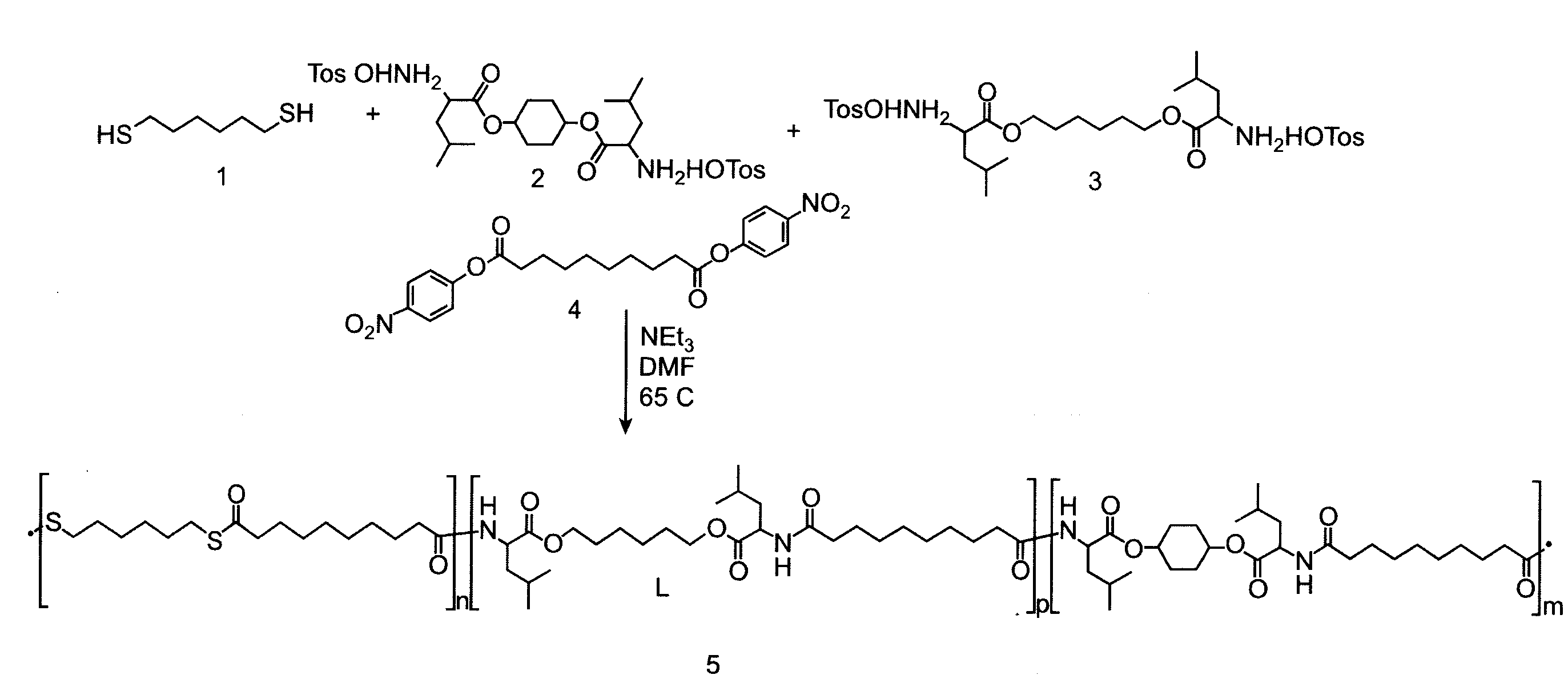
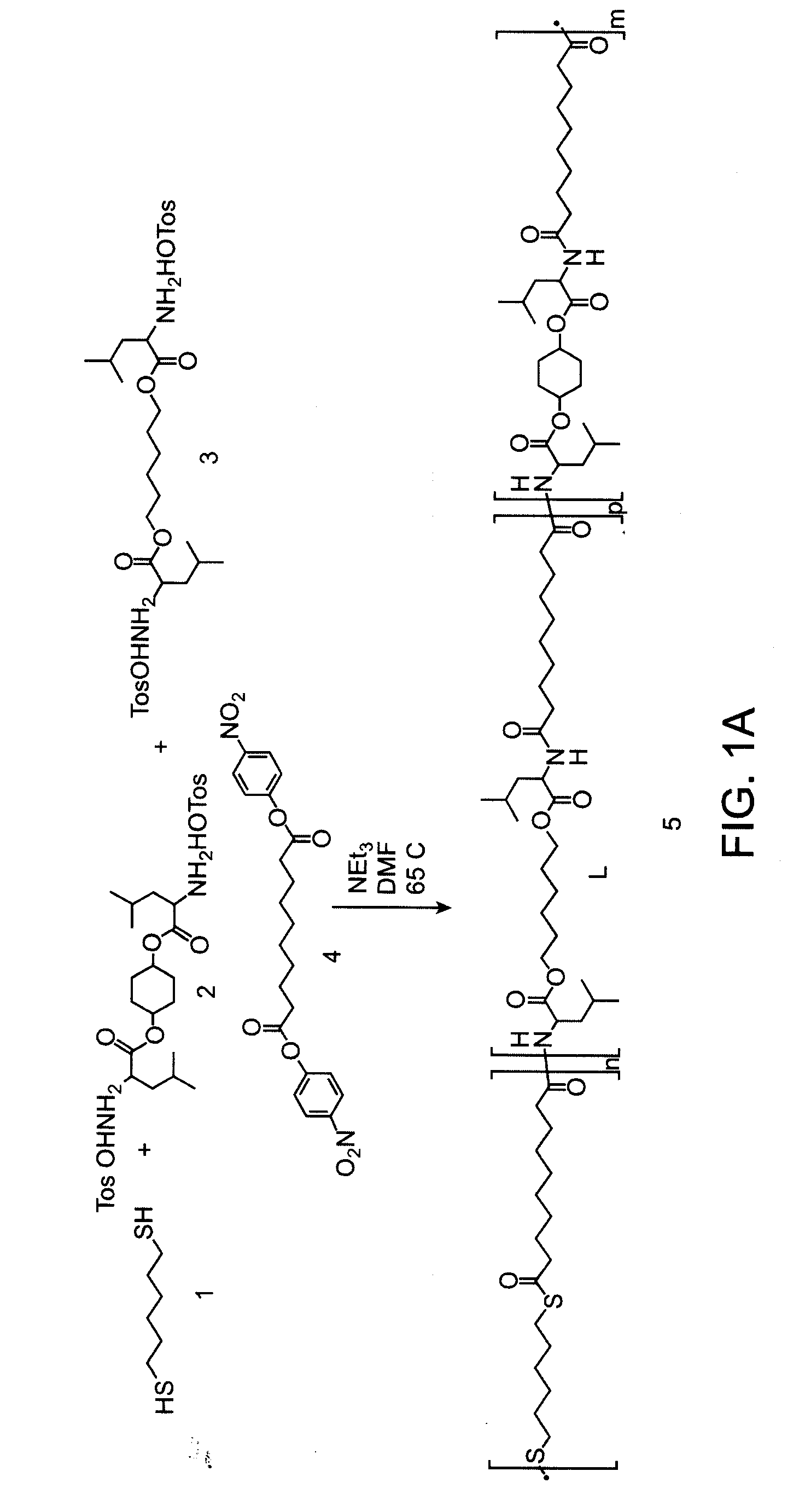
[0115]A PTEA copolymer, PEA-Hexanedithiol was synthesized from a nucleophilic mixture of hexane dithiol, leucine(cyclohexanediol), and leucine(hexanediol) with stoichiometric ratio of 0.99 to the electrophile dinitrophenly sebacinate as the linking unit according to the reaction scheme shown in FIG. 1A.
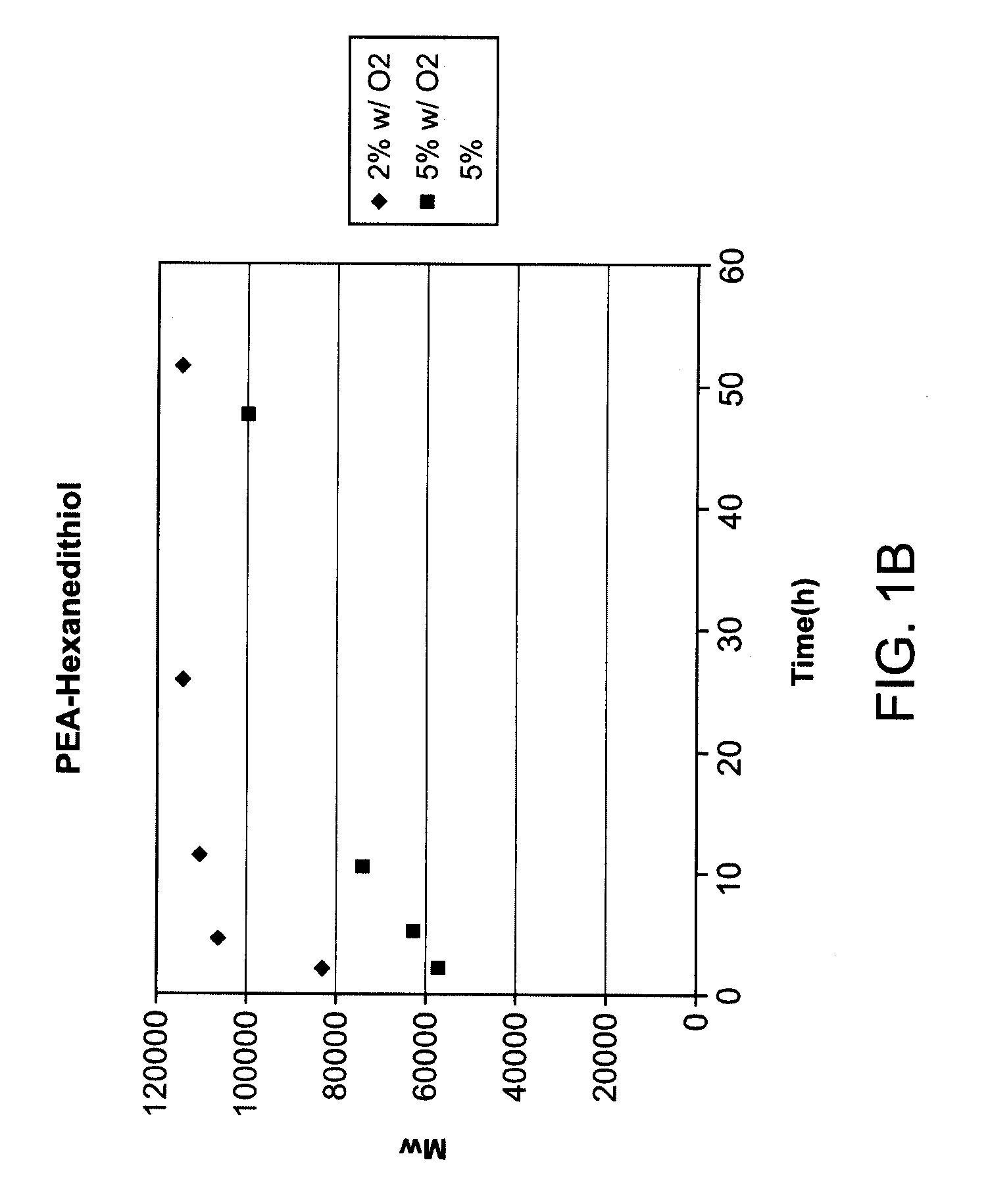
[0116]Molecular weight studies (FIGS. 1B and 1C; Table 9) show that molecular weight of polymer with the presence of the dithiol monomer is much higher, indicating that incorporation of dithiol units in the polymer was success. This is confirmed by 1H NMR studies (Data not shown).
TABLE 9Molecualr weight (weight average molecular weight, Mw) as aunction of time for PEA-HexanedithiolTime (h)24.511.526522%82800106200110200114100114200withO2Time (h)2510.524485%56411.561942.573260.58906899650withO25%6260069600784008930096800
example 2
Synthesis of -[TE II]n-[TE I]h-[EA VI]p-[EA VII]m-
[0117]A PTEA copolymer, -[TE II]n-[TE I]h-[EA VI]p-[EA VII]m-, was synthesized from a nucleophilic mixture of hexane dithiol and leucine(cyclohexanediol) with stoichiometric ratio of 0.99 to the electrophile mixture of dinitrophenyl sebacinate and dinitrophenyl adipate as the linking units according to the reaction scheme shown in FIG. 2.
example 3
Synthesis of -[TE II]n-[TE I]h-[EA VI]p-[EA VII]n[EA II]k-[EA I]o-
[0118]A PTEA copolymer, -[TE II]n-[TE I]h-[EA VI]p-[EA VII]m-[EA II]k-[EA I]o-, was synthesized from a nucleophilic mixture of hexane dithiol, leucine(cyclohexanediol), and leucine(hexanediol) with stoichiometric ratio of 0.99 to the electrophile mixture of dinitrophenyl sebacinate and dinitrophenyl adipate as the linking units according to the reaction scheme shown in FIG. 3.
PUM
| Property | Measurement | Unit |
|---|---|---|
| molar ratio | aaaaa | aaaaa |
| temperature | aaaaa | aaaaa |
| molecular weight | aaaaa | aaaaa |
Abstract
Description
Claims
Application Information
 Login to View More