
Projection optical system, exposure apparatus, and method of manufacturing device
- Summary
- Abstract
- Description
- Claims
- Application Information
AI Technical Summary
Benefits of technology
Problems solved by technology
Method used
Image

Examples
first numerical embodiment
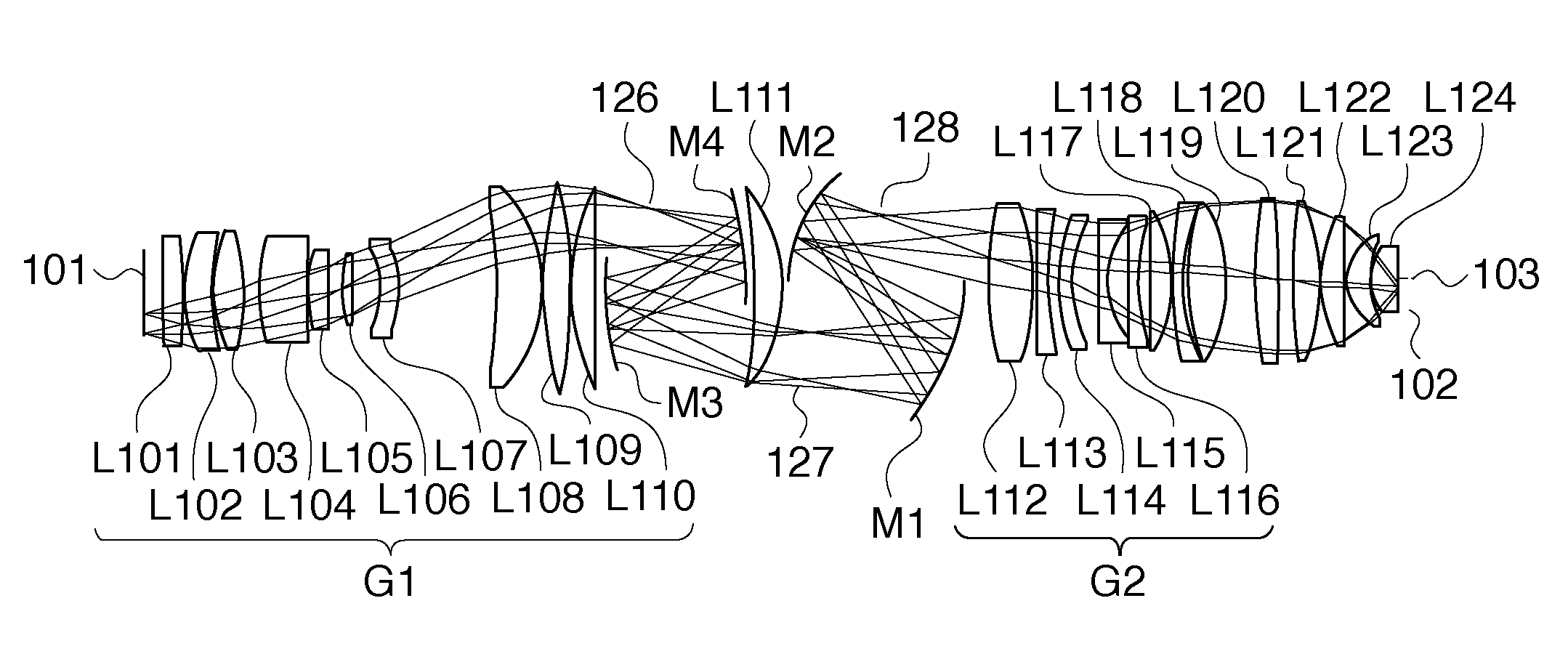
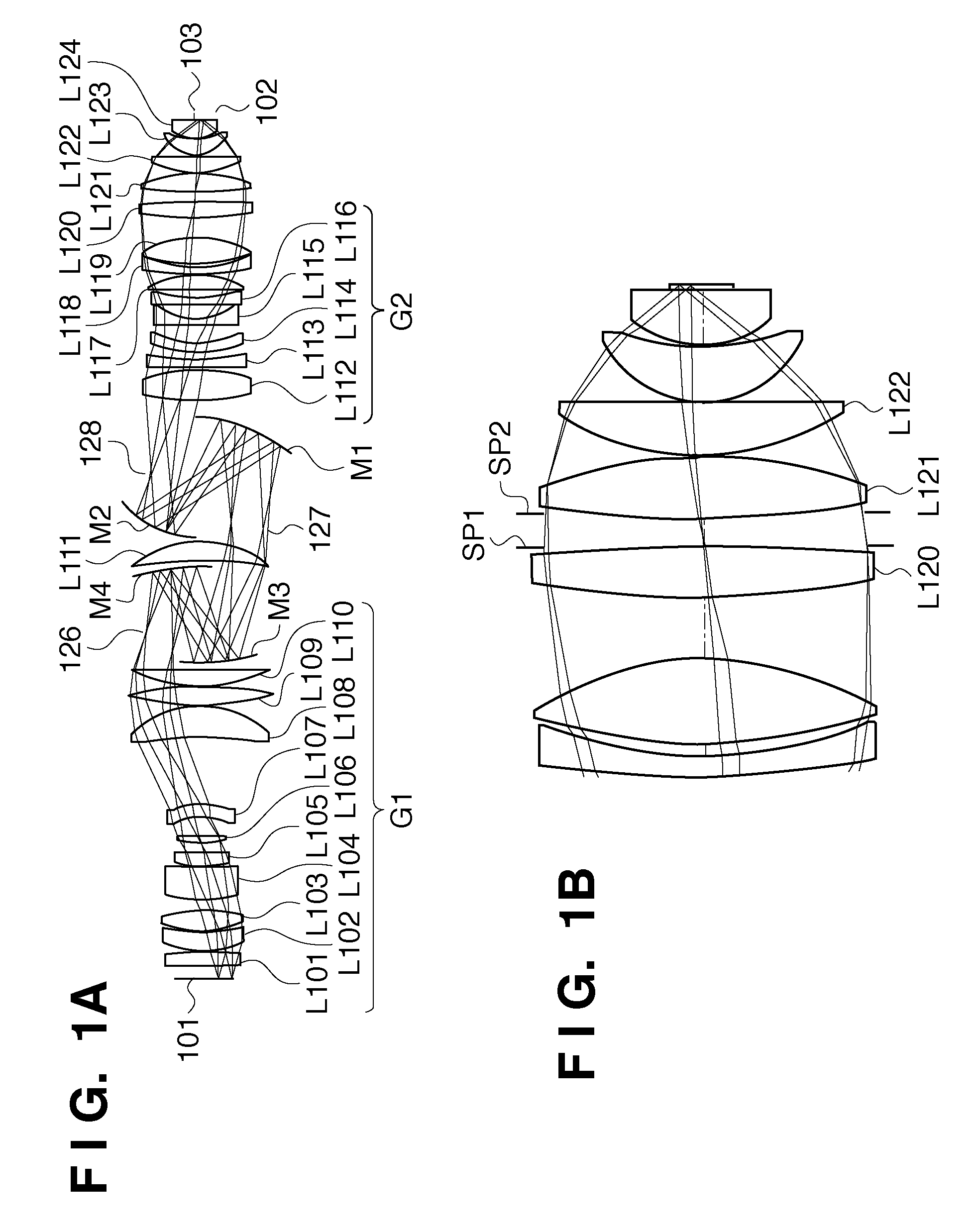
[0060]FIG. 1A shows the lens arrangement of a catadioptric projection optical system as the first numerical embodiment. Referring to FIG. 1A, the imaging optical system G1, the intermediate image 127 of the real image, the reflecting concave mirror M1, the concave mirror M2, the intermediate image 128 of the real image, and the imaging optical system G2 are sequentially arranged from the first object 101 side along the optical path.
[0061]In the first numerical embodiment, the imaging optical system G1 comprises lenses L101 to L110, a concave mirror M3, a concave mirror M4, and a lens L111. More specifically, the imaging optical system G1 sequentially has, from the first object side, the aspherical positive lens L101 having a nearly plano-convex shape with its nearly flat surface facing the first object side, the aspherical positive lens L102 having a meniscus shape with its convex surface facing the first object side, and the positive lens L103 having a biconvex shape. Following the...
second numerical embodiment
[0074]Tables 4 and 5 show various constituent factors or elements of the second numerical embodiment.
TABLE 4NA = 1.20β = ¼Radius of CurvatureSurface Interval[mm][mm]Materialr0 = ∞d0 = 25.19881r1 = 10146.97189d1 = 33.27555SiO2Asphericalr2 = −696.78276d2 = 1.59058Surfacer3 = 223.04724d3 = 41.44895SiO2Asphericalr4 = 621.07430d4 = 2.39338Surfacer5 = 223.44378d5 = 46.39318SiO2r6 = −310.19954d6 = 20.93568r7 = 281.76963d7 = 70.00000SiO2r8 = 478.35430d8 = 1.05014r9 = 156.81626d9 = 32.00000SiO2Asphericalr10 = 1393.77884d10 = 21.26122Surfacer11 = 192.11219d11 = 18.04448SiO2r12 = −438.32491d12 = 39.17674r13 = −138.24946d13 = 29.94391SiO2Asphericalr14 = −140.10195d14 = 142.39793Surfacer15 = −938.67110d15 = 69.95628SiO2r16 = −222.66871d16 = 3.02453Asphericalr17 = 463.33151d17 = 40.03651SiO2Surfacer18 = −777.63117d18 = 1.01162r19 = 362.03914d19 = 37.24490SiO2r20 = −37671.40243d20 = 222.43920Asphericalr21 = −453.83756d21 = −209.43920M1SurfaceAsphericalr22 = 476.77816d22 = 219.45691M2Surfacer23 = −...
third numerical embodiment
[0082]FIG. 8A shows the lens arrangement of a dioptric projection optical system as the third numerical embodiment of the present invention. The dioptric projection optical system comprises an imaging optical system G1 and an imaging optical system G2 sequentially arranged from the first object 101 side along an optical path.
[0083]In the third numerical embodiment, the imaging optical system G1 comprises lenses L301 to L316. More specifically, the imaging optical system G1 sequentially has, from the first object side, the aspherical negative lens L301 having a biconcave shape with its concave surface facing the first object side, the negative lens L302 having a meniscus shape with its concave surface facing the first object side, and the aspherical positive lens L303 having a meniscus shape with its concave surface facing the first object side. Following the lens L303, the imaging optical system G1 sequentially has the positive lens L304 having a biconvex shape, the positive lens L3...
PUM
 Login to View More
 Abstract
Description
Claims
Application Information
 Login to View More