
EL Display Device
a display device and electroluminescent technology, applied in semiconductor devices, instruments, electrical apparatus, etc., can solve the problems of display screen voltage drop, etc., to suppress display screen brightness unevenness, the aperture ratio is not reduced, and the resistance of the power source line can be decreased
- Summary
- Abstract
- Description
- Claims
- Application Information
AI Technical Summary
Benefits of technology
Problems solved by technology
Method used
Image

Examples
first embodiment
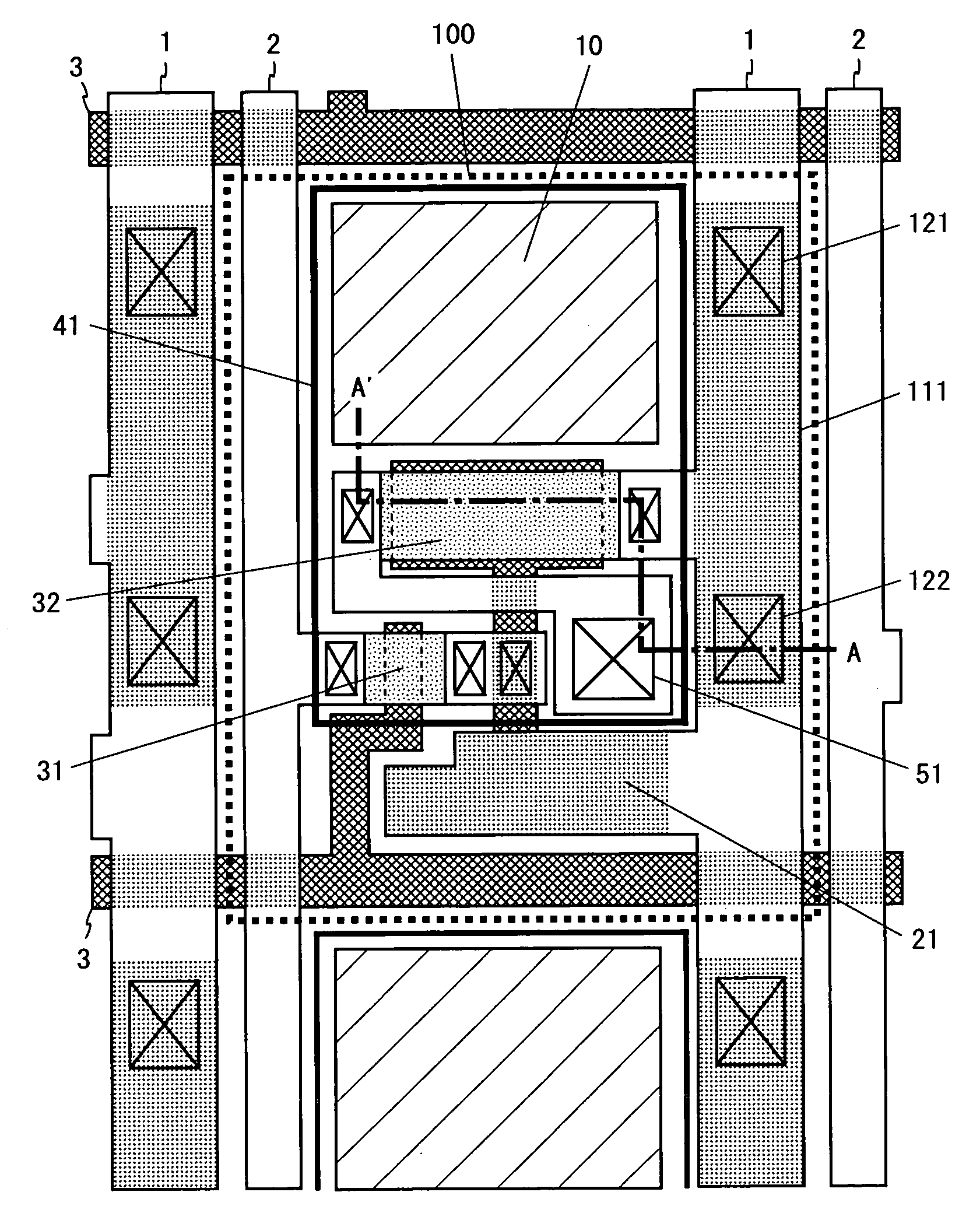
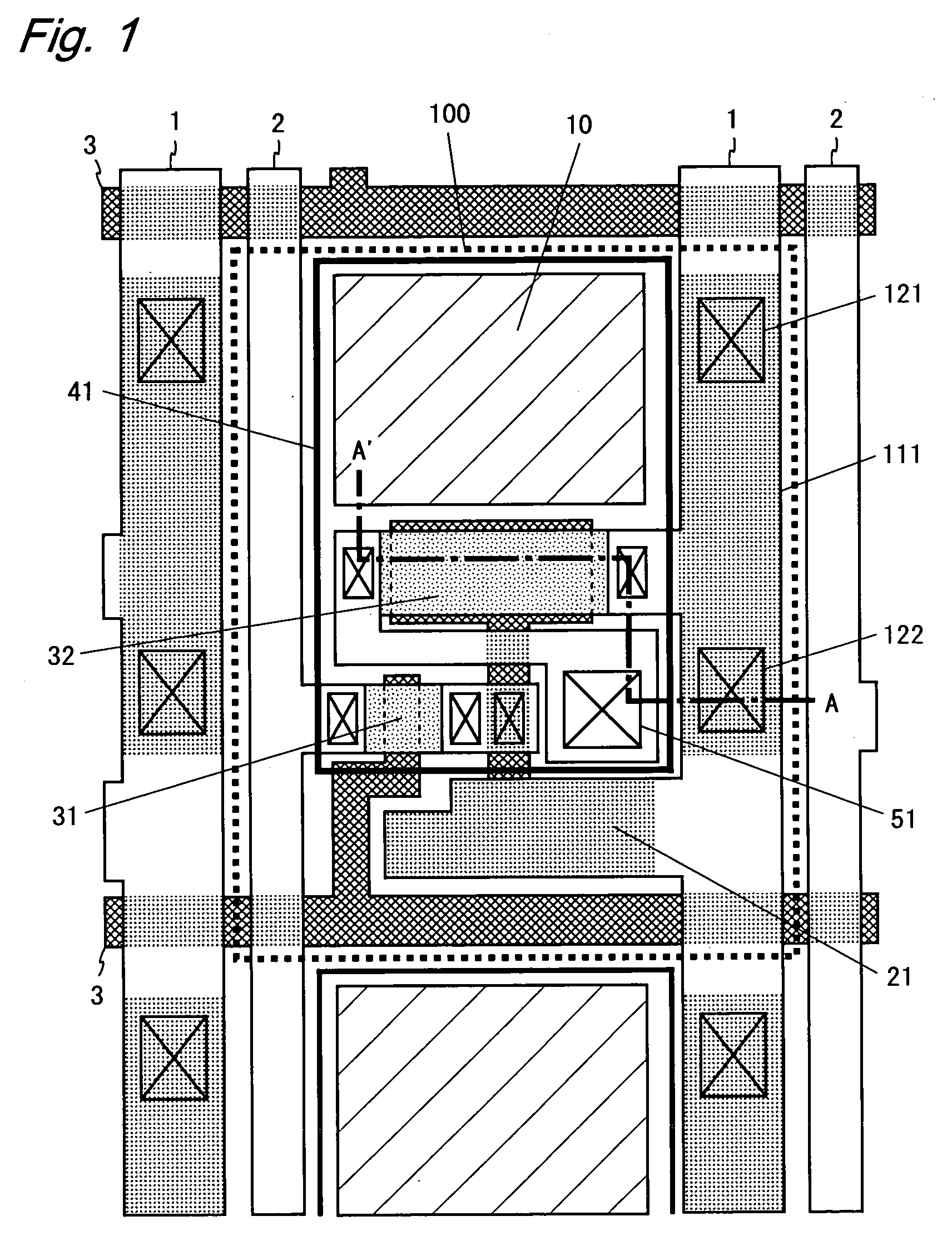
[0059]FIG. 1 is a plan view of a pixel in an EL display device according to a first embodiment of the present invention. A layout of pixels included in the EL display device according to this embodiment is shown in FIG. 1. A pixel 100 (a portion surrounded by a bold broken line) shown in FIG. 1 functions as one pixel in an EL display device that performs monochromatic display, and functions as a sub pixel corresponding to one color in an EL display device that performs color display. The EL display device according to this embodiment is an active matrix-type EL display device having a plurality of pixels 100 arranged two-dimensionally.
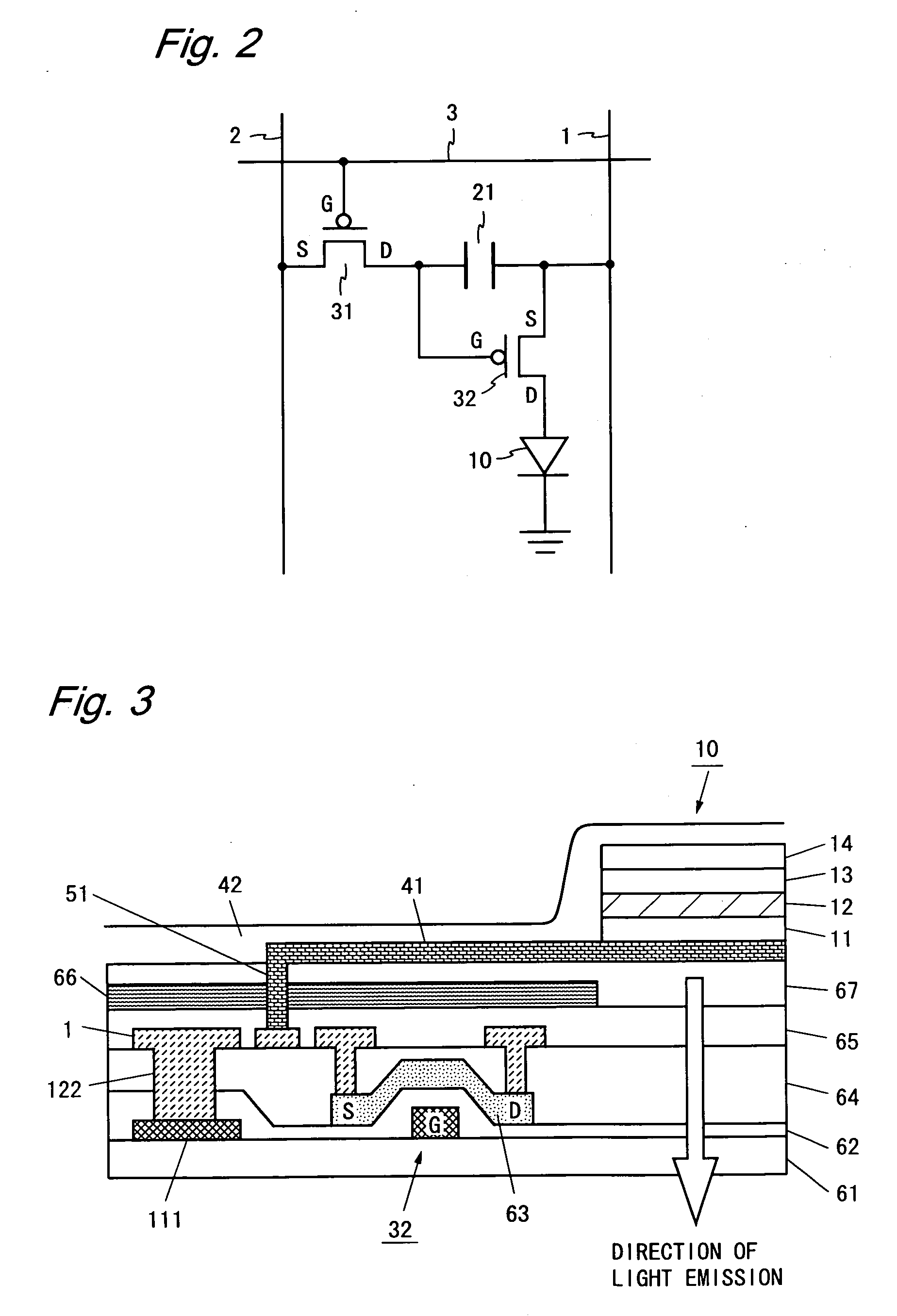
[0060]As shown in FIG. 1, the EL display device according to this embodiment includes a plurality of power source lines 1, a plurality of data lines 2 and a plurality of scanning lines 3. These lines are arranged on one of two wiring layers: upper and lower wiring layers. Of the upper and lower wiring layers, hereinafter, the lower wiring layer (a wiri...
sixth embodiments
Second to Sixth Embodiments
[0081]EL display devices according to second to sixth embodiments are almost equal in configuration to the EL display device according to the first embodiment. In the following, therefore, constituent elements identical with those in the first embodiment are denoted by the identical reference symbols and description thereof will not be given, and description will be given of differences between the second to sixth embodiments and the first embodiment.
[0082]FIG. 4 is a plan view of a pixel in the EL display device according to the second embodiment of the present invention. A pixel 200 shown in FIG. 4 includes one contact 221 which is almost equal in length to the bypass line 111, in place of the two contacts 121 and 122. The contact 221 can be formed by a method which is equal to that for the contacts 121 and 122.
[0083]In the EL display device according to the second embodiment, as described above, by providing the single contact 221 which is almost equal ...
PUM
 Login to View More
 Abstract
Description
Claims
Application Information
 Login to View More