
Lyophilization Process
a technology of lyophilization and piper, which is applied in the direction of organic chemistry, heterocyclic compound active ingredients, antibacterial agents, etc., can solve the problems of serious or critical consequences for patients, inability to lyophilize piper, and particle presence in solution, especially if injected intravenously, and achieves the effect of reducing the risk of infection
- Summary
- Abstract
- Description
- Claims
- Application Information
AI Technical Summary
Benefits of technology
Problems solved by technology
Method used
Image

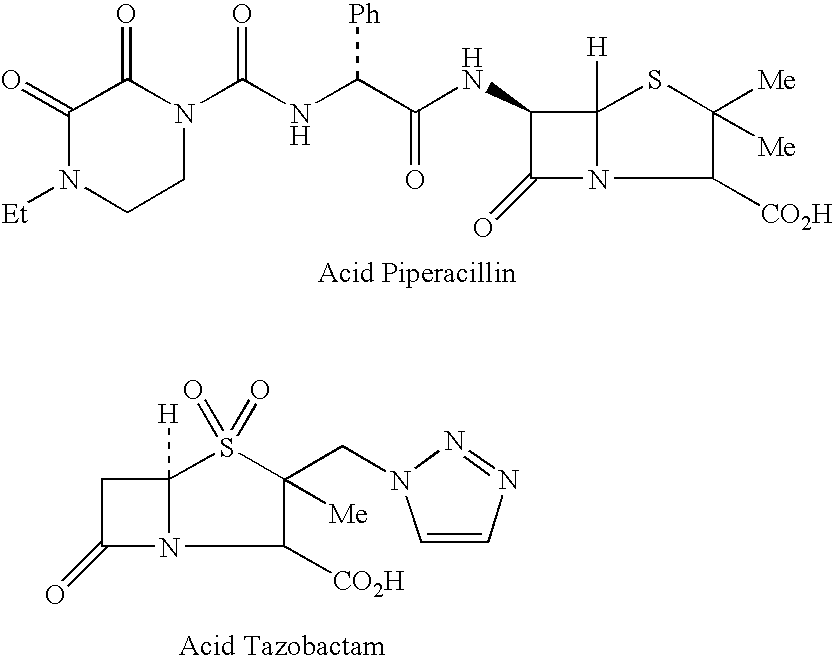
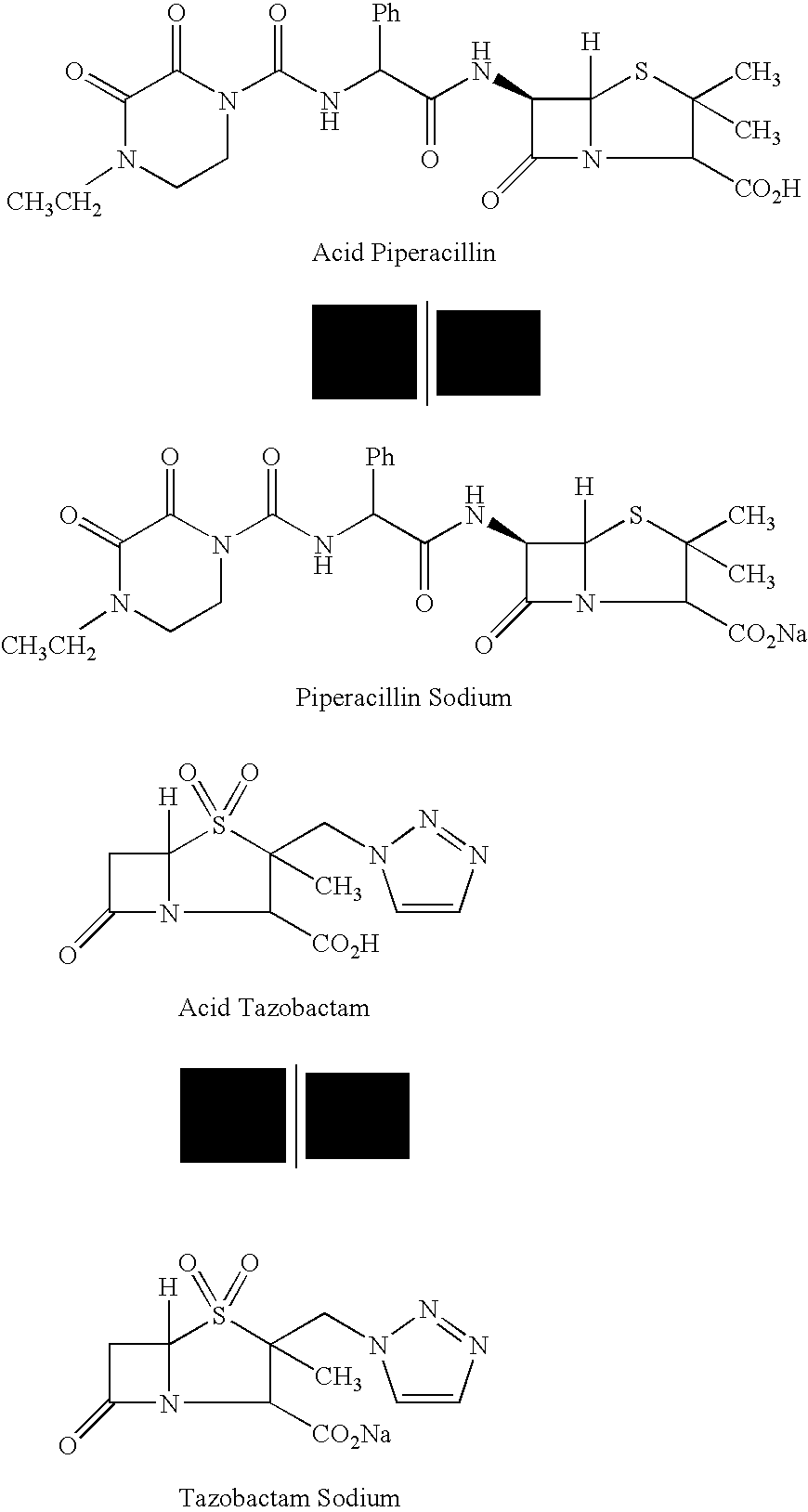
Examples
example 1
[0128]In a 1 L stirred reactor, 109 mL of water, 60.00 g of Piperacillin Monohydrate (equivalent to 58.00 g of anhydrous acid; 11.2 cMol) and 7.25 g (2.4 cMol) of Tazobactam (Piperacillin to Tazobactam ratio 8:1) are loaded. With good stirring 11.43 g of sodium bicarbonate (13.6 cMol) are loaded in portions over a period of 1 hour. Stirring is continued for 30 minutes while vacuum is applied to an absolute pressure of 20-30 mBar. CO2 is measured to be less than 75 mg / L (if higher, stirring under vacuum is continued for additional 30 minutes) and pH adjusted to a value between 5.5 and 7.0 by means of Piperacillin Monohydrate (PIP) or Sodium Bicarbonate (BIC) addition, as needed. The solution is then lyophilized.
Initial pHmg CO2 / LAdjustAdjusted pHFinal pHSST7.8720.4 g PIP6.86.5T
example 2
[0129]In a 1 L stirred reactor, 109 mL of water and 11.43 g of sodium bicarbonate (13.6 cMol) are loaded. Temperature is lowered to a value between 6 and 9° C. With good stirring 60.00 g of Piperacillin Monohydrate (equivalent to 58.00 g of anhydrous acid; 11.2 cMol) and 7.25 g (2.4 cMol) of Tazobactam (Piperacillin to Tazobactam ratio 8:1) are loaded in portions over a period of 1 hour. Stirring is continued for 30 minutes while vacuum is applied to an absolute pressure of 20-30 mBar. CO2 is measured to be less than 75 mg / L (if higher, stirring under vacuum is continued for additional 30 minutes) and pH adjusted to a value between 5.5 and 7.0 by means of Piperacillin Monohydrate (PIP) or Sodium Bicarbonate (BIC) addition, as needed. The solution is then lyophilized.
Initial pHmg CO2 / LAdjustAdjusted pHFinal pHSST7.5670.4 g PIP6.66.3T
example 3
[0130]In a 1 L stirred reactor, 109 mL of water and 11.43 g of sodium bicarbonate (13.6 cMol) are loaded. Temperature is lowered to a value between 6 and 9° C. With good stirring 72.90 g (13.6 cMol) of Piperacillin Monohydrate are loaded in portions over a period of 1 hour. Stirring is continued for 30 minutes while vacuum is applied to an absolute pressure of 20-30 mBar. CO2 is measured to be less than 75 mg / L (if higher, stirring under vacuum is continued for additional 30 minutes) and pH adjusted to a value between 5.5 and 7.0 by means of Piperacillin Monohydrate (PIP) or Sodium Bicarbonate (BIC) addition, as needed. The solution is then lyophilized.
Initial pHmg CO2 / LAdjustAdjusted pHFinal pHSST7.9610.5 g PIP6.96.6T
PUM
| Property | Measurement | Unit |
|---|---|---|
| Temperature | aaaaa | aaaaa |
| Temperature | aaaaa | aaaaa |
| Temperature | aaaaa | aaaaa |
Abstract
Description
Claims
Application Information
 Login to View More