[0022]determining an expected directional reaction (x′) of the regulation or
process variable to the stipulated (assigned) manipulated variable (y),
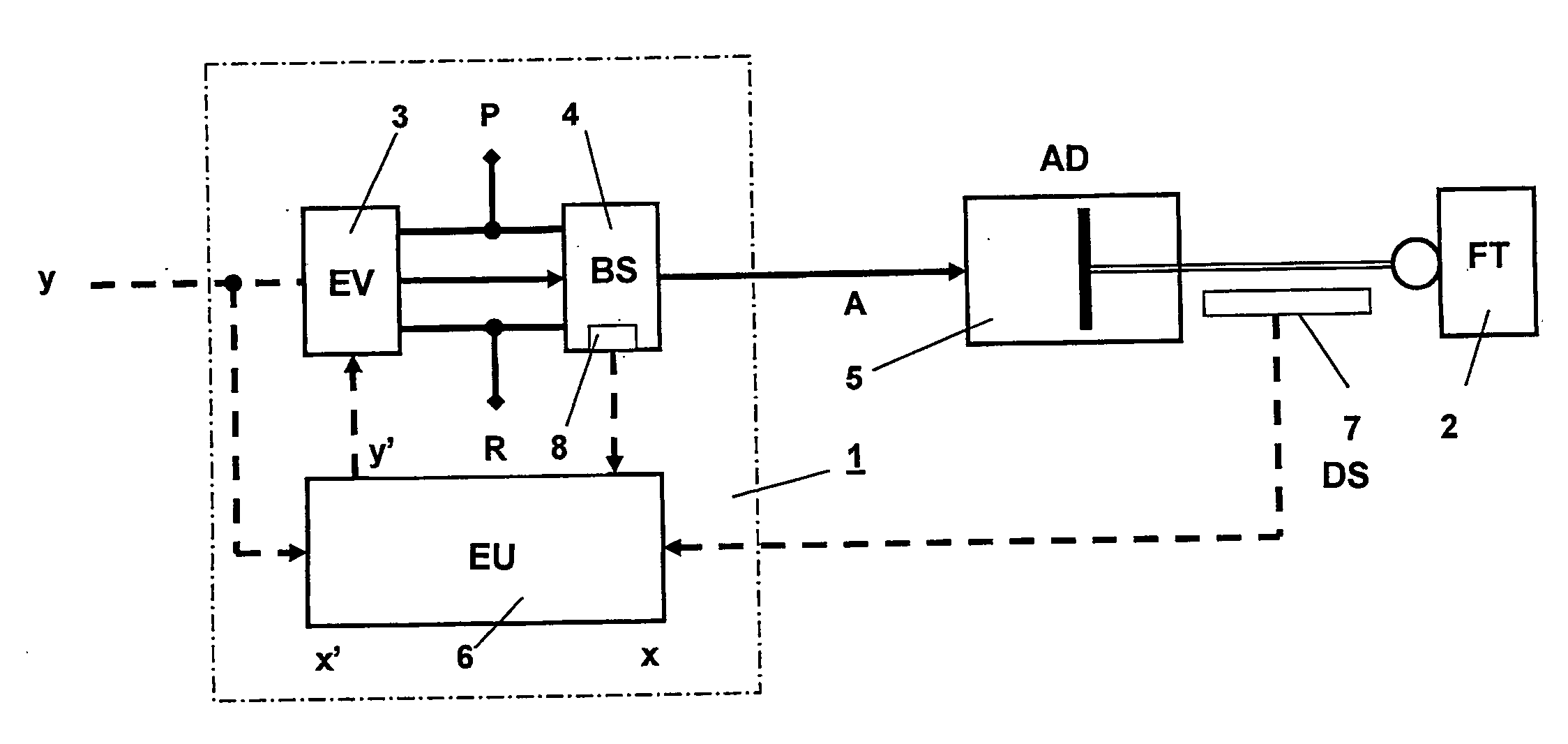
[0027]According to an exemplary embodiment, by means of the electrical emergency
signal, the pressure medium acting upon the booster stage can be enclosed via a
neutral position of the electropneumatic valve, so as to achieve a leaktight closure. Moreover, an electrical activation signal can be transmitted to the electropneumatic valve, which can cause the pressure medium acting upon the booster stage to be discharged to the
atmosphere via the exhaust air duct of the electropneumatic valve. A reversal of activation opposite to the original direction is thereby achieved, so that the position controller can assume its initial position.
[0026]An advantageous aspect of the above-described exemplary method is that, independent of the switching position of the pressure medium-operated position controller, the desired blocking fail-safe behavior can be ensured, in the event of a failure of pneumatic energy, by means of an active activation of the pneumatic
pilot control. Moreover, this ensures that the electropneumatic valve of the
pilot control cannot continue to be fed with outflowing pressure medium from the actuating drive. This
adaptive control forms the basis for sending a diagnostic message corresponding to the fault situation to a central
control unit (e.g., CPU). When a potential pneumatic energy failure is detected, the new activation signal required for the desired blocking may only need to be applied for a short time. Thereafter, the actuating signal stipulated by the process regulation and control loop can be transmitted, unchanged, to the electropneumatic valve, with the effect that, in the event of a possible faulty detection of a pneumatic energy failure, regulation can continue to operate, unaffected. It is also conceived that if a pneumatic energy failure is detected, the activation signal required for the desired blocking can be applied, perhaps permanently, and further normal operation solely by interaction between an overriding control and an operator can be achieved. This is practical especially when a corresponding diagnostic message has previously been transmitted to the overriding control, whereupon the operator has to react in order to rectify the fault.
[0028]According to an exemplary embodiment, an evaluation unit is provided, as an
electronic circuit, for example, to determine an expected directional reaction of the regulation or
process variable to the stipulated manipulated variable, and compare the expected directional reaction with the actual directional reaction. In
signal processing terms, the expected directional reaction can, for example, be formed by means of the
mathematical relation of the first derivative of the expected speed signal dx′ / dt, and the comparison with the measured speed signal dx / dt is carried out. If the measured speed signal dx / dt and the expected speed signal dx′ / dt possess the same direction due to the same signs, a pressure medium failure can be established as a fault situation when the expected direction does not correspond to the measured direction of the actuating drive, i.e., the signs are different.
[0029]According to an exemplary embodiment, in regards to
signal processing in the evaluation unit, a tolerance band corresponding to the
system-induced quantization
noise is applied in the measured speed signal dx / dt to prevent an unwanted detection of a pressure medium failure.
[0030]With regard to a device corresponding to the exemplary method described above, and any modifications and / or refinements as described hereinafter, the means used for the detection of the current position of the booster stage can be, for example, a contactlessly operating
position sensor which is arranged at a suitable location on the housing of the position controller. A suitable location is where the
position sensor can reliably monitor the
stroke movement of the movable parts within the booster stage. A capacitive or inductive
position sensor, for example, may in this case be considered as a contactless position sensor. In the latter case, a permanent
magnet can be integrated in the movable valve parts, to generate the inductive measurement effect in the inductive position sensor.


 Login to View More
  Login to View More