Unlock instant, AI-driven research and patent intelligence for your innovation.

Dc-dc converter

a converter and synchronous rectifier technology, applied in the direction of automatic control, process and machine control, instruments, etc., can solve the problems of increasing electric power consumption, dc-dc converters with synchronous rectifiers are susceptible to the occurrence of reverse currents, and increasing the power consumed by the cpu proportionally to the frequency of the clock

Active Publication Date: 2010-02-25
NISSHINBO MICRO DEVICES INC
View PDF4 Cites 18 Cited by
  • Summary
  • Abstract
  • Description
  • Claims
  • Application Information

AI Technical Summary

Benefits of technology

[0021]In view of the foregoing, one illustrative embodiment of the present invention provides a DC-DC converter that includes a switching transistor including a first terminal connected to a power input terminal, an inductor including a first end connected to a second terminal of the switching transistor and a second end connected to an output terminal, a synchronous rectification transistor including a first terminal connected to a junction node between the switching transistor and the inductor and a second terminal connected to a ground terminal, a first electric current detector to detect whether or not an electric current flowing through the synchronous rectification transistor is larger than a first electric current, a second electric current detector to detect whether or not the electric current flowing through the synchronous rectification transistor is larger than a second electric current that is larger than the first electric current and flows in a positive direction, and a selection mechanism to select one of the first electric current detector and the second electric current detector in accordance with a control signal. The synchronous rectification transistor is turned off by an output signal from one of the first electric current detector and the second electric current detector that is selected, and while the synchronous rectification transistor is on, a direction of the electrical current flowing through the synchronous rectification transistor is as the positive direction when the electrical current flows from the junction node to the ground terminal and as a negative direction when the electrical current flows from the ground terminal to the junction node.
[0022]Another illustrative embodiment of the present invention provides a DC-DC converter includes above-described a switching transistor, an inductor and a synchronous rectification transistor, and further includes a first voltage detector to dete

Problems solved by technology

However, when the clock speed is increased, the power consumed by the CPU increases in proportion to the frequency of the clock, which is a problem in a device with a limited power supply such as a mobile phone or the like.
As a result, electric power consumption is increased.
In a discontinuous mode, DC-DC converters with synchronous rectifier are susceptible to the occurrence of a reverse current, meaning that the electrical current flows to a ground terminal from an output terminal connecting to a load circuit through the inductor and a synchronous rectification transistor.
When a reverse current occurs, power conversion efficiency of the DC-DC converter in particularly is impaired.
Herein, in a case in which the output voltage of the DC-DC converter changes from a higher voltage to a lower voltage, when the load current is low, it takes a longer time for a capacitor connected to the output terminal to discharge, and consequently, reduction of the output voltage requires a longer time.
A similar problem occurs when the power supply is turned off.
Here too, a similar problem occurs when the power supply is turned on.
However, in the above-described approach, while the output voltage changes, the period during which the reverse current occurs is not controlled.
Additionally, because the reverse current is increased over time, when the electric load current is lower, undershoot of the output voltage may be generated.
At that time, the electricity stored in the inductor for supplementing the reverse current is excessive, and as a result, the overshoot occurs.
Moreover, because the above-described approach takes no countermeasures when the power is turned on, the overshooting generated immediately after the power on cannot be prevented.

Method used

the structure of the environmentally friendly knitted fabric provided by the present invention; figure 2 Flow chart of the yarn wrapping machine for environmentally friendly knitted fabrics and storage devices; image 3 Is the parameter map of the yarn covering machine
View more

Image

Smart Image Click on the blue labels to locate them in the text.
Viewing Examples
Smart Image
  • Dc-dc converter
  • Dc-dc converter
  • Dc-dc converter

Examples

Experimental program
Comparison scheme
Effect test

first embodiment

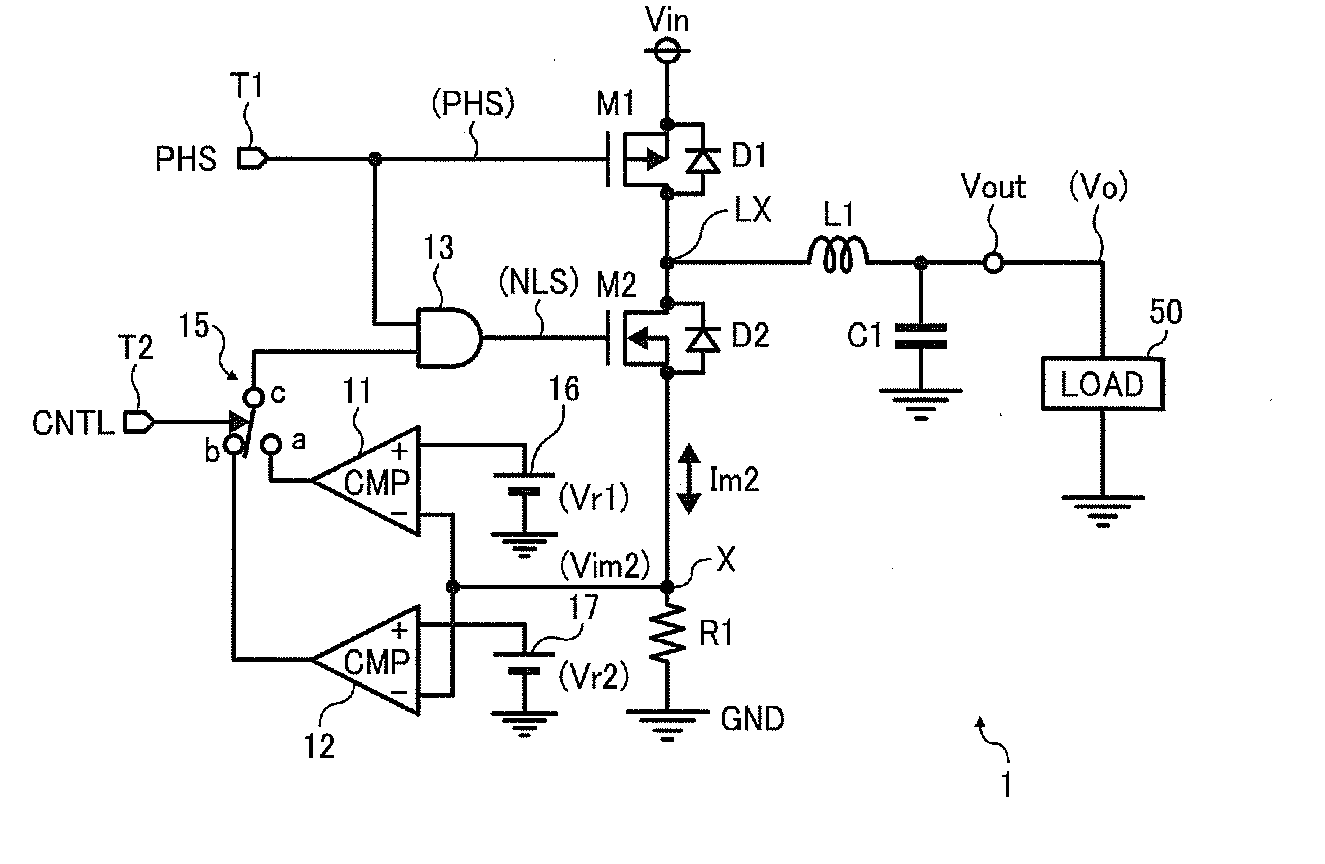
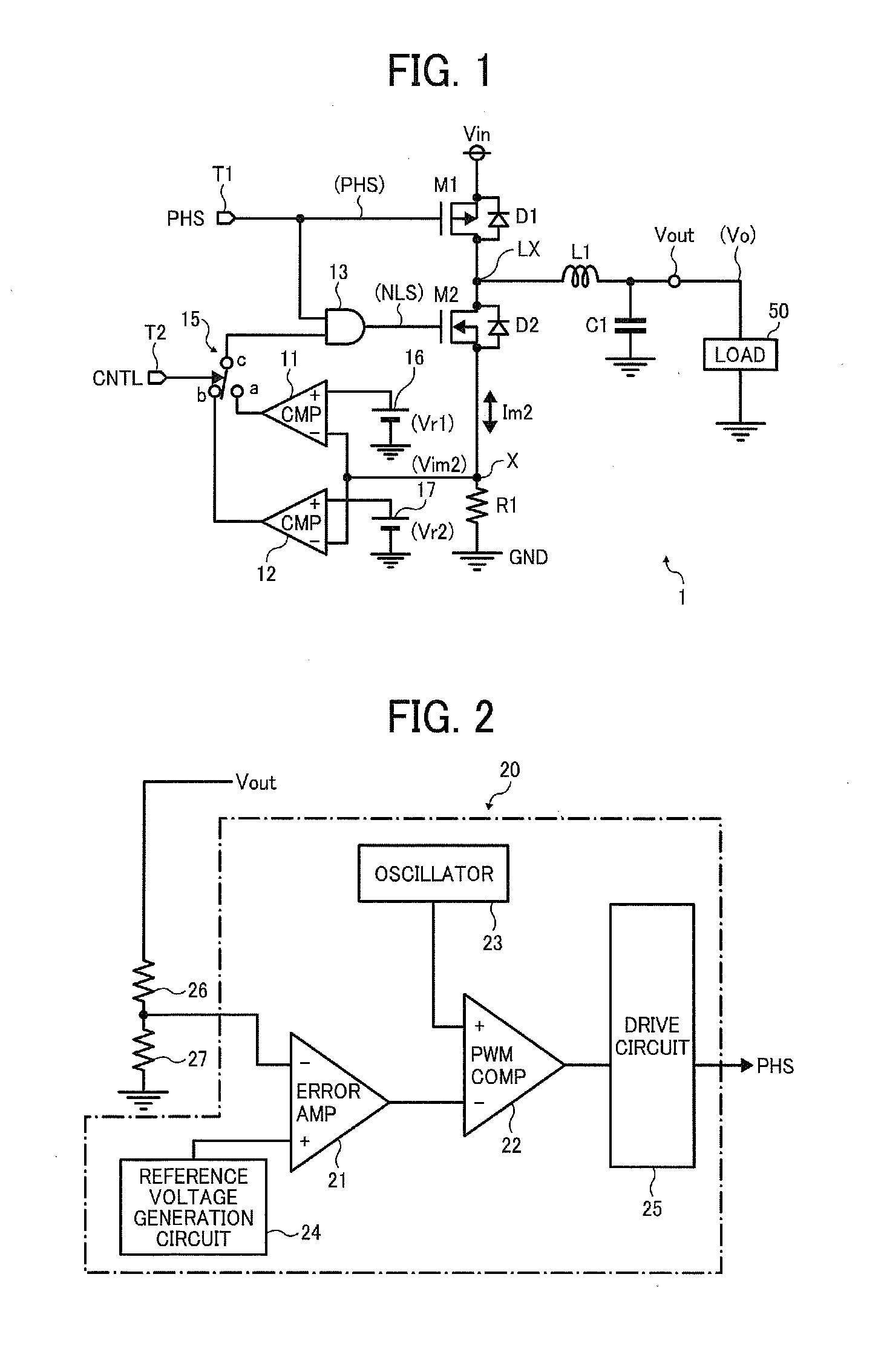
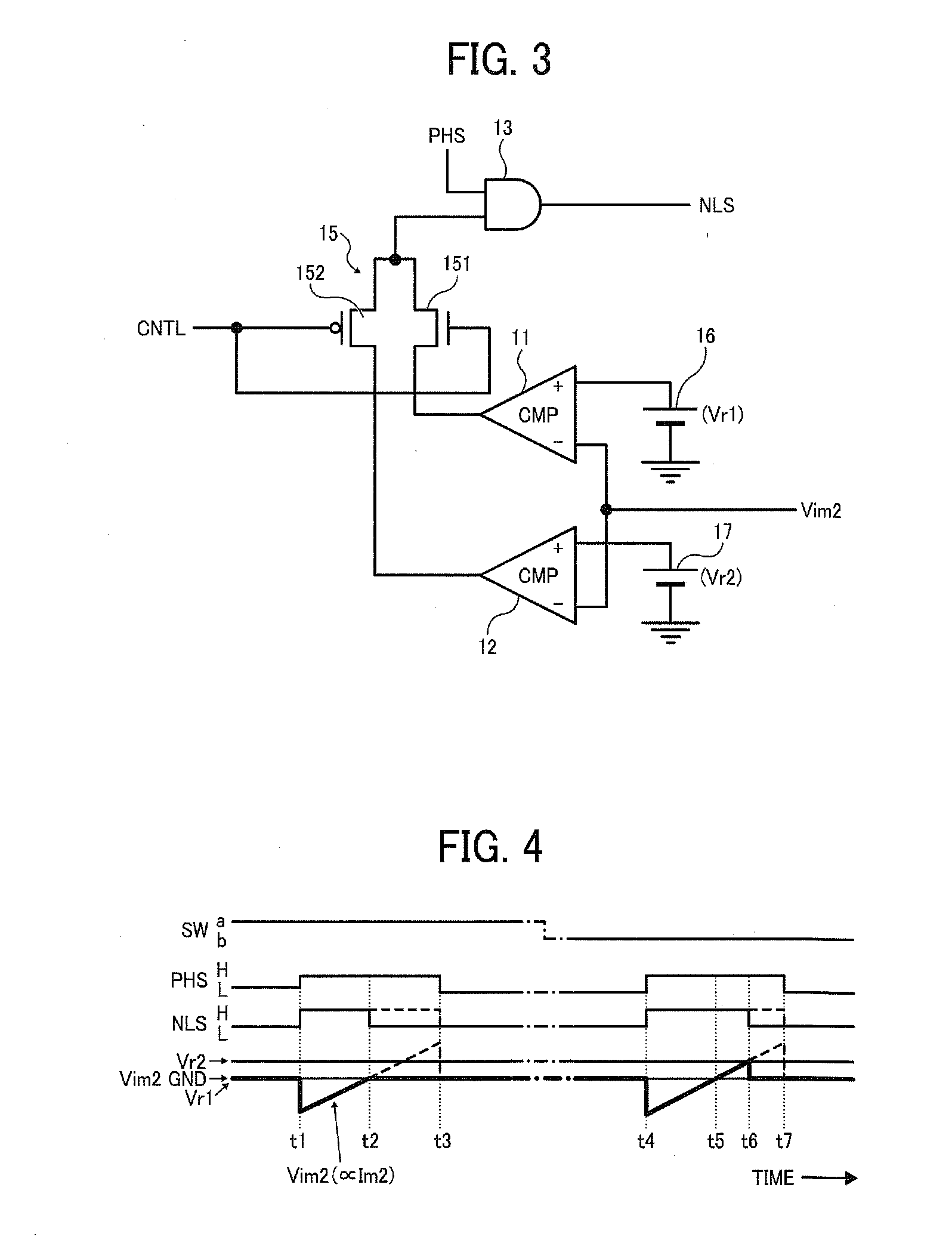
[0038]FIG. 1 illustrates circuitry of an output portion of a DC-DC converter 1 according to the present embodiment. The output portion of the DC-DC converter 1 includes comparators 11 and 12, an AND circuit 13, a switch 15, a first reference voltage source 16, a second reference voltage source 17, a switching transistor M1, a synchronous rectification transistor M2, a resistor R1, an inductor L1, and a capacitor C1. It is to be noted that a diode D1 is a dependent diode parasitic to the switching transistor M1, and a diode D2 is a dependent diode parasitic to the synchronous rectification transistor M2.

[0039]Further, the output portion of the DC-DC converter 1 includes a power input terminal Vin, an output terminal Vout, a ground terminal GND, and internal terminals T1 and T2. An input voltage V1 is applied between the power input terminal Vin and the grand terminal GND, and an output voltage Vo of the DC-DC converter 1 is outputted from the output terminal Vout, and thus, power is ...

second embodiment

[0087]Next, a second embodiment of the present invention is described below. FIG. 5 illustrates circuitry of an output portion of a DC-DC converter 1A according to the second embodiment.

[0088]In contrast to the first embodiment, in the second embodiment the resistor R1 is removed and the source of the synchronous rectification transistor M2 is directly connected to the ground terminal GND, and the inverting terminals of the comparator 11 and the comparator 12 are connected to a junction node LXA.

[0089]Then, in the second embodiment, the comparator 11 serves as the first voltage detector, and the comparator 12 serves as the second voltage detector. The remainder of the configuration is similar to that of the first embodiment, and therefore a description thereof is omitted.

[0090]The operation of the circuit in the present embodiment is described below with reference to FIG. 6, which is a timing chart of the operation in the second embodiment.

[0091]In FIG. 6, reference character VLXA r...

third embodiment

[0106]Next, a third embodiment of the present invention is described below. FIG. 7 illustrates circuitry of an output portion of a DC-DC converter 1B according to the third embodiment.

[0107]The third embodiment differs from the first embodiment in that the configuration shown in FIG. 7 includes one comparator 20 instead of the two comparators 11 and 12, and the switch 15 is disposed between a non-inverting input terminal of the comparator 20 and the first reference voltage Vr1 or the second reference voltage Vr2. An output terminal of the comparator 20 is connected to the second input terminal of the AND circuit 13, and an inverting terminal of the comparator 20 is connected to a junction node between the source of the synchronous rectification transistor M2 and the resistor R1. The comparator 20 serves as both a first reference voltage output device and a second reference voltage output device.

[0108]The circuit when the common contact c is connected to the contact a in the switch 1...

the structure of the environmentally friendly knitted fabric provided by the present invention; figure 2 Flow chart of the yarn wrapping machine for environmentally friendly knitted fabrics and storage devices; image 3 Is the parameter map of the yarn covering machine
Login to View More

PUM

No PUM Login to View More

Abstract

A DC-DC converter includes a switching transistor connected to an inductor and a power input terminal, with the inductor connected to an output terminal, a synchronous rectification transistor connected to a junction node therebetween, a first electric current detector to detect whether or not an electric current flowing through the synchronous rectification transistor is larger than a first electric current, a second electric current detector to detect whether or not the electric current flowing through the synchronous rectification transistor is larger than a second electric current that is larger than the first electric current, and a selection mechanism to select one of the first and second electric current detectors in accordance with a control signal. The synchronous rectification transistor is turned off by outputting an output signal the selected current detector.

Description

CROSS-REFERENCE TO RELATED APPLICATIONS[0001]This patent specification claims priority from Japanese Patent Application No. 2008-211963, filed on Aug. 20, 2008 in the Japan Patent Office, which is hereby incorporated by reference herein in its entirety.BACKGROUND OF THE INVENTION[0002]1. Field of the Invention[0003]The present invention relates to a synchronous rectification DC-DC (direct current to direct current) converter.[0004]2. Discussion of the Background[0005]Contemporary electronic devices are advanced and perform various sophisticated operations. For example, mobile phones frequently play recorded videos as well as still images.[0006]As a result, the performance of a CPU (central processing unit) used in the devices is also enhanced, and the CPU operates at an increased clock speed.[0007]However, when the clock speed is increased, the power consumed by the CPU increases in proportion to the frequency of the clock, which is a problem in a device with a limited power supply ...

Claims

the structure of the environmentally friendly knitted fabric provided by the present invention; figure 2 Flow chart of the yarn wrapping machine for environmentally friendly knitted fabrics and storage devices; image 3 Is the parameter map of the yarn covering machine
Login to View More

Application Information

Patent Timeline
no application Login to View More
IPC IPC(8): H02M3/335
CPCY02B70/1466H02M3/1588Y02B70/10
Inventor NODA, IPPEI
Owner NISSHINBO MICRO DEVICES INC
Features
  • R&D
  • Intellectual Property
  • Life Sciences
  • Materials
  • Tech Scout
Why Patsnap Eureka
  • Unparalleled Data Quality
  • Higher Quality Content
  • 60% Fewer Hallucinations
Social media
Patsnap Eureka Blog
Learn More