
Apparatus and method for two eye imaging for iris identification
a technology of iris identification and apparatus, applied in the field of apparatus (or devices) and method for imaging two eyes of a subject, can solve the problems of limited extraction of information from the iris and retina of a single, extra processing, and the inability to easily enable the determination of the degree of iris rotation or substantially remove the iris rotation problem
- Summary
- Abstract
- Description
- Claims
- Application Information
AI Technical Summary
Benefits of technology
Problems solved by technology
Method used
Image

Examples
Embodiment Construction
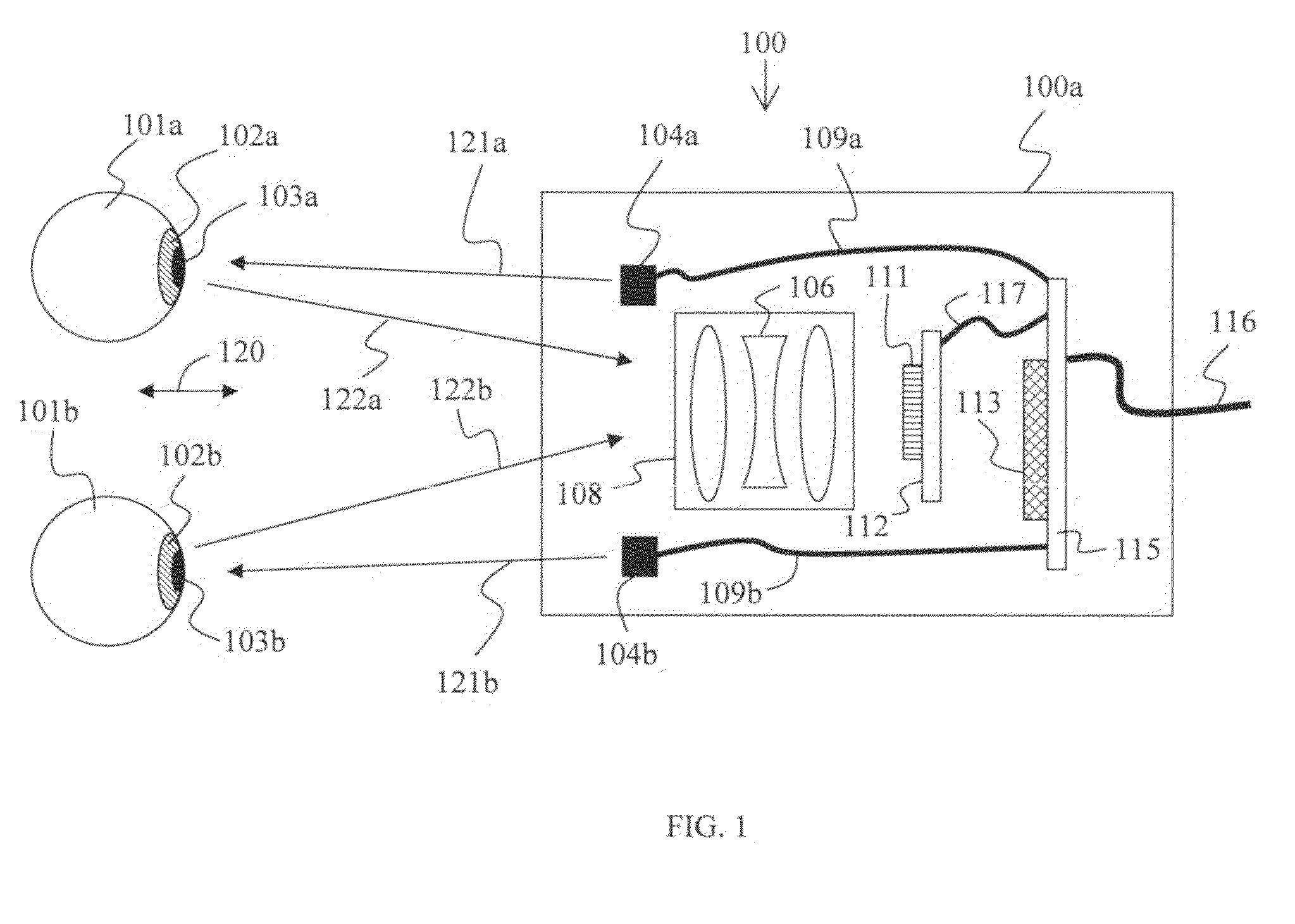
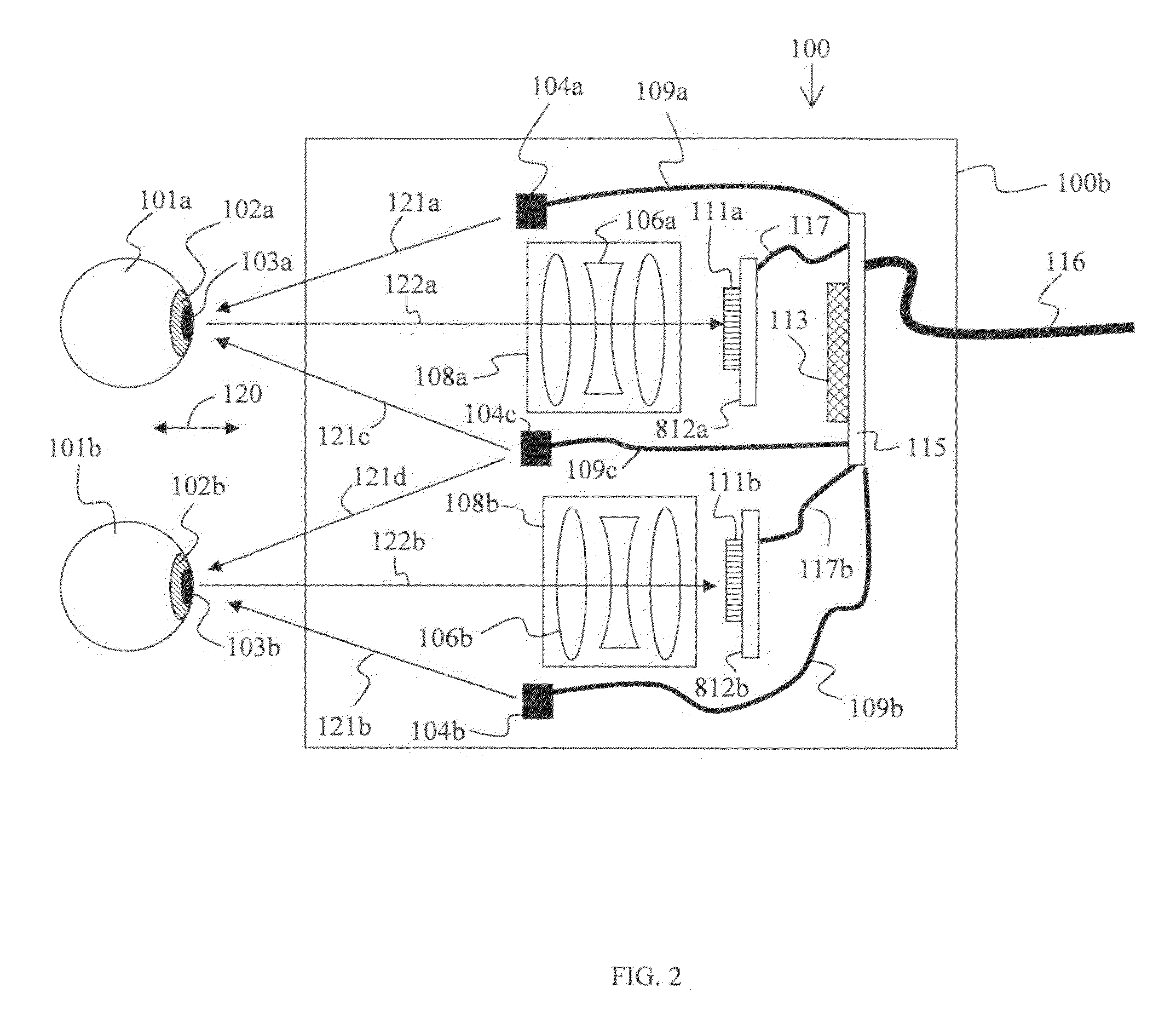
[0050]Referring to FIGS. 1 and 2, an iris capture device (or apparatus) 100 is shown having in one embodiment a housing 100a with a sensor array 111 (FIG. 1) for capturing both eyes 101a and 101b of a subject person in a single image, and in another embodiment a housing 100b having two sensor arrays 111a and 111b (FIG. 2) each for capturing a different eye 101a and 101b, respectively, of a subject person.
[0051]In FIG. 1, the housing 100a further has an optical system 108 composed of one or more optical elements or lenses 106 which focuses and relays light representing a two-dimensional (2-D) image of the two irises 102a and 102b onto sensor 111. Sensor 111 may comprise a 2-D array of sensor elements, such as a complementary metal-oxide semiconductor (CMOS) or a charge-coupled device (CCD), or a one-dimensional (1-D) sensor array mechanically scanned to generate a 2-D image. The focus adjustment may be set by the operator or subject by physically moving the device 100 bi-directionall...
PUM
 Login to View More
 Abstract
Description
Claims
Application Information
 Login to View More