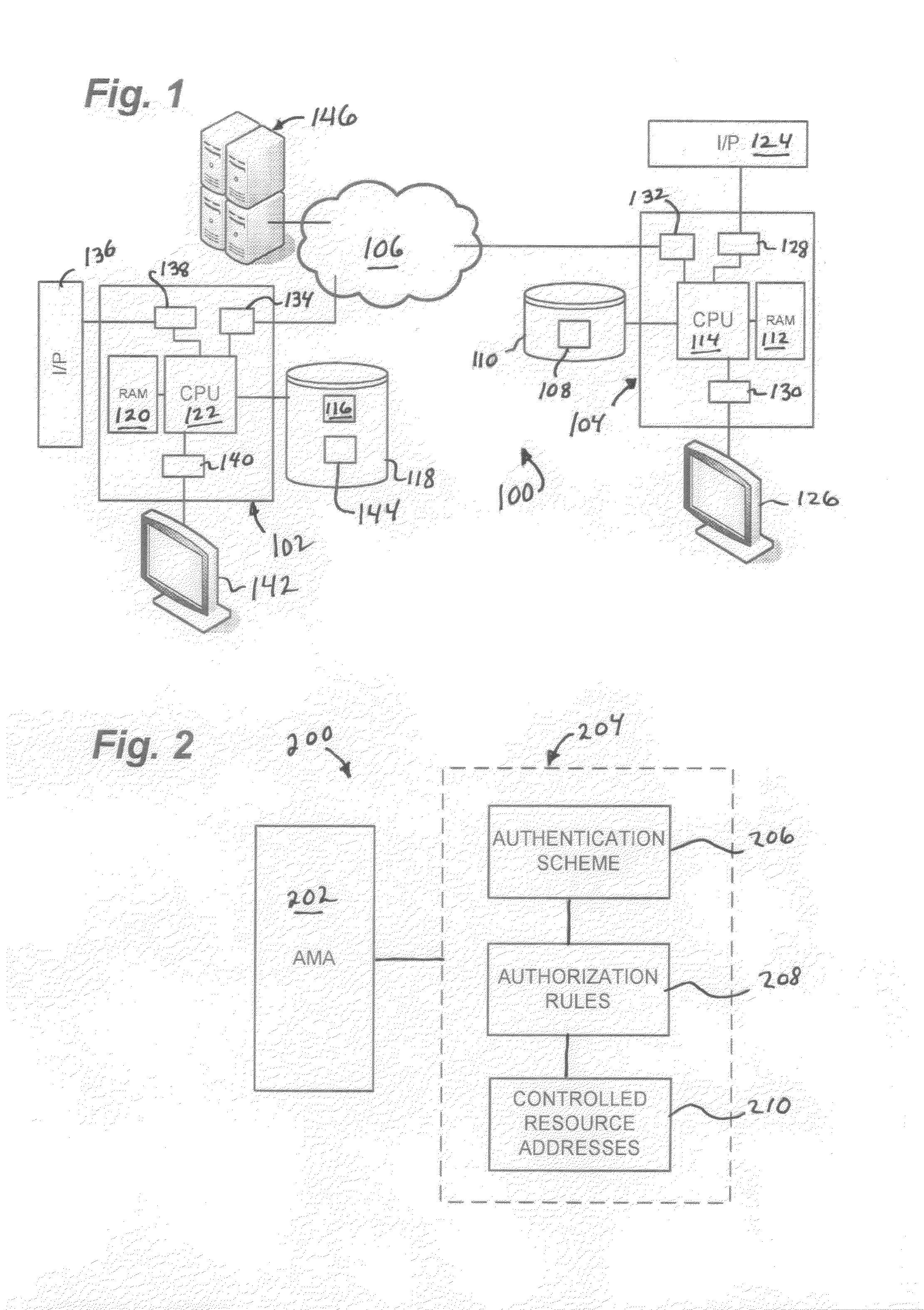
[0010]The network resource addresses may comprise Uniform Resource Locators (URL's) or other computer network addresses for locating any network resource to which the authorization rules apply. The AMA may be configured to recognize and apply the authorization rules to any request for a resource that uses the network resource address or addresses designated by the access policy domain. In some embodiments, the access policy domain may specify that all resources available to clients through the access control server are designated controlled resources, except for authorization resources such as login pages and hardware “fingerprint” comparison functions. In more secure environments, access to login resources may be permitted only to recognized client devices. In other embodiments, the access policy domain may specify a relatively small subset of network resources that are accessible through the access control server as the controlled network resources.
[0011]In any case, the network resources specified in the access policy domain should be exclusively available through the access control server, for example, by being stored in or served from nodes over which the access control server has exclusive control. Therefore, a client should be unable to access a controlled network resource except through the access control server. The access control server should therefore receive all requests for those resources that are capable of being fulfilled. The AMA should, in turn, apply the access control policy to determine which requests received by the access control server will be fulfilled, and which will be denied.
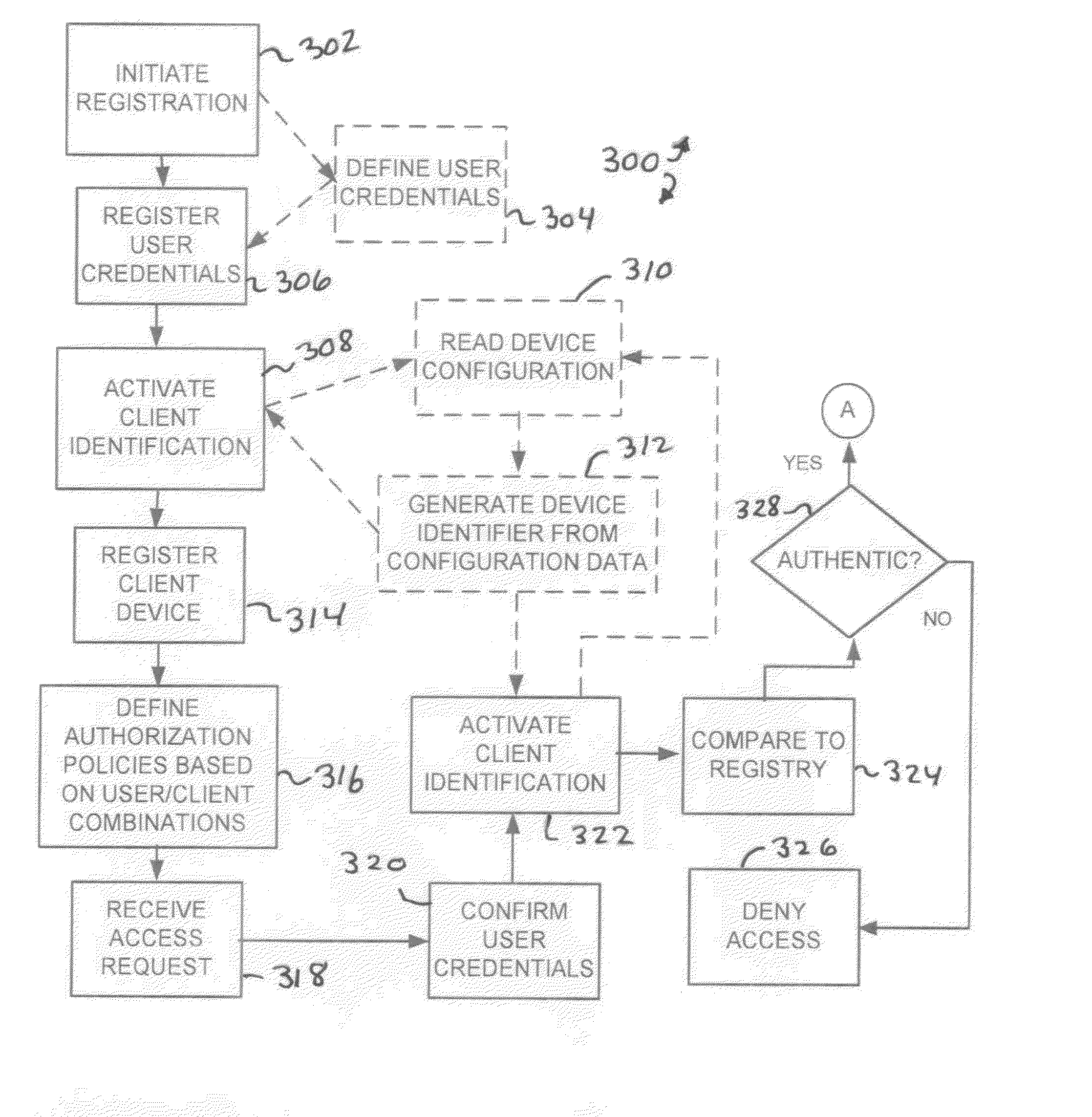
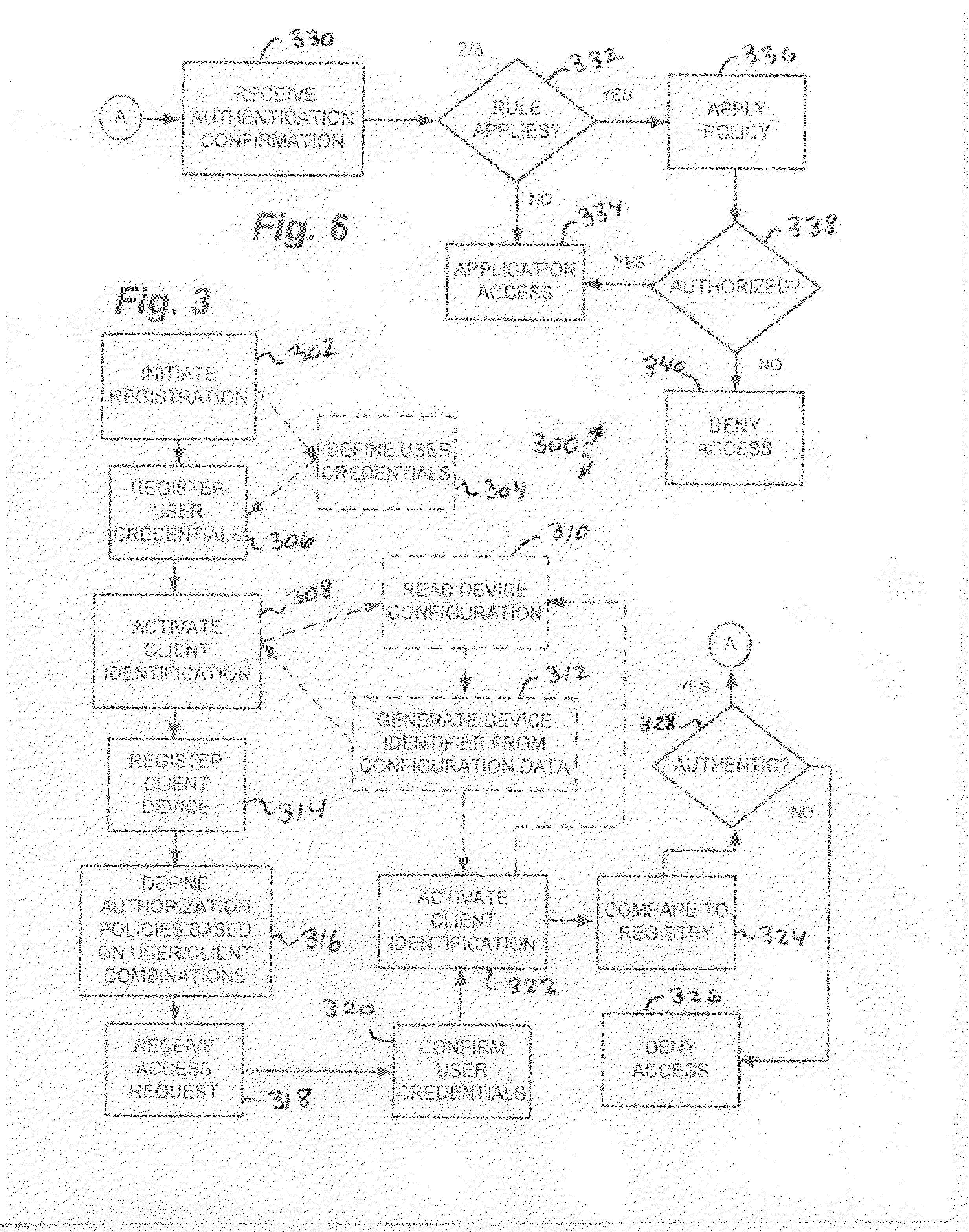
[0012]Registration of client machines is an important aspect of the present technology. The access control server maintains or has secure access to a registry of client identifiers. The client identifiers represent client hardware “fingerprints” gathered for each client entered in the client registry. A hardware fingerprint is characterized by being reliably reproducible by an application operating on a particular client machine, while being virtually irreproducible by any other means, and virtually impossible to guess using any systematic or brute force algorithm. In short, each fingerprint is a complex and unique data pattern generated from a stable system configuration of a particular client machine. Methods for generating a machine fingerprint are discussed in the detailed description below.
[0013]Registration of a client machine may be accomplished by generating a machine fingerprint on the machine as part of a secure session initiated through the AMA. For example, an authorized service technician may initiate a secure session using a client to be registered, with the resulting fingerprint stored in the client registry used by the access control server. The fingerprint need not be stored at the client device, and for greater system security, should not be stored anywhere except in the secure data registry and its secure data back-ups.
[0014]During an authentication session with the access control server, the AMA may generate a machine fingerprint by activating a fingerprint-generating application on the client machine. The fingerprint generating application may cooperate with the AMA to generate the fingerprint using a process that minors the fingerprint generating process used during registration of the client machine. Therefore, provided the client system configuration is unchanged, the resulting fingerprint will match the data in the client registry used by the AMA, positively identifying the client as a registered machine. The AMA may then apply the authorization rules to the specific access request or requests following successful authentication, in the manner described herein.
[0015]A more complete understanding of the system and method for network access control will be afforded to those skilled in the art, as well as a realization of additional advantages and objects thereof, by a consideration of the following detailed description. Reference will be made to the appended sheets of drawings which will first be described briefly.


 Login to View More
  Login to View More