Radiotherapeutic apparatus

US20100329422A1Active Publication Date: 2010-12-30ELEKTA AB
9 Cites 14 Cited by

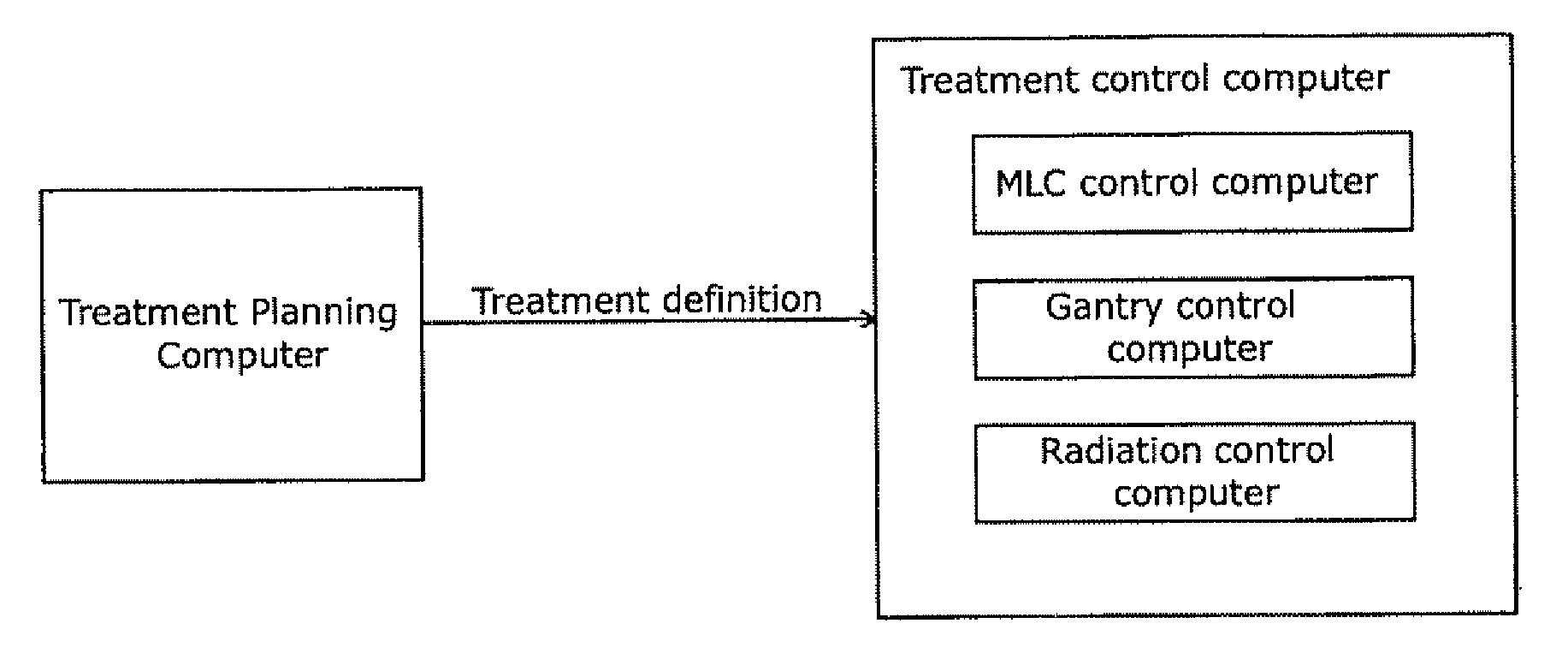
Patent Information

Authority / Receiving Office
US · United States
Current Assignee / Owner
Publication Date
2010-12-30

Smart Images

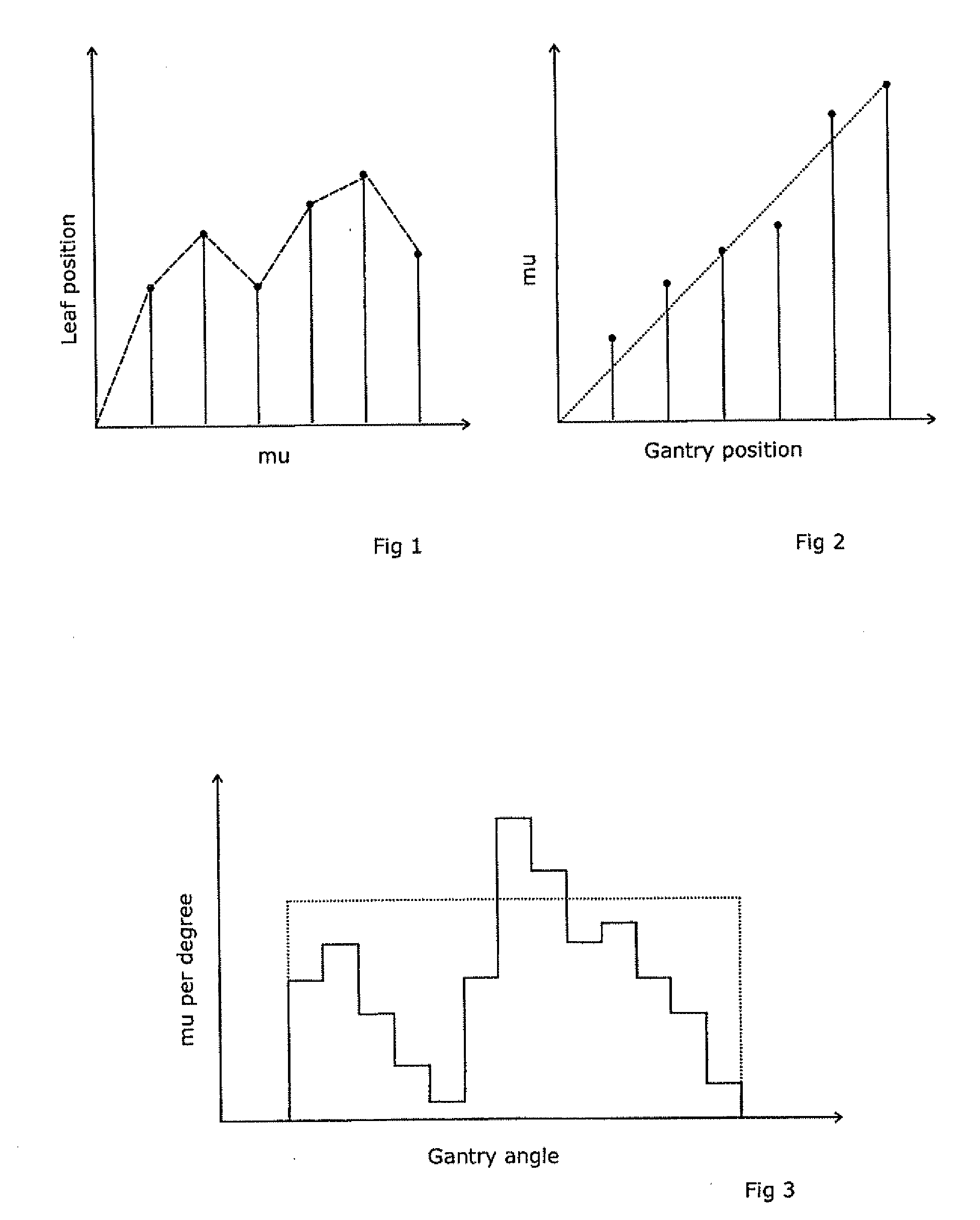
  • Figure 1
    Figure 1
  • Figure 2
    Figure 2
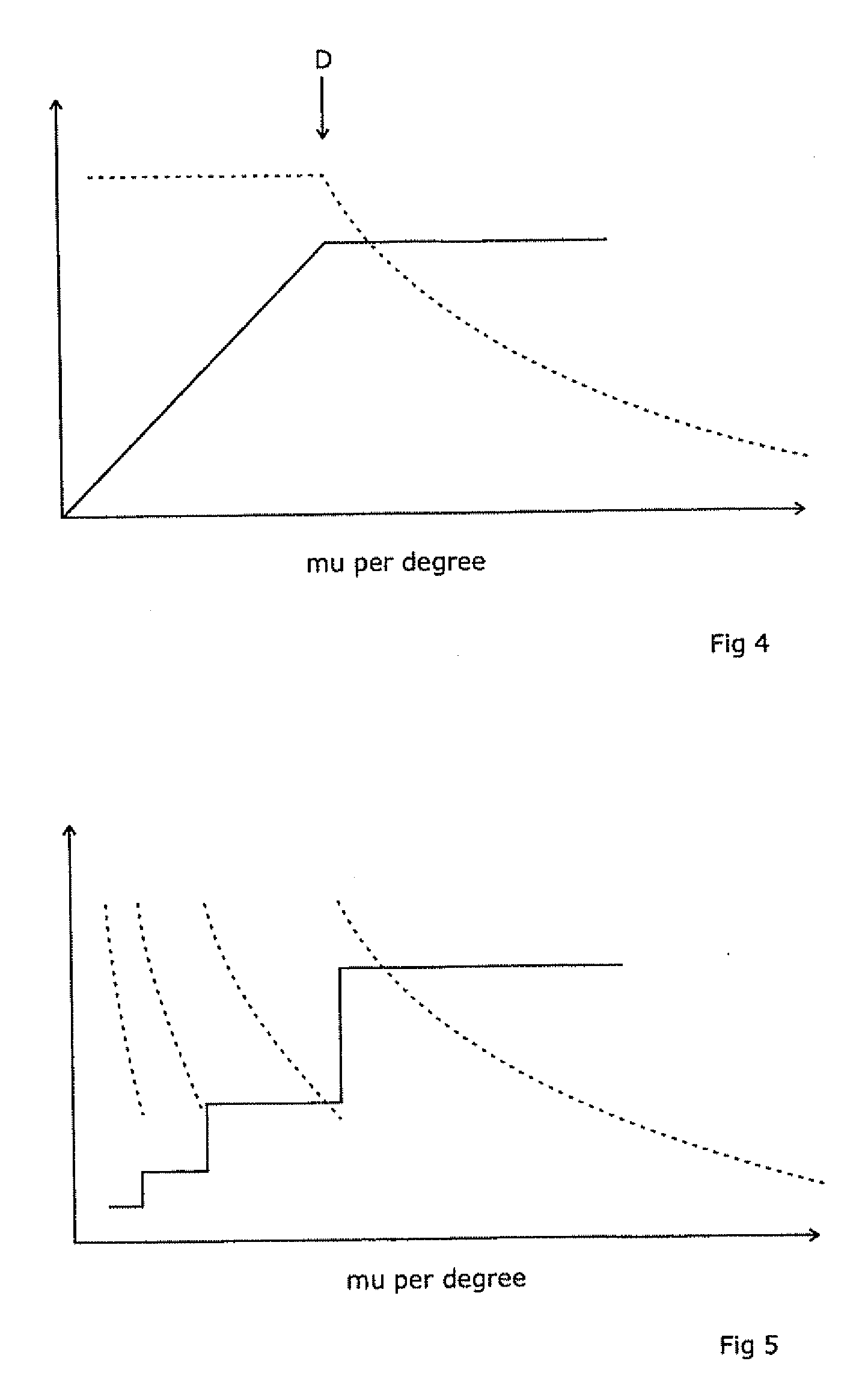
  • Figure 3
    Figure 3
Patent Text Reader

Abstract

A radiotherapeutic apparatus comprises a source able to emit a beam of therapeutic radiation along a beam axis, a multi-leaf collimator arranged to collimate the beam to a desired shape, wherein the source is rotateable about a rotation axis that is substantially orthogonal and intersects with the beam axis thereby to describe an arc around that axis, and further comprises a control means able to control the dose / time rate of the source, the rotation speed of the source, and the multi-leaf collimator position. The control means is arranged to receive a treatment plan in which the arc is divided into a plurality of notional arc-segments, and specifying the total dose for the arc-segment and a Start and end MLC position. It then controls the source in accordance with that plan over an first arc-segment such that at least one of the rotation speed and dose rate are constant and the multi-leaf collimator changes shape, and a second arc segment such that at least one of the rotation speed and dose rate are constant at a level different to the constant level adopted during the first arc-segment. It achieves this by calculating the total time required for the arc segment for a plurality of factors including an MLC leaf movement from a prescribed position at the start of the arc-segment to a prescribed position at the end of the arc-segment, at a maximum leaf speed, rotation of the source from the start to the end of the arc-segment at a maximum source rotation speed, delivery of the dose at a maximum dose rate per time, selecting the factor dictating the longest time, and Controlling the apparatus so that the selected factor operates at its respective maximum and the remaining factors are operated at a reduced rate selected to match that longest time, wherein the total time required for the arc segment for at least one factor relating to a moving geometry item is the greater of (a); a time required to complete the segment at a continuous defined upper speed for the geometry item and (b) a time required to accelerate the geometry item until it is travelling at the defined upper speed. Generally, the time required to accelerate the geometry item to the defined upper speed will include a time to accelerate the geometry item to that speed, and a further time to accelerate the geometry item beyond that speed and subsequently decelerate it until travelling at that speed.
Need to check novelty before this filing date? Find Prior Art

Description

[0001] This Application is a Section 371 National Stage Application of International Application No. PCT / EP2007 / 009227, filed Oct. 24, 2007 and published as WO 2009 / 052845 A1 on Apr. 30, 2009, the content of which is hereby incorporated by reference in its entirety.FIELD OF THE INVENTION

[0002] The present invention relates to radiotherapeutic apparatus.BACKGROUND ART

[0003] A radiotherapeutic apparatus is typically controlled by a Treatment Control Computer. When equipped with a Multi-Leaf Collimator (“MLC”) the Treatment Control Computer can be considered to contain a Radiation Control Computer which controls the radiation generation, an MLC Control computer which controls the shape of the MLC and a Gantry Control Computer which controls the position of the Gantry. These computers may physically be one or more computers but in this text are considered as distinct functional elements of the system. “Mu” is an abbreviation for “monitor units”, which is the term used for units of radiatio...

Examples

Embodiment Construction

[0049]A desired treatment is described by a Treatment Planning computer in terms of a sequence of “control points”. Each “control point” defines a position of the gantry, the dose that is to be delivered between this and the next (or previous) control point, and the shape of the MLC at that control point. Each consecutive pair of control points defines (between them) an arc-segment.

[0050]Control points could (in theory) be spaced strategically around the complete arc. However, the availability of relatively cheap processing power means that there is little benefit in going to the effort of doing so, and control points are therefore typically spaced regularly around the arc such as every degree, every few degrees, or every fraction of a degree.

Basic Methodology

[0051]This treatment is put into effect by, between the nth and the (n+1)th control point, moving the gantry from the position of the nth control point to the position of the (n+1)th control point at a rotation speed and a dose...