Apparatus and method for detecting triacetone triperoxide
- Summary
- Abstract
- Description
- Claims
- Application Information
AI Technical Summary
Benefits of technology
Problems solved by technology
Method used
Image

Examples
example 1
Affinity Examination of Analytes
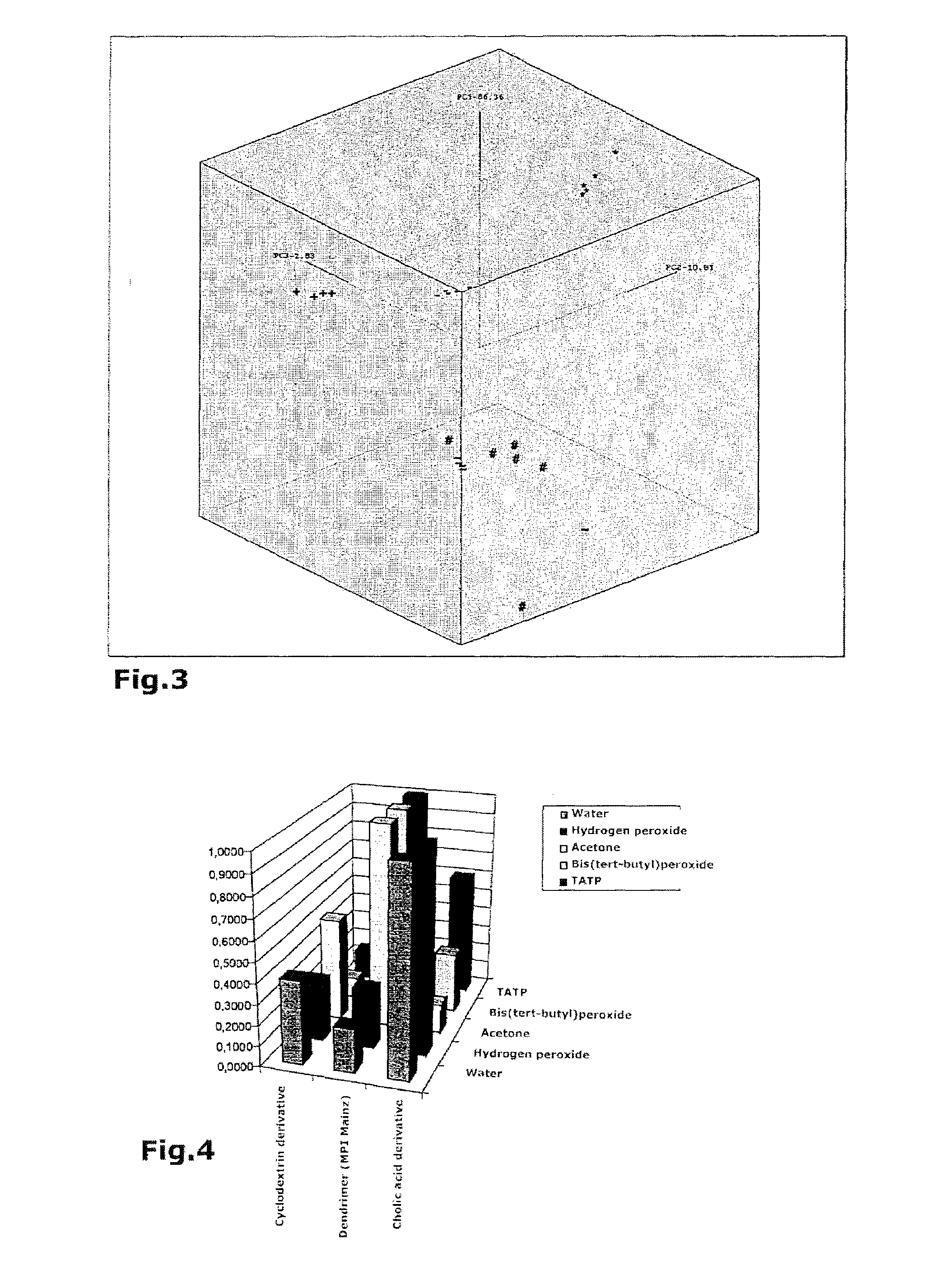
[0063]The affinity of different coatings for TATP was examined. Thus, in addition to triacetone triperoxide (TATP), water, hydrogen peroxide solution (30%) and acetone were considered as potential cross sensitivities, and in addition, bis(tert-butyl)peroxide was considered due to its structural similarity with TATP. For these five analytes, serial concentrations were measured at a sensor temperature of 35° C., and the isotherm was respectively determined.
[0064]The concentration range in which the analytes were measured is mainly defined by their vapor pressures at 20° C. A survey of the analytes employed, their vapor pressure and the measured concentration ranges is shown in Table 1.
TABLE 1Survey of the examined analytesVapor pressureConcentration rangeAnalyte[ppm (v / v)][ppm (v / v)]Water 23,000 (at 20° C.)*1150-6900H2O2 (30%) 14,500 (at 20° C.)** 725-4350Acetone245,310 (at 20° C.)***12,265-73,593Bis(tert-butyl)peroxide 53,329 (at 20° C.)*** 2666-15,99...
example 2
Detection in an Open System
[0065]An open system was designed for measurements in an open system with a distance between the analyte source and the sensor array. Thus, a fan is installed in a duct or an air lock opposite the sensor, and an air stream directed against the sensor is generated (about 2 m / s). This air stream conveys analytes to the sensor very quickly and with a relatively low dilution rate over a distance of about 1 m. In the following, the model analyte phenol is shown, which has a vapor pressure comparable to that of TATP. Almost independently of the distance, the examinations show a signal build-up within 2-4 seconds (FIG. 10).
example 3
Temporal Resolution / Identification of TATP
[0066]The sensor array described in this patent exhibits very fast response times for the reliable identification of a signal. Three seconds after the addition (s), a first response (t) by the sensors can already be seen. This three seconds is the apparatus-related dead time of the system. At the time (u) (5 s later), the signals are already sufficiently distinctive for a reliable identification. This time is way before the equilibrium of the incorporation (v). The results are summarized in FIG. 11.
PUM
 Login to View More
 Abstract
Description
Claims
Application Information
 Login to View More
PatSnap Eureka turns technology decisions into work you can execute. Powered by our Innovation Knowledge Graph, it runs expert workflows across engineering, life sciences, materials and intellectual property. Get your review-ready output in minutes.


