Unlock instant, AI-driven research and patent intelligence for your innovation.

Networking system call data division for zero copy operations

Inactive Publication Date: 2011-11-03
MAGNOLIA LICENSING LLC
View PDF3 Cites 5 Cited by
  • Summary
  • Abstract
  • Description
  • Claims
  • Application Information

AI Technical Summary

Benefits of technology

[0010]A method for sending data over a network that efficiently passes the data to be sent from the user space of an operating system to the kernel space and reduces the overhead caused by system calls while passing the data, while handling data in an operating system and sending the data over a network with increased network throughput.
[0011]According to an exemplary embodiment, a host computer sending data over a network is operated by an operating system that comprises at least a user space and a kernel space. The operating system uses system calls for providing the data to be sent over the network from the user space to the kernel space. The amount of data provided to the kernel space within one system call is allowed to exceed the size of an IP packet. This provides the advantage compared to the solution known in the art that more data than the size of one IP packet may be passed within one system call. Increasing the amount of data which may be passed within one system call from the user space to the kernel space of an operating system reduces the total number of system calls needed for passing a defined amount of data, and hence, for sending the data over the network. As each system call occupies the CPU for a certain number of CPU cycles, reducing the number of system calls also reduces the CPU payload.
[0012]The network interface sends the data in MTU-sized packets over the bus. By way of example, the operating system arranges with a routine running in user space, data to be sent into units of the size of the maximum transmission unit of the network or a fraction thereof. This pre-processing is done in user space for efficiently transferring the data into kernel space. In other words, in one embodiment, a large buffer in user space will be divided into MTU-sized blocks. This allows arrangement and fragmentation of the data into MTU-sized packets to not be done by the kernel anymore. This further reduces the CPU payload.

Problems solved by technology

Every operation needed for preparing data to be transferred over the network hardware requires the intervention of the central processing unit (CPU) and therefore, blocks the CPU for a certain time.
Thus, the network hardware causes a significant CPU payload.
A limitation of this solution is that the data fragments passed within one IO-vector to the kernel space must not exceed the size of one packet that can be sent over the network.
Therefore, the amount of data passed to the kernel networking stack in case of UDP / IP within one system call is limited to 64 kB.
This copy process is very CPU intensive.
By way example, in the case a 10 Gbit networking system, the copying process using the ‘sendmsg’ system call is too slow and causes unsatisfactory performance.
This leads to serious payload and performance degradation of a computer in the case where a 10 Gbit networking hardware is operated.
However, the usage of the ‘sendfile’ system call is restricted to data already stored within the kernel space or accessible via a file structure.
However, a zero copy process for user defined transport protocols or unreliable transports (over UDP / IP) is necessary.
This further reduces the CPU payload.
Quite often applications can't respect a single block size when writing data into memory.
For example, a flag provided by the system call but currently not in use is suitable for this purpose.

Method used

the structure of the environmentally friendly knitted fabric provided by the present invention; figure 2 Flow chart of the yarn wrapping machine for environmentally friendly knitted fabrics and storage devices; image 3 Is the parameter map of the yarn covering machine
View more

Image

Smart Image Click on the blue labels to locate them in the text.
Viewing Examples
Smart Image
  • Networking system call data division for zero copy operations
  • Networking system call data division for zero copy operations
  • Networking system call data division for zero copy operations

Examples

Experimental program
Comparison scheme
Effect test

Embodiment Construction

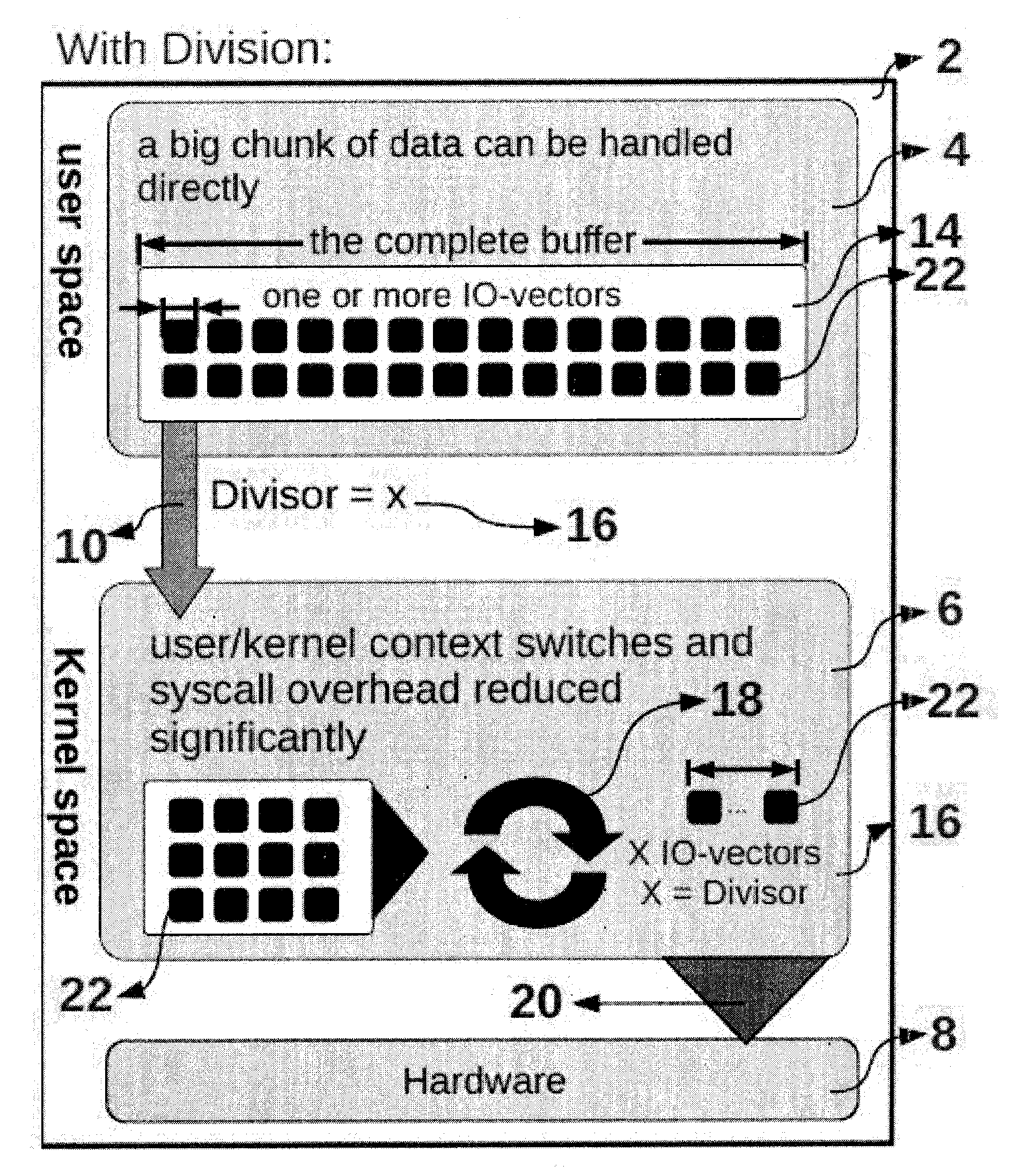
[0027]FIG. 2 shows an operating system 2 modified according to the invention. A system call 10 is used to copy data from the user space 4 to the kernel space 6. In order to send multiple user-space buffers 22, the system call ‘sendmsg’ is enhanced. The buffers 22 are spread across the memory 14 region of the application. These buffers 22 must be referenced by a message header struct (msghdr struct) which is passed to the mentioned system call 10 according to an exemplary embodiment. For example, the message header struct comprises the following e.g. elements:

 struct msghdr{void *msg_name; / *Address to send to / receive from* / socklen_t msg_namelen; / *Length of address data* / struct iovec *msg_iov; / *Vector of data to send / receive into* / size_t msg_iovlen; / *Number of elements in the vector* / void *msg_control;  / *Ancillary data (eg BSD filedesc passing)* / size_t msg_controllen; / *Ancillary data buffer length* / int msg_flags; / *Flags on received message* / };

[0028]According to the invention, the stru...

the structure of the environmentally friendly knitted fabric provided by the present invention; figure 2 Flow chart of the yarn wrapping machine for environmentally friendly knitted fabrics and storage devices; image 3 Is the parameter map of the yarn covering machine
Login to View More

PUM

No PUM Login to View More

Abstract

A method for sending data over a network from a host computer. The host computer includes an operating system comprising at least a user space and a kernel space. The amount of data provided from the user space to the kernel space within one system call exceeds the size of an IP packet. A loop function in an application in the user space sends multiple packets to the kernel space within a single system call containing IO vectors which contain pointers to the data in the user space. A last data unit being processed may be designated using a flag included in the message header. In the kernel space a second loop function is used to reassemble the vector groups and pass them down the network stack. The data may then be passed to the network hardware using a direct memory access transfer directly from the user space to the network hardware.

Description

FIELD OF THE INVENTION[0001]The present invention relates generally to network data communications.CROSS REFERENCE TO RELATED APPLICATIONS[0002]This applications claims priority of co-pending European patent application Serial No. 10305439.1 filed Apr. 27, 2010 pursuant to 35 U.S.C. §119(a)-(d).BACKGROUND OF THE INVENTION[0003]In order to transfer a packet over a network, the packet data is passed from a user space of an operating system to a kernel space of the operating system. The data is handled and generated by a user or a computer application in the user space of the operating system. Network stacks usually reside within the kernel space of the operating system. A connection over a network is established and managed by the network hardware running the network stacks. A kernel routine runs in the network stack, each time data is passed downstream from the user space to the kernel space of the operating system. To process data in order to prepare it for sending over a network, a...

Claims

the structure of the environmentally friendly knitted fabric provided by the present invention; figure 2 Flow chart of the yarn wrapping machine for environmentally friendly knitted fabrics and storage devices; image 3 Is the parameter map of the yarn covering machine
Login to View More

Application Information

Patent Timeline
no application Login to View More
IPC IPC(8): G06F15/16G06F15/167
CPCG06F9/544H04L69/16G06F9/545
Inventor KEILHAU, TIMOSIEMENS, EDUARD
Owner MAGNOLIA LICENSING LLC
Features
  • R&D
  • Intellectual Property
  • Life Sciences
  • Materials
  • Tech Scout
Why Patsnap Eureka
  • Unparalleled Data Quality
  • Higher Quality Content
  • 60% Fewer Hallucinations
Social media
Patsnap Eureka Blog
Learn More