
Suppression of a hypersensitivity immune response with unrelated antigen derived from allergen source material
a technology of immune response and allergy source material, applied in the field of immunotherapy, to achieve the effect of reducing airway hyperresponsiveness, triggering the immune response, and reducing the number of sneezes
- Summary
- Abstract
- Description
- Claims
- Application Information
AI Technical Summary
Benefits of technology
Problems solved by technology
Method used
Image

Examples
example 1
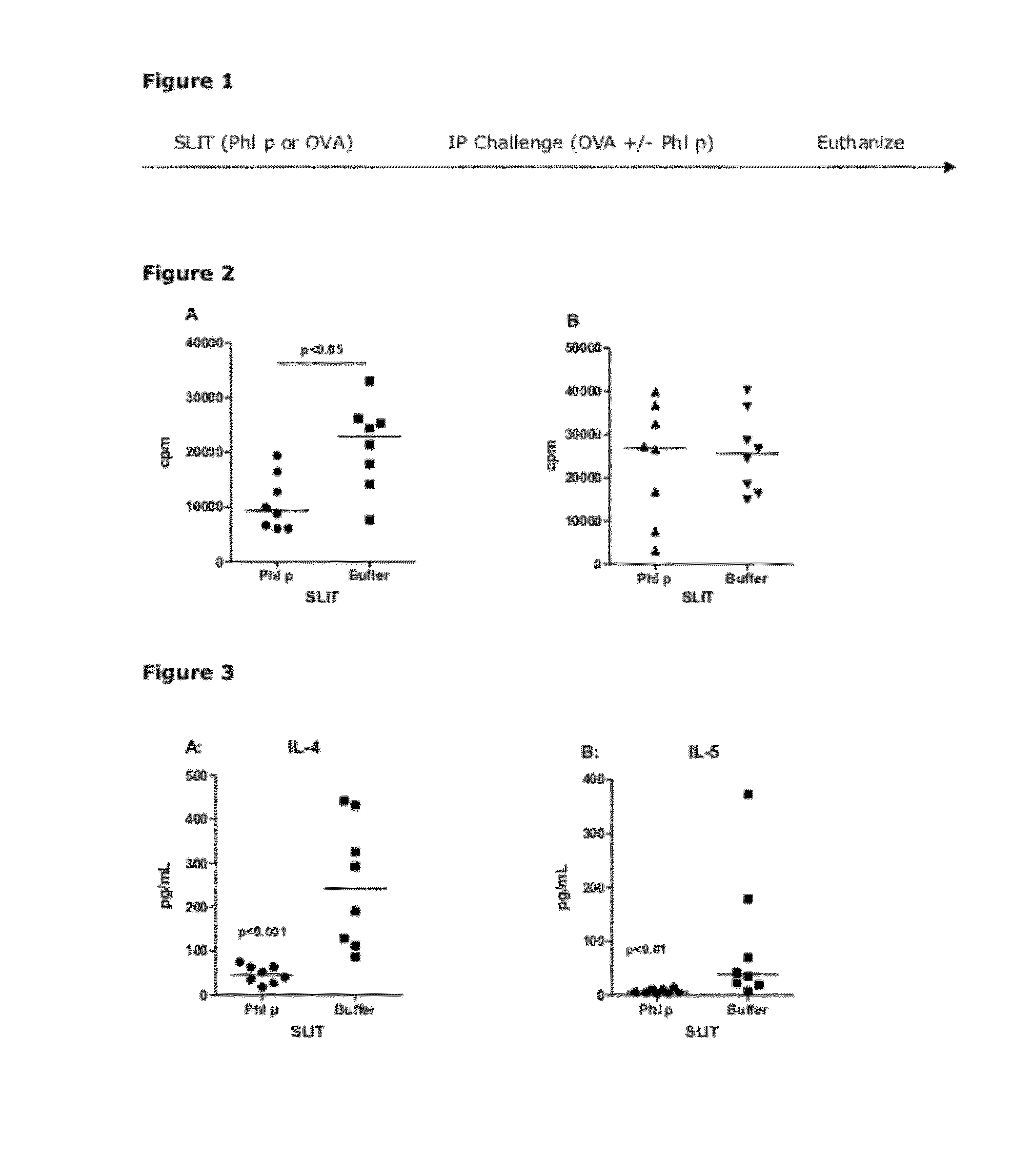
Prophylactic Treatment of Naïve Mice with an Unrelated Antigen
Methods:
[0236]An extract of grass pollen of the species phleum pratense (Phl p) is obtained by extracting defatted grass pollen with an aqueous saline solution.
Animals
[0237]Female, 6-10 week-old BALB / cJ mice were bred in-house and maintained on a defined diet not containing component cross reacting with antisera to Phl p. Each experimental group consisted of 8 animals.
Animal Experiments
[0238]Naïve mice received sublingual immunotherapy (SLIT) with 40 μg Phl p extract or buffer for two weeks before being immunized to raise an immune response against another antigen. SLIT was performed by holding the scruff of the mice and carefully applying 5 μl of allergen solution under the tongue. The mice were held by the scruff for additional 20 seconds to prevent the animal from swallowing the allergen solution. The mice were then challenged by intraperitoneal injection of either 8 μg Phl p extract mixed with 250 μg chicken ovalbumin...
example 2
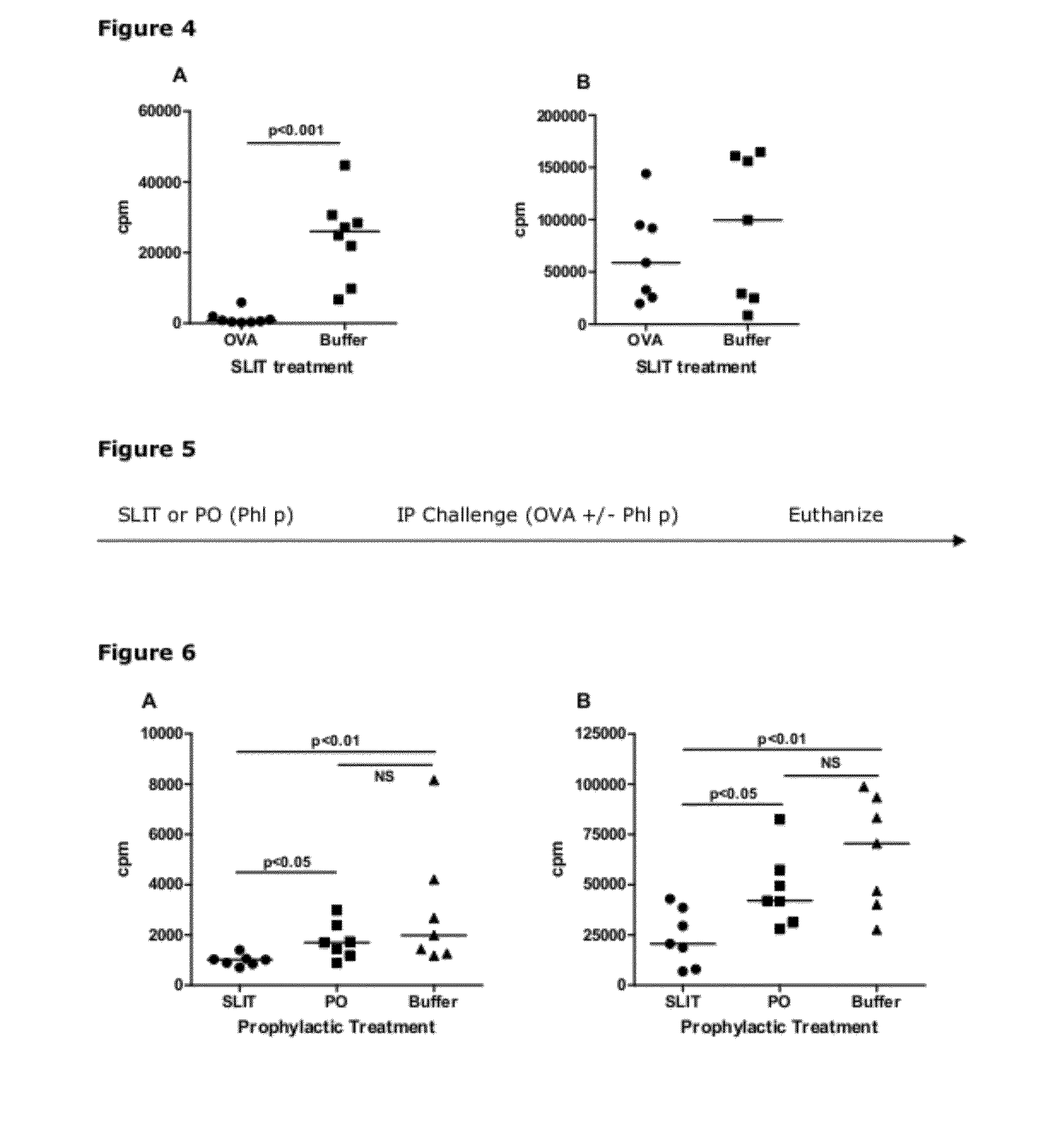
Comparison of the Sublingual Route Versus the Per-Oral Route of Administering an Unrelated Antigen
Methods:
[0245]Phl p, an extract of grass pollen of the species phleum pratense is obtained by extracting defatted grass pollen with an aqueous saline solution.
Animals
[0246]Female, 6-10 week-old BALB / cJ mice were bred in-house and maintained on a defined diet not containing component cross reacting with antisera to Phl p. Each experimental group consisted of 8 animals.
Animal Experiments
[0247]Naïve mice were treated daily with 40 μg Phl p extract either by the sublingual or the peroral (intragastric gavache) route for two weeks. The mice were then immunized to raise an immune response against another antigen by intraperitoneal injection. This injection consisted of 8 μg Phl p extract mixed with 250 μg ovalbumin (OVA) adsorbed to aluminium hydroxide. Ten to twelve days later the mice were euthanized, spleens were removed and cells were set up in an in vitro re-stimulation assay. In this as...
example 3
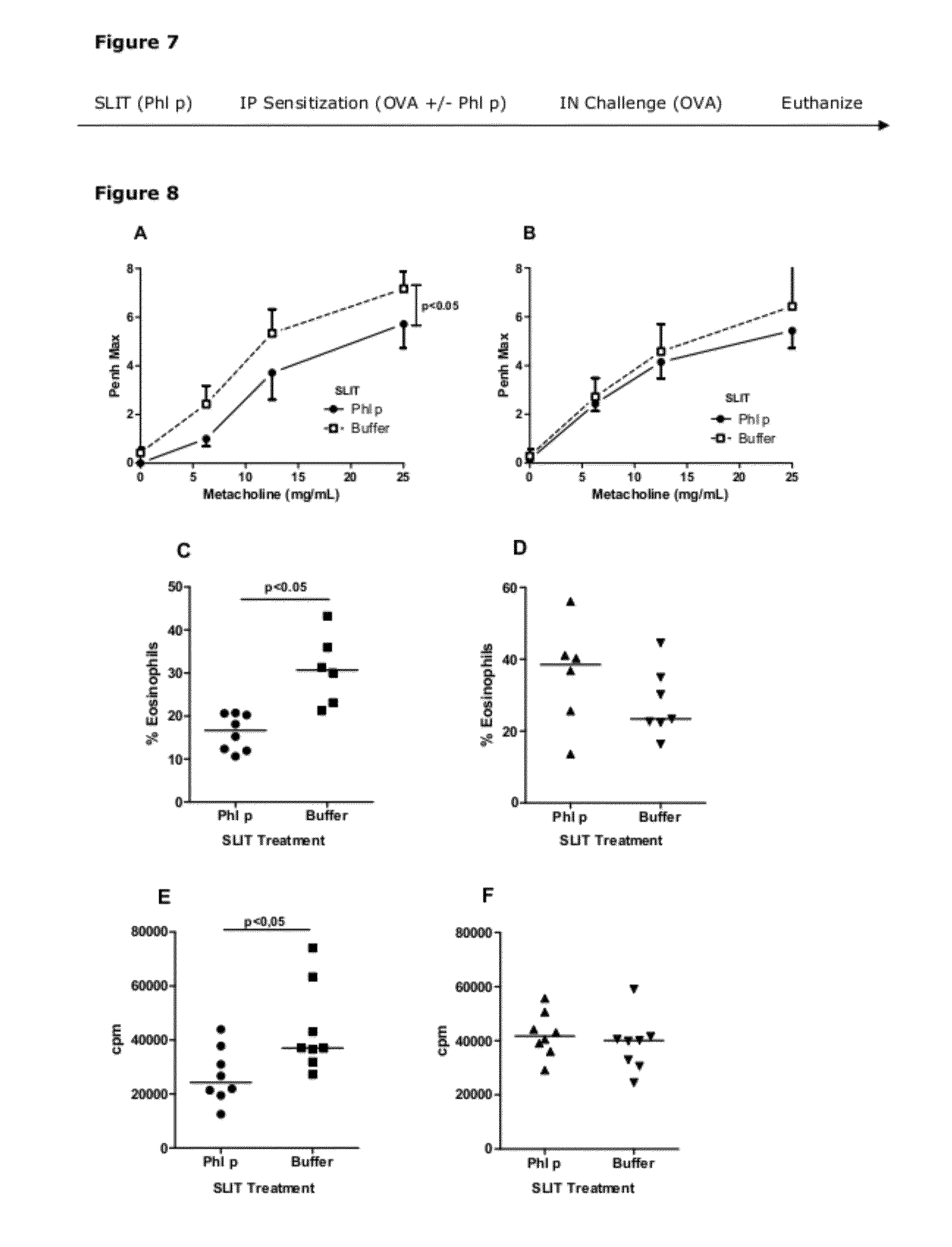
Prophylactic Treatment of Naive Mice with an Unrelated Antigen to Reduce Clinical Relevant Symptoms on a Hypersensitivity Immune Response
Methods:
[0250]Phl p, an extract of grass pollen of the species phleum pratense is obtained by extracting defatted grass pollen with an aqueous saline solution.
Animals
[0251]Female, 6-10 week-old BALB / cJ mice were bred in-house and maintained on a defined diet not containing component cross reacting with antisera to Phleum pratense (Phl p). Each experimental group consisted of 8 animals.
Animal Experiments
[0252]Naive mice were treated by sublingual immunotherapy (SLIT) with 40 μg Phl p extract for 2 weeks. Subsequently, the mice were immunized by three weekly i.p. injections of either a mix of 10 μg OVA and 8 μg Phl p extract or 10 μg OVA alone adsorbed to aluminium hydroxide. Subsequently, the mice were challenged intra-nasally (IN) with 50 μg of OVA for four days so as to induce clinically relevant readouts of a Th2-driven immune response. The mice ...
PUM
| Property | Measurement | Unit |
|---|---|---|
| total volume | aaaaa | aaaaa |
| water-soluble | aaaaa | aaaaa |
| pH | aaaaa | aaaaa |
Abstract
Description
Claims
Application Information
 Login to View More