
Virtual image display apparatus
a virtual image and display device technology, applied in the field of virtual image display devices, can solve the problems of insufficient external light, observer's uneasy feeling, and observer's inability to judge the status of the external world, and achieve the effect of wide angle of view and high performan
- Summary
- Abstract
- Description
- Claims
- Application Information
AI Technical Summary
Benefits of technology
Problems solved by technology
Method used
Image

Examples
first embodiment
[0075]Hereinafter, referring to drawings, a first virtual image display apparatus of a first embodiment related to the invention will be described in detail.
A. Appearance of First Virtual Image Display Apparatus
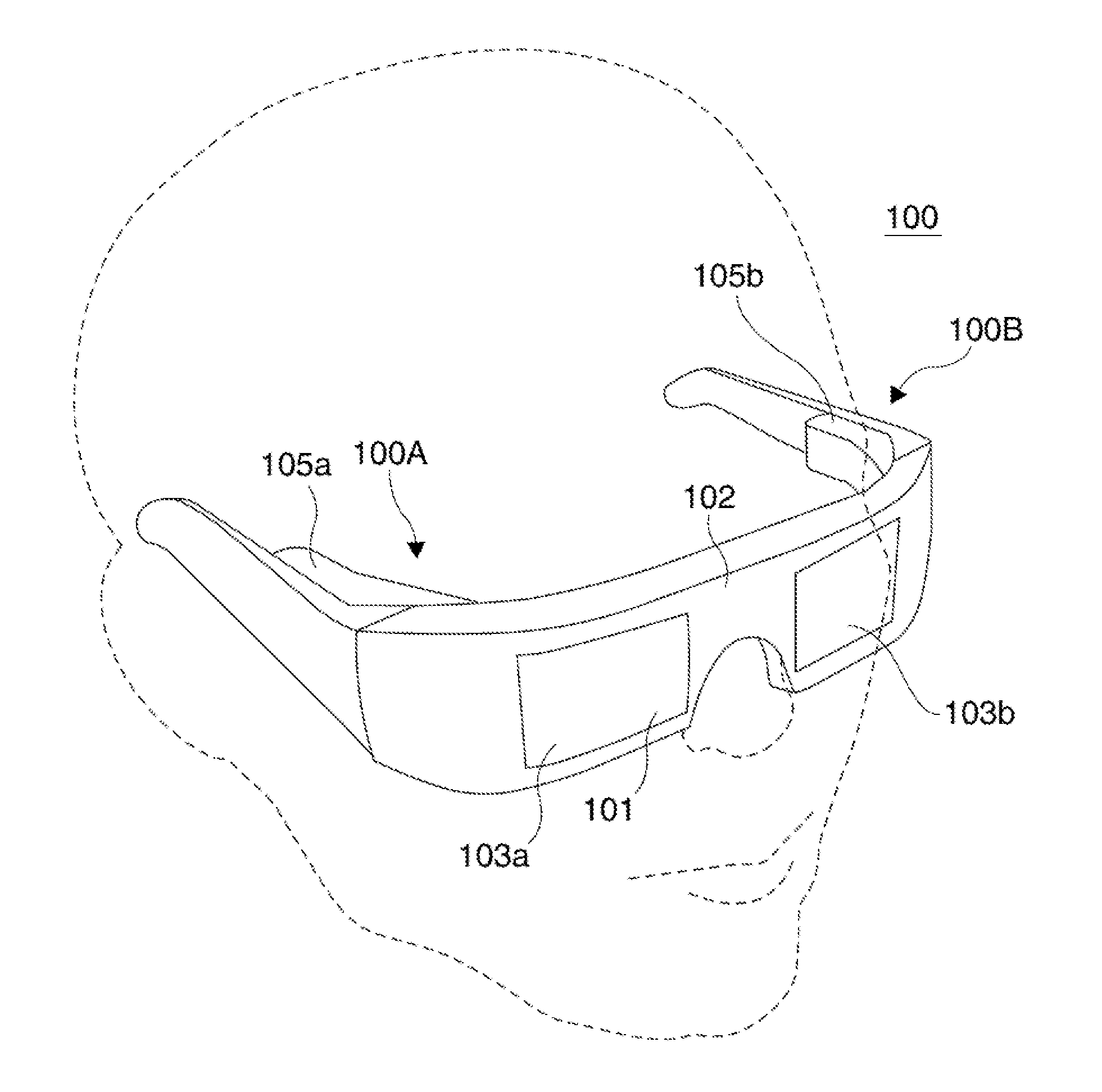
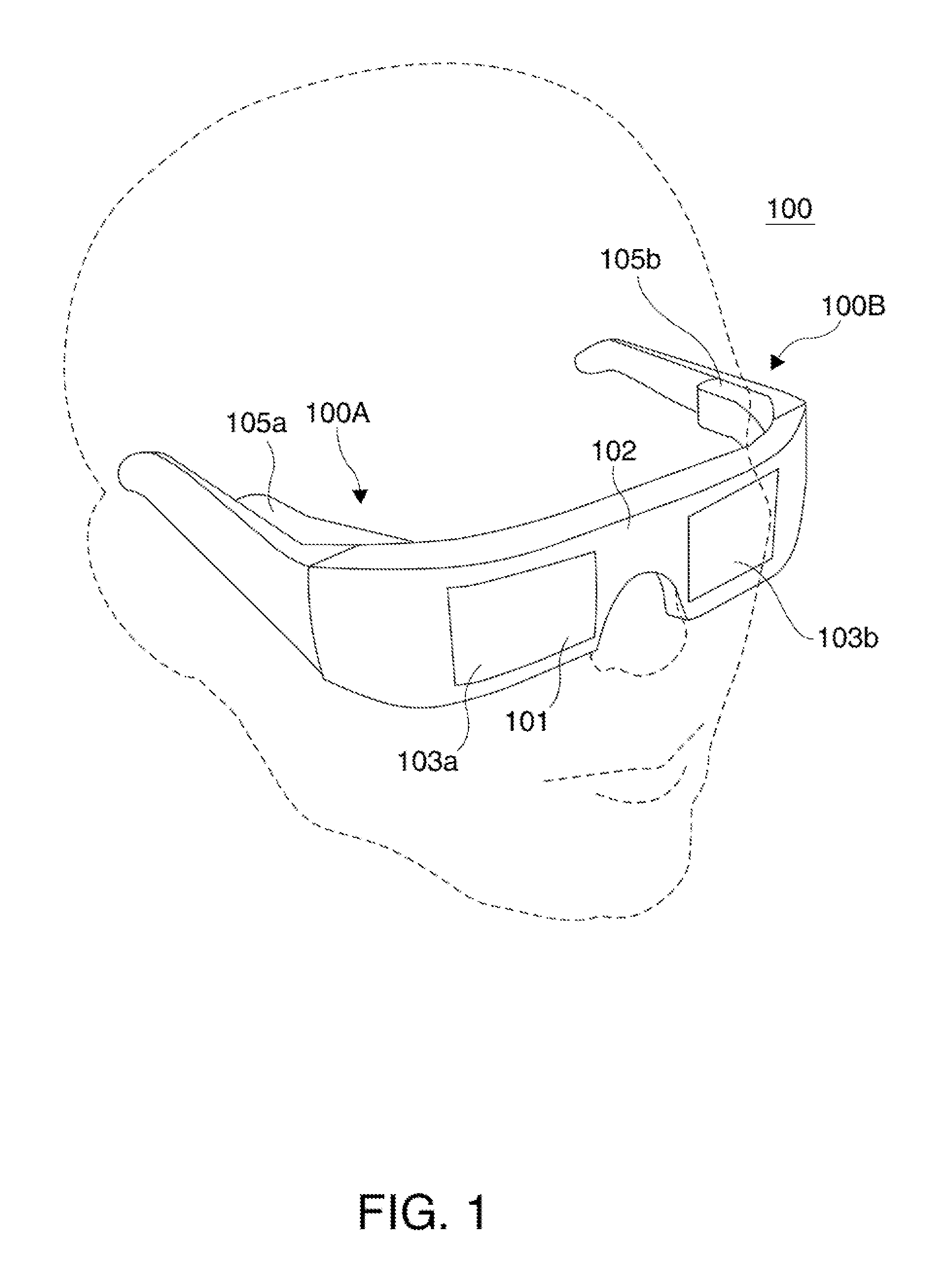
[0076]The first virtual image display apparatus 100 shown in FIG. 1 is a head mount display having an appearance of the glasses, and enables an observer who wears the virtual image display apparatus 100 to visually recognize an image light corresponding to a virtual image and the observer to see or observe an external image in a see-through manner. The virtual image display apparatus 100 includes a see-through member 101 which covers the eye in front of the observer, a frame 102 for supporting the see-through member 101, and first and second built-in apparatus portions 105a and 105b added to a portion from a cover portion in both of a left and a right edge of the frame 102 to rear bow portion (temple). Here, the see-through member 101 is an optical member (a transmitting eye ...
examples of first embodiment
[0120]Hereinafter, Examples of the perspective projection device which is incorporated in a first virtual image display apparatus according to the invention will be described. The symbols used in each Example are arranged below.
[0121]SPH: a pupil
[0122]FFSk: a free curved surface (k in the prism=the number of the surface)
[0123]SPH: a sphere shape or a flat surface (the surface of a protective glasses)
[0124]R: a radius of curvature
[0125]T: a distance between surfaces on the axis
[0126]Nd: a refractive index with respect to d line of an optical material
[0127]Vd: Abbe number with respect to d line of an optical material
[0128]TLY: an inclination angle (°) of an optical axis in a lateral cross section (XZ cross section) of a certain surface (TLY may change before and after the certain surface)
[0129]DCX: a deviation amount of an optical axis of X axis direction in a lateral cross section (XZ cross section) of a certain surface
example 1
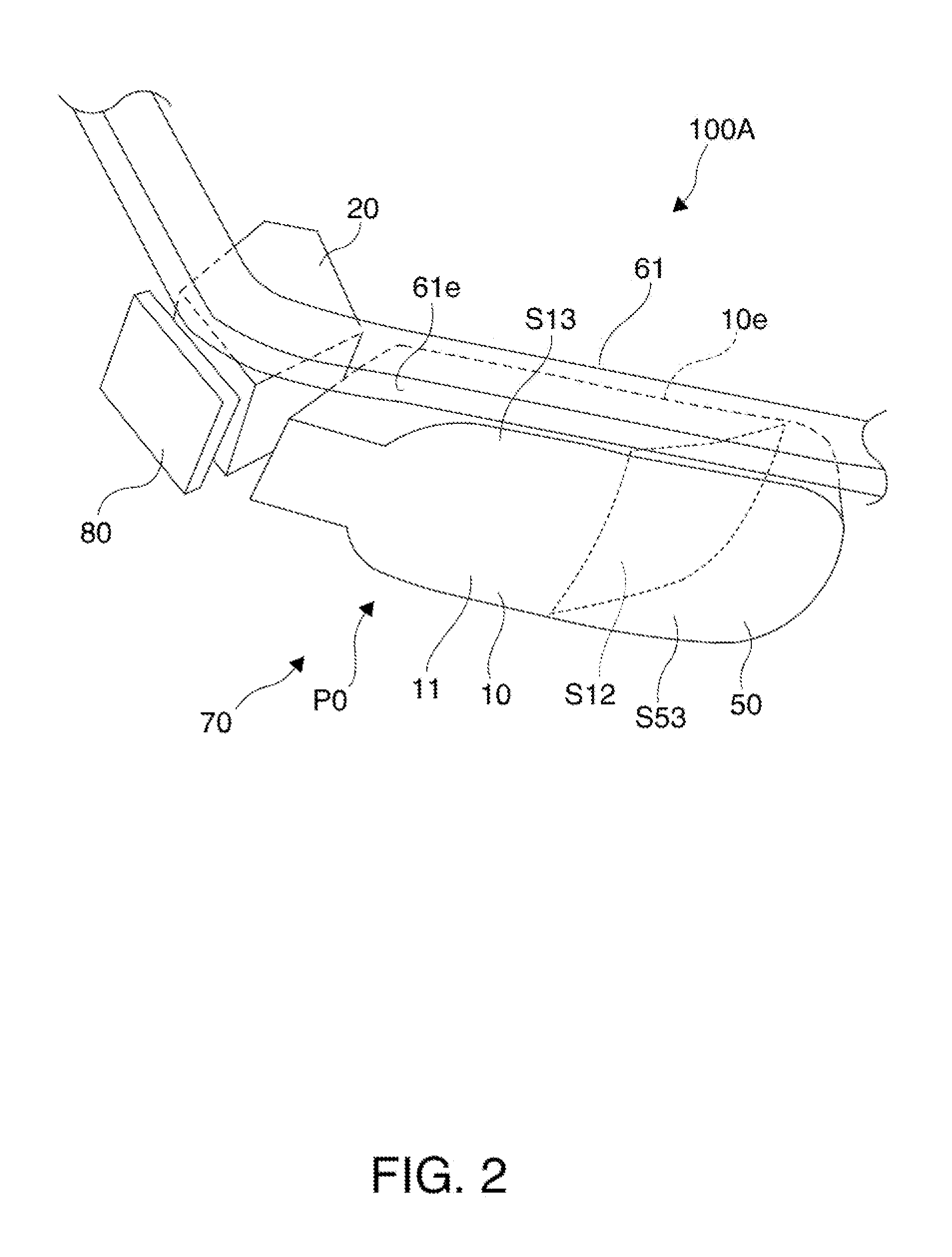
[0130]Data of optical surfaces constituting the first and second prisms in a perspective projection device of Example 1 is shown in Table 1. Further, for example, FFS1 means the first surface S11, FFS2 means the second surface S12, and FFS3 means the third surface S13.
TABLE 1NoTypeRTNdVd1SPH∞20.002FFS1−93.5395.501.52555.953FFS2−52.343−5.501.52555.954FFS1−93.5399.001.52555.955FFS3−93.539−12.001.52555.956FFS4−7.126−2.007FFS5−25.191−12.001.52555.958FFS648.79310.001.52555.959FFS7−19.626−11.001.52555.9510FFS8955.532−3.0011SPH∞−1.601.45867.8212ImageSurface
[0131]With respect to optical surfaces in a prism constituting Example 1, an optical axis inclination angle (tilt) TLY and an optical axis deviation amount (decenter) DCX in the lateral cross section are shown in Table 2 below.
TABLE 2TLY(BeforeDCX(AfterTLY(AfterNoTypeSurface)Surface)Surface)2FFS10003FFS2−280284FFS10005FFS3020.367−42.196FFS40007FFS50008FFS6−210−219FFS7−220−2210FFS8000
[0132]With regard to each of optical surfaces in the pr...
PUM
 Login to View More
 Abstract
Description
Claims
Application Information
 Login to View More