
Preparation process of an antiviral drug (entecavir) and intermediates thereof
a technology of antiviral drugs and intermediates, which is applied in the field of preparation of antiviral drugs (entecavir) and intermediates thereof, can solve the problems of easy dimerization, unstable ep481754, and so as to reduce the amount of metal to be used, avoid high dilution reaction conditions, and reduce reaction time
- Summary
- Abstract
- Description
- Claims
- Application Information
AI Technical Summary
Benefits of technology
Problems solved by technology
Method used
Image

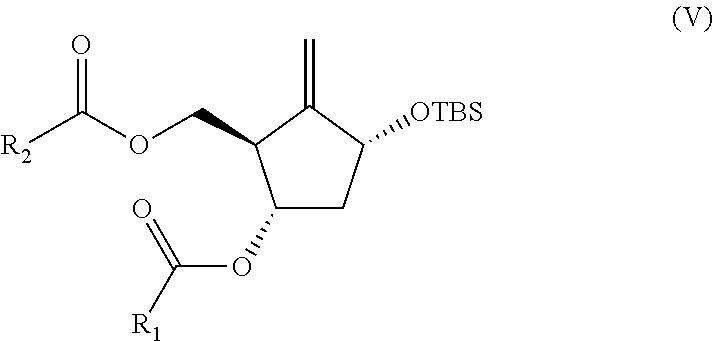
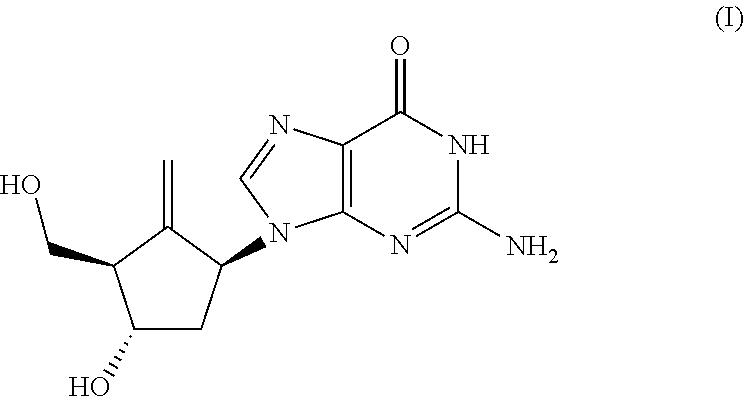
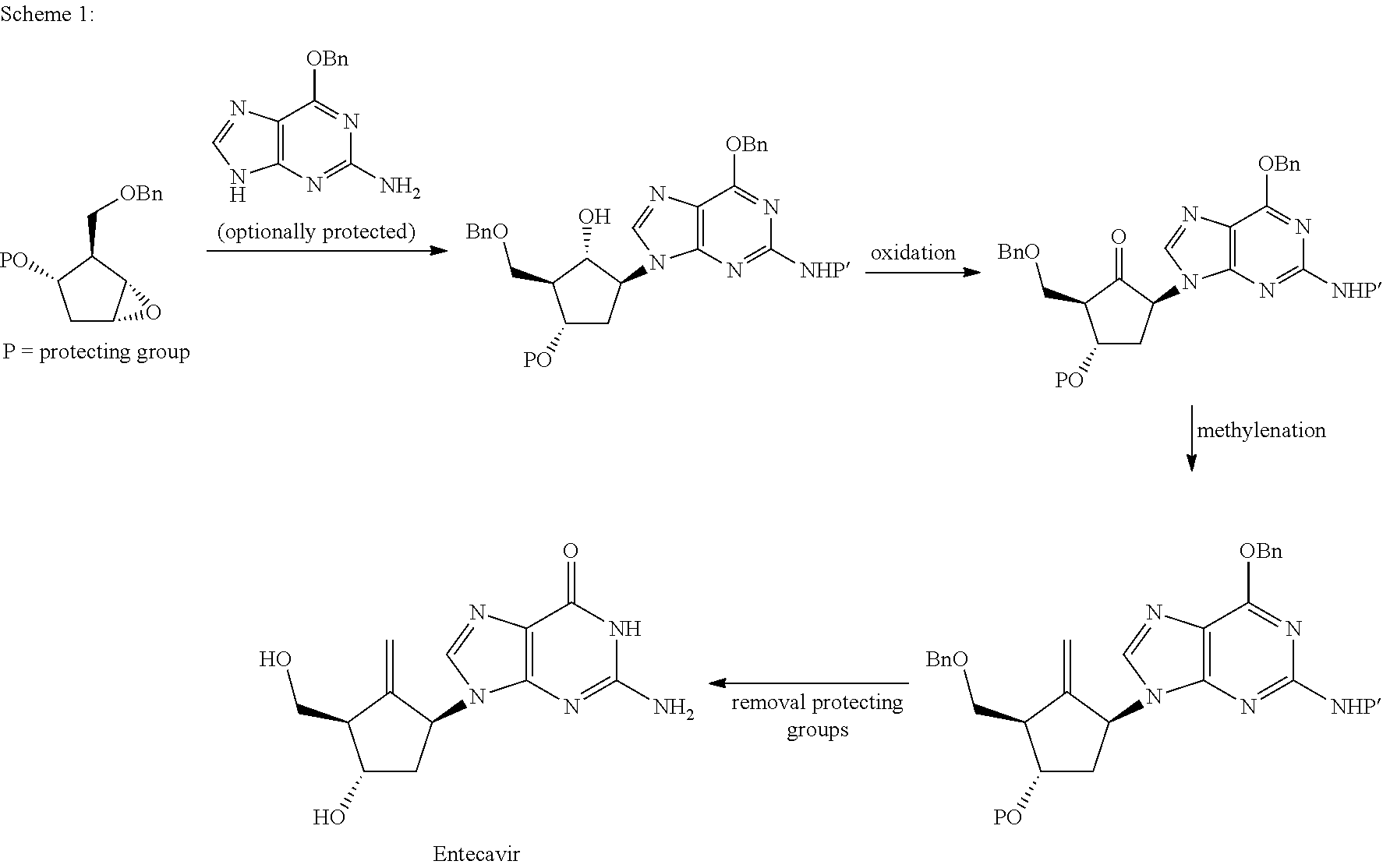
Examples
example 1
Preparation of (3S,5R)-7-(trimethylsilyl)hept-1-en-6-yne-3,5-diol (XI)
[0085]To a solution of (+)-DIPCl (90-105%) (25 g, 77.94 mmol) in anhydrous tetrahydrofuran (THF) (40 mL) at 0° C. under N2 atmosphere, triethylamine (NEt3) (85.02 mmol, 11.6 mL) was added under stirring. Then, 4-trimethylsilyl-3-butyn-2-one 98% (70.85 mmol, 9.78 g) was added dropwise and the reaction mixture was stirred 2 h at −5° C.-0° C. Then the solution was cooled to −78° C. A solution of acrolein (90% purity) (102.6 mmol, 7.62 mL) in anhydrous THF (20 mL) was added slowly and the reaction mixture was stirred 1 h at −78° C. A solution of lithium borohydride (LiBH4) 2 M in hexane (106.28 mmol, 53 mL) was added slowly. The reaction mixture was further stirred 1 h at −78° C., and then quenched carefully with saturated solution of NH4Cl (40 mL) for 0.5 h. (temperature increased from −78° C. to room temperature). The mixture was partitioned with H2O (40 mL) and tert-butyl methyl ether (TBME) (90 mL). Water layer wa...
example 2
Preparation of (3S,5R)-5-(tert-butyldimethylsilyloxy)-7-(trimethylsilyl)hept-1-en-6-yn-3-ol (X)
[0087]To a solution of diol (XI) (5.0 g, 25.2 mmol) and imidazole (2.1 g, 30.3 mmol) in anhydrous THF (60 mL) at 0° C. under N2 atmosphere, a solution of TBSCl (4.23 g, 27.7 mmol) in anhydrous THF (20 mL) was added dropwise and the reaction mixture was warmed up to room temperature. The reaction mixture was stirred for 5 h. Then, a 22% solution of NH4Cl (25 mL) was added slowly and the reaction mixture was stirred 10 min. The mixture was partitioned and the organic phase was dried (MgSO4), and the volatiles were removed in vacuo. Then the resulting oily substance was purified by flash chromatography on silica gel (hexane-ethyl acetate from 90:10 to 80:20) to give 4.84 g (61%) of the compound of the title. Light yellow oil. Rf (hexane:AcOEt 80:20)=0.55. [α]D=+39.9 (c 1.0, CHCl3). IR (Film) (cm−1): 3424, 3081, 2958, 2172.
example 3
Preparation of (3S,5R)-5-(tert-butyldimethylsilyloxy)hept-1-en-6-yn-3-ol (IXa)
[0088]K2CO3 (0.101 g, 0.73 mmol) was added in one portion to a stirred solution of (X) (0.455 g, 1.46 mmol) in anhydrous methanol (MeOH) (4.5 mL) at room temperature under N2 atmosphere. The reaction mixture was stirred for 1 h. After completion of the reaction, the volatiles was removed and CH2Cl2 (10 mL) was added to the residue. The mixture was filtered, dried (MgSO4) and the volatiles were removed to give 0.366 g (yield: 100%) of compound of the title. Light yellow oil. Rf (hexane:AcOEt 80:20)=0.43. [α]D=+32.7 (c 1.0, CHCl3). IR (Film) (cm−1): 3417, 3079, 2956, 2109.
PUM
 Login to View More
 Abstract
Description
Claims
Application Information
 Login to View More