SRAM layouts

a layout and array technology, applied in the field of sram array and cell layout, can solve the problems of not allowing such individual transistor sizing, becoming very difficult to vary the width of the electrode material sharing a particular track,

US20140003133A1Active Publication Date: 2014-01-02SYNOPSYS INC
1 Cites 37 Cited by

Patent Information

Authority / Receiving Office
US · United States
Patent Type
Applications(United States)
Current Assignee / Owner
Publication Date
2014-01-02

Smart Images

  • Figure 1
    Figure 1
  • Figure 2
    Figure 2
  • Figure 3
    Figure 3
Patent Text Reader

Abstract

Roughly described, the cell layout in an SRAM array is re-arranged such that the gate electrodes for transistors for which flexibility to use one channel length is desired, are formed along a different track from those for transistors for which flexibility to use a different channel length is desired. Not only does such a re-arrangement permit optimization of device ratios, but also in certain implementations can also reduce, rather than increase, cell area. Specific example layouts are described. The invention also involves layout files, macrocells, lithographic masks and integrated circuit devices incorporating these principles, as well as fabrication methods.
Need to check novelty before this filing date? Find Prior Art

Description

CROSS-REFERENCE TO OTHER APPLICATIONS

[0001] This application is a non-provisional of U.S. Provisional Application No. 61 / 690,563, filed 28 Jun. 2012, which is incorporated herein by reference in its entirety.BACKGROUND

[0002] 1. Field of the Invention

[0003] The invention relates to static random access memory (SRAM), and more particularly to SRAM array and cell layouts, layout methods for such memories, and related technologies.

[0004] 2. Description of Related Art

[0005] In most integrated circuit designs, SRAM is a critical component that occupies relatively large area, draws significant power, and determines chip performance. Despite feature size scaling, the minimum channel length in an SRAM cell remains nearly twice as large as that in core logic areas, due to the need to control variability and leakage.

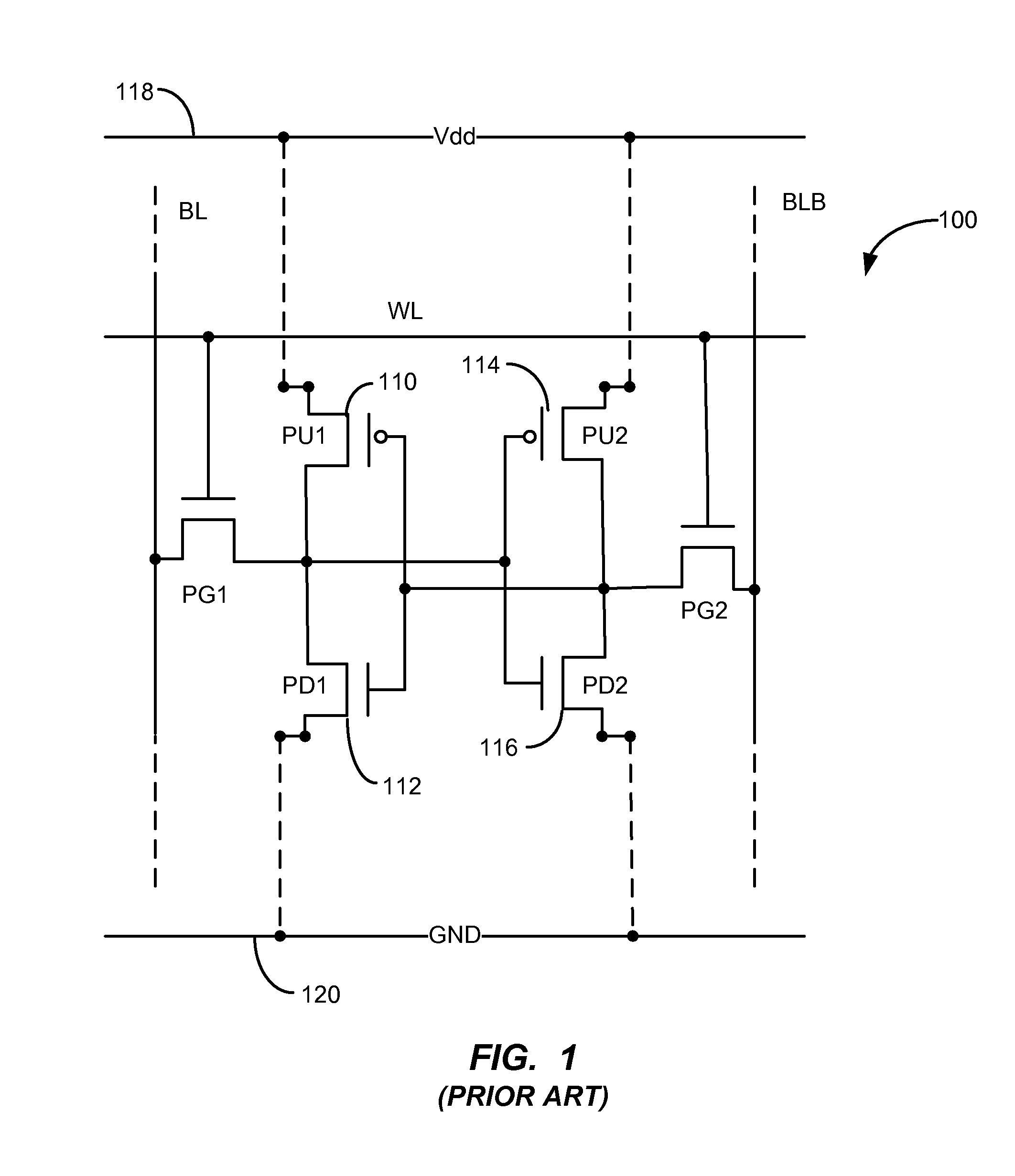
[0006] A typical 6-transistor SRAM cell 100 circuit schematic is shown in FIG. 1. It is based on a pair of cross-connected inverters, and includes a first inverter made with a first P-ch...

Examples

Embodiment Construction

[0025]The following description is presented to enable any person skilled in the art to make and use the invention, and is provided in the context of a particular application and its requirements. Various modifications to the disclosed embodiments will be readily apparent to those skilled in the art, and the general principles defined herein may be applied to other embodiments and applications without departing from the spirit and scope of the present invention. Thus, the present invention is not intended to be limited to the embodiments shown, but is to be accorded the widest scope consistent with the principles and features disclosed herein.

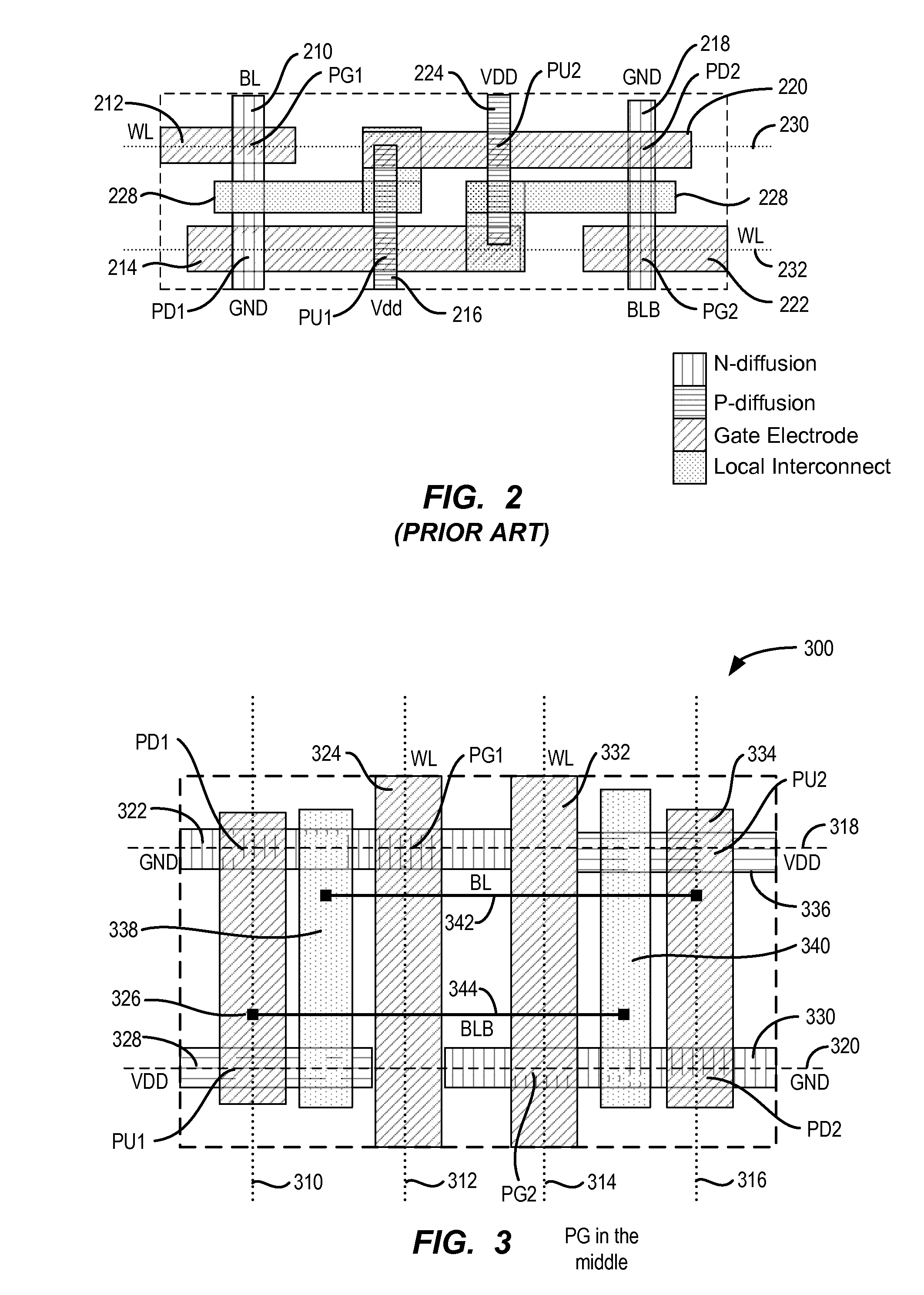
[0026]FIG. 3 is a plan view of an example layout 300 incorporating aspects of the invention, of the 6-transistor SRAM circuit of FIG. 1. It includes four gate electrode tracks 310, 312, 314 and 316 rather than two as in FIG. 2, and two diffusion tracks 318, 320 rather than four as in FIG. 2. In particular, the layout includes an N-channel diffu...