Check patentability & draft patents in minutes with Patsnap Eureka AI!

Methods of and apparatus for determining particle inclusion and size in molten metal

a technology of inclusion and size, applied in the direction of pulse manipulation, pulse technique, instruments, etc., can solve the problems of increased breakage rate during metal wire production, significant time-consuming and laborious, and battery life is significantly reduced, so as to achieve no loss, low resistance, and high resistance

Active Publication Date: 2014-09-18
NOVELIS INC
View PDF7 Cites 0 Cited by
  • Summary
  • Abstract
  • Description
  • Claims
  • Application Information

AI Technical Summary

Benefits of technology

The patent describes an apparatus that uses ultra-capacitors and field effect transistors to analyze the metal cleanliness of a sample. The apparatus is designed to be compact and minimize noise, and uses surface-mounted FETs to achieve this. The use of a single internal electrode and a single external electrode reduces the size and cost of the apparatus. The apparatus can be used only in its non-conductive and fully-conductive states, which reduces heat generation and the need for bulky heat sinks. The use of surface-mounted FETs makes the apparatus more compact and less susceptible to noise. Overall, the apparatus is designed to be efficient, compact, and effective in analyzing metal cleanliness.

Problems solved by technology

Molten metals, particularly molten aluminum and molten steel, are frequently contaminated by entrained small non-metallic inclusions that give rise to a variety of shortcomings or defects in products manufactured from the molten metal.
For example, such inclusions may cause the solidified metal to tear during mechanical working operations, or may introduce pin-holes and streaks in foils and surface defects and blisters into sheets, or give rise to increased rates of breakage during the production of metal wire, etc.
While the use of batteries as the current source can be effective, batteries take a significant time to recharge and require additional equipment to ensure that the recharging takes place properly.
They also tend to be heavy, bulky and may have a short operational life if constantly subjected to rapid discharge and recharge cycles.
Another problem that conventional apparatus may encounter is the generation of considerable heat, representing a loss of efficiency and requiring extra size and weight for cooling devices or heat sinks.
However, ultra-capacitors have a lower volume charge density than rechargeable batteries and cannot therefore supply high currents at constant rates for extended periods of time.
In the device of the Marcotte et al. patent, the use of an ultra-capacitor can result in the generation of significant heat and require circuitry that is susceptible to inclusion of electrical noise.
This has necessitated complex measures for eliminating noise from the test signal, e.g. by providing three or more electrodes to generate a reference signal for comparison purposes.
Previous LiMCA designs, particularly those incorporating batteries, have generally employed large ballast resistors and transistors operating in a linear (intermediate) region to maintain steady current generating high heat losses and requiring heat management to keep operating temperatures within a safe region.
However, while effective, this increases the size and cost of the apparatus and requires additional circuitry.

Method used

the structure of the environmentally friendly knitted fabric provided by the present invention; figure 2 Flow chart of the yarn wrapping machine for environmentally friendly knitted fabrics and storage devices; image 3 Is the parameter map of the yarn covering machine
View more

Image

Smart Image Click on the blue labels to locate them in the text.
Viewing Examples
Smart Image
  • Methods of and apparatus for determining particle inclusion and size in molten metal
  • Methods of and apparatus for determining particle inclusion and size in molten metal
  • Methods of and apparatus for determining particle inclusion and size in molten metal

Examples

Experimental program
Comparison scheme
Effect test

Embodiment Construction

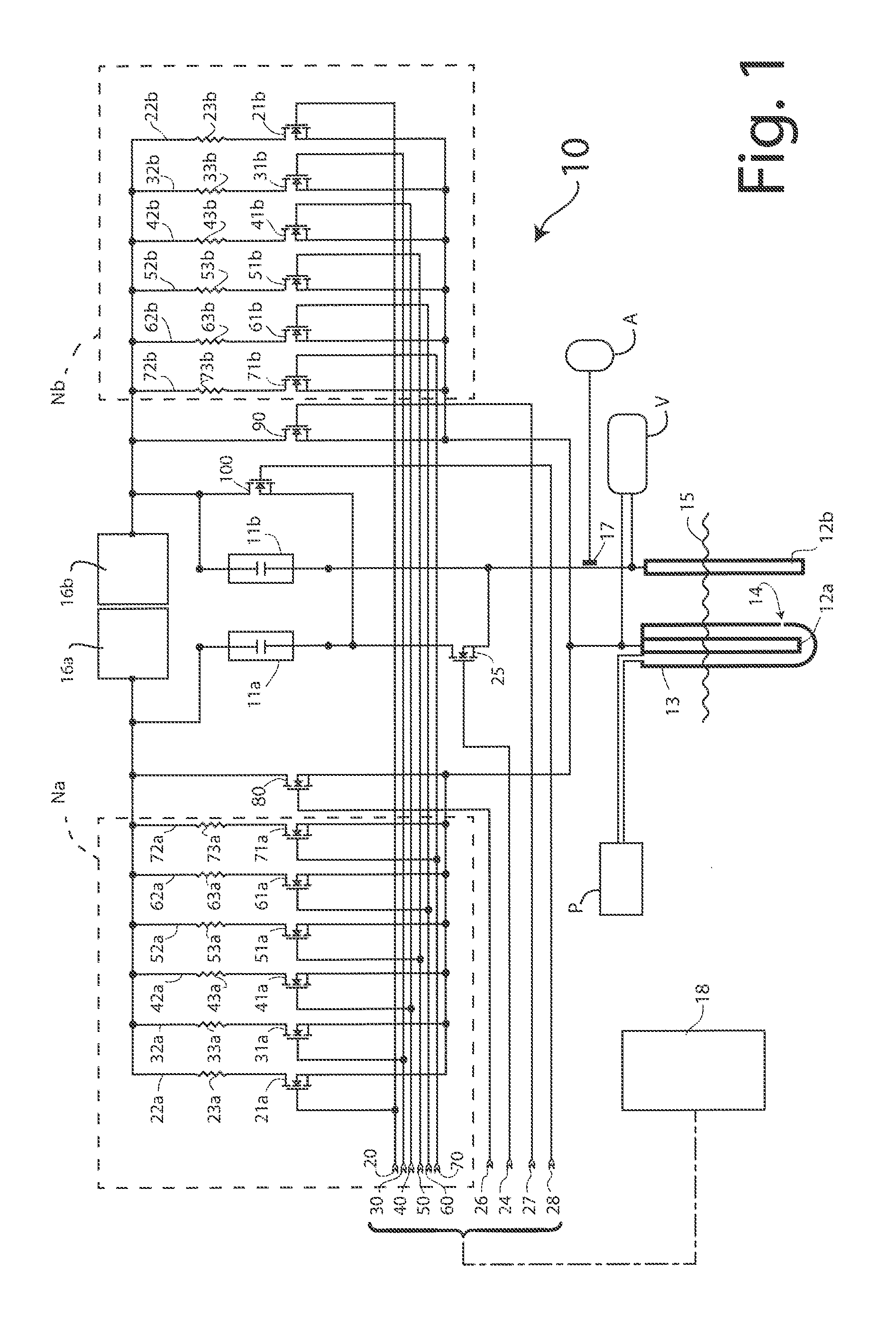
[0039]FIG. 1 shows a circuit diagram 10 suitable for supplying cleanliness-measurement current in a LiMCA analyzer according to one exemplary embodiment of the invention. This circuit, or at least the majority of it, may be provided on a circuit board referred to as a “power board.” The apparatus may also include a “main board” containing equipment for initiating a calibration routine, and an “analog board” containing measuring, recording and possibly signal processing devices. For convenience, the main board may be remote from the power board and analog board, e.g. located in a control case (not shown) connected to the power board in a probe unit by an umbilical cable of suitable length (for example, thirty feet in length). The analog board is preferably positioned as close as possible to the power board for minimal susceptibility to noise.

[0040]In the circuit diagram 10, two ultra-capacitors 11a and 11b are provided to supply direct current ultimately to electrodes 12a (positive) ...

the structure of the environmentally friendly knitted fabric provided by the present invention; figure 2 Flow chart of the yarn wrapping machine for environmentally friendly knitted fabrics and storage devices; image 3 Is the parameter map of the yarn covering machine
Login to View More

PUM

PropertyMeasurementUnit
voltageaaaaaaaaaa
discharge voltageaaaaaaaaaa
period of timeaaaaaaaaaa
Login to View More

Abstract

Methods and apparatus for measuring the cleanliness of molten metal. Direct current is passed through molten metal advancing through a passage. A voltage signal is analyzed for the presence of solid generally non-metallic inclusions in the metal. A method includes sampling digital data of the voltage signal to generate data samples; updating a delayed running average of the data samples to establish a baseline for identifying sudden changes in amplitude of the data samples; determining a threshold by adding a prescribed value to the baseline; identifying a possible inclusion when a significant number of data samples exceeds the threshold; storing a maximum count as the data samples using peak detection until a prescribed number of the data samples fall below the threshold; and comparing a parameter of the possible inclusion with a lookup table to categorize the possible inclusion as either (i) an actual inclusion or (ii) noise.

Description

RELATED APPLICATION[0001]This application claims the benefit of U.S. Provisional Patent Application Ser. No. 61 / 778,044 filed Mar. 12, 2013, the entire contents of which are incorporated by reference.FIELD OF THE INVENTION[0002]This invention relates to methods of and apparatus for determining the presence or absence of solid and generally non-metallic inclusions within molten metal including determining size and concentration information of such inclusions.BACKGROUND OF THE INVENTION[0003]Molten metals, particularly molten aluminum and molten steel, are frequently contaminated by entrained small non-metallic inclusions that give rise to a variety of shortcomings or defects in products manufactured from the molten metal. For example, such inclusions may cause the solidified metal to tear during mechanical working operations, or may introduce pin-holes and streaks in foils and surface defects and blisters into sheets, or give rise to increased rates of breakage during the production ...

Claims

the structure of the environmentally friendly knitted fabric provided by the present invention; figure 2 Flow chart of the yarn wrapping machine for environmentally friendly knitted fabrics and storage devices; image 3 Is the parameter map of the yarn covering machine
Login to View More

Application Information

Patent Timeline
no application Login to View More
Patent Type & Authority Applications(United States)
IPC IPC(8): H03K5/125G01N27/07
CPCG01N27/07H03K5/125G01N27/4161G01N33/205
Inventor HILDENBRANDT, LESLIE CALVINTHORNTON, GARY
Owner NOVELIS INC
Features
  • R&D
  • Intellectual Property
  • Life Sciences
  • Materials
  • Tech Scout
Why Patsnap Eureka
  • Unparalleled Data Quality
  • Higher Quality Content
  • 60% Fewer Hallucinations
Social media
Patsnap Eureka Blog
Learn More