Variable-gain dual-output transconductance amplifier-based instrumentation amplifiers
a transconductance amplifier and amplifier technology, applied in differential amplifiers, amplifiers with semiconductor devices/discharge tubes, amplifiers, etc., can solve problems such as distortion of cmos transmission gate switches
- Summary
- Abstract
- Description
- Claims
- Application Information
AI Technical Summary
Benefits of technology
Problems solved by technology
Method used
Image



Examples
Embodiment Construction
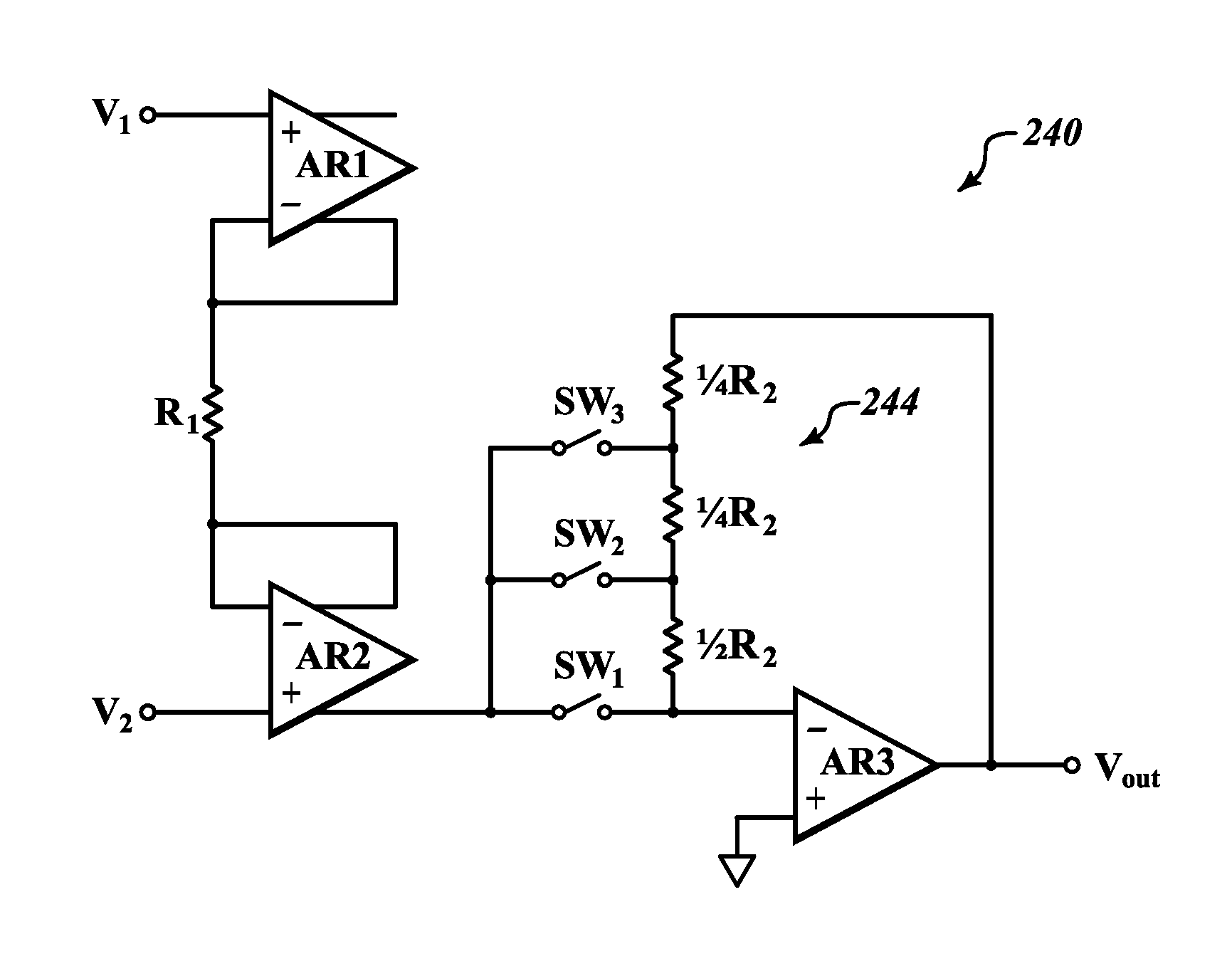
[0010]FIG. 2 illustrates an instrumentation amplifier (IA) 20. For clarity, dual-output transconductance amplifier (DOTA) symbols 26, 28 are used to represent current conveyors. One of ordinary skill would understand how to apply current conveyors to the IA 20. The gain of the IA 20 is defined by the following equation:
AV=VOUT / (V1-V2)=R2 / R1 (1)
[0011]As shown in FIG. 3, a IA 40 includes an additional resistor, R3, between resistor R1 and the DOTA 26. The voltage gain remains the same, Av =R2 / R1, because there is no significant current flowing through the resistor R3, especially when using CMOS amplifiers, and no voltage is developed across the resistor R3.
[0012]Also in the IA 40, a resistor R4 is added between the resistor R1 and the DOTA 26. The gain remains the same for small values of the resistor R4. In this case, the same current that flows through the resistor R1 also flows through the resistor R4 but the voltage that develops across the resistor R4 does not affect overall gai...
PUM
 Login to View More
 Abstract
Description
Claims
Application Information
 Login to View More