High voltage input circuit for a differential amplifier
- Summary
- Abstract
- Description
- Claims
- Application Information
AI Technical Summary
Benefits of technology
Problems solved by technology
Method used
Image



Examples
first embodiment
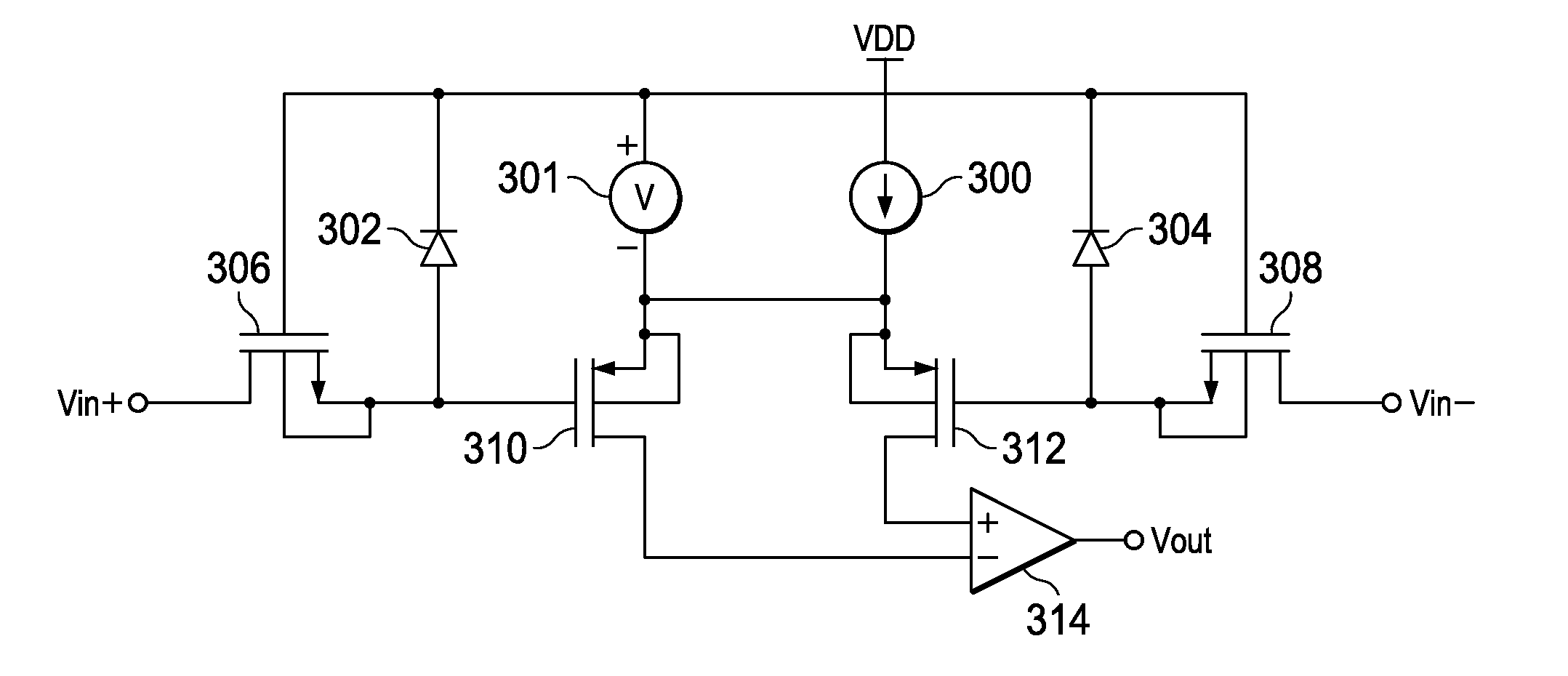
[0020]Referring to FIG. 3A, there is a circuit diagram of a high voltage differential amplifier circuit of the present invention. Here and in the following discussion, the same reference numerals are used in the drawing figures to indicate substantially the same circuit elements. The circuit includes differential amplifier 314 having output terminal Vout. The differential amplifier may be an operational amplifier configured as a linear amplifier, integrator, or other special purpose amplifier as is known in the art. The differential amplifier 314 has first (−) and second (+) input terminals. A first p-channel input transistor 310 has a current path coupled to the first (−) input terminal. A second p-channel input transistor 312 has a current path coupled to the second (+) input terminal. The first and second input transistors are preferably balanced and have substantially the same threshold voltage and are oriented to compensate for any slight misalignment during fabrication. N-chan...
second embodiment
[0023]Turning now to FIG. 4A, there is a circuit diagram of a high voltage differential amplifier circuit of the present invention. The circuit includes differential amplifier 314 having output terminal Vout. The differential amplifier 314 has first (−) and second (+) input terminals. A first p-channel input transistor 316 has a current path coupled to the first (−) input terminal. A second p-channel input transistor 318 has a current path coupled to the second (+) input terminal. The first and second input transistors are preferably balanced and have substantially the same threshold voltage and are oriented to compensate for any slight misalignment during fabrication. N-channel transistor 306 has a current path coupled between a first differential input terminal (Vin+) and a control terminal of the first input transistor 316. N-channel transistor 308 has a current path coupled between a second differential input terminal (Vin−) and a control terminal of the second input transistor ...
third embodiment
[0025]Turning now to FIG. 5A, there is a circuit diagram of a high voltage differential amplifier circuit of the present invention. The circuit includes differential amplifier 314 having output terminal Vout. The differential amplifier 314 has first (−) and second (+) input terminals. A first p-channel input transistor 310 has a current path coupled to the first (−) input terminal. A second p-channel input transistor 312 has a current path coupled to the second (+) input terminal. The first and second input transistors are preferably balanced and have substantially the same threshold voltage and are oriented to compensate for any slight misalignment during fabrication. N-channel transistor 306 has a current path coupled between a first differential input terminal (Vin+) and a control terminal of the first input transistor 310. N-channel transistor 308 has a current path coupled between a second differential input terminal (Vin−) and a control terminal of the second input transistor ...
PUM
 Login to View More
 Abstract
Description
Claims
Application Information
 Login to View More
PatSnap Eureka turns technology decisions into work you can execute. Powered by our Innovation Knowledge Graph, it runs expert workflows across engineering, life sciences, materials and intellectual property. Get your review-ready output in minutes.


