Solid electrolyte, all-solid-state battery including the same, and method for making solid electrolyte
Inactive Publication Date: 2016-06-23
HITACHI LTD
View PDF4 Cites 19 Cited by
Summary
Abstract
Description
Claims
Application Information
AI Technical Summary
This helps you quickly interpret patents by identifying the three key elements:
Problems solved by technology
Method used
Benefits of technology
Benefits of technology
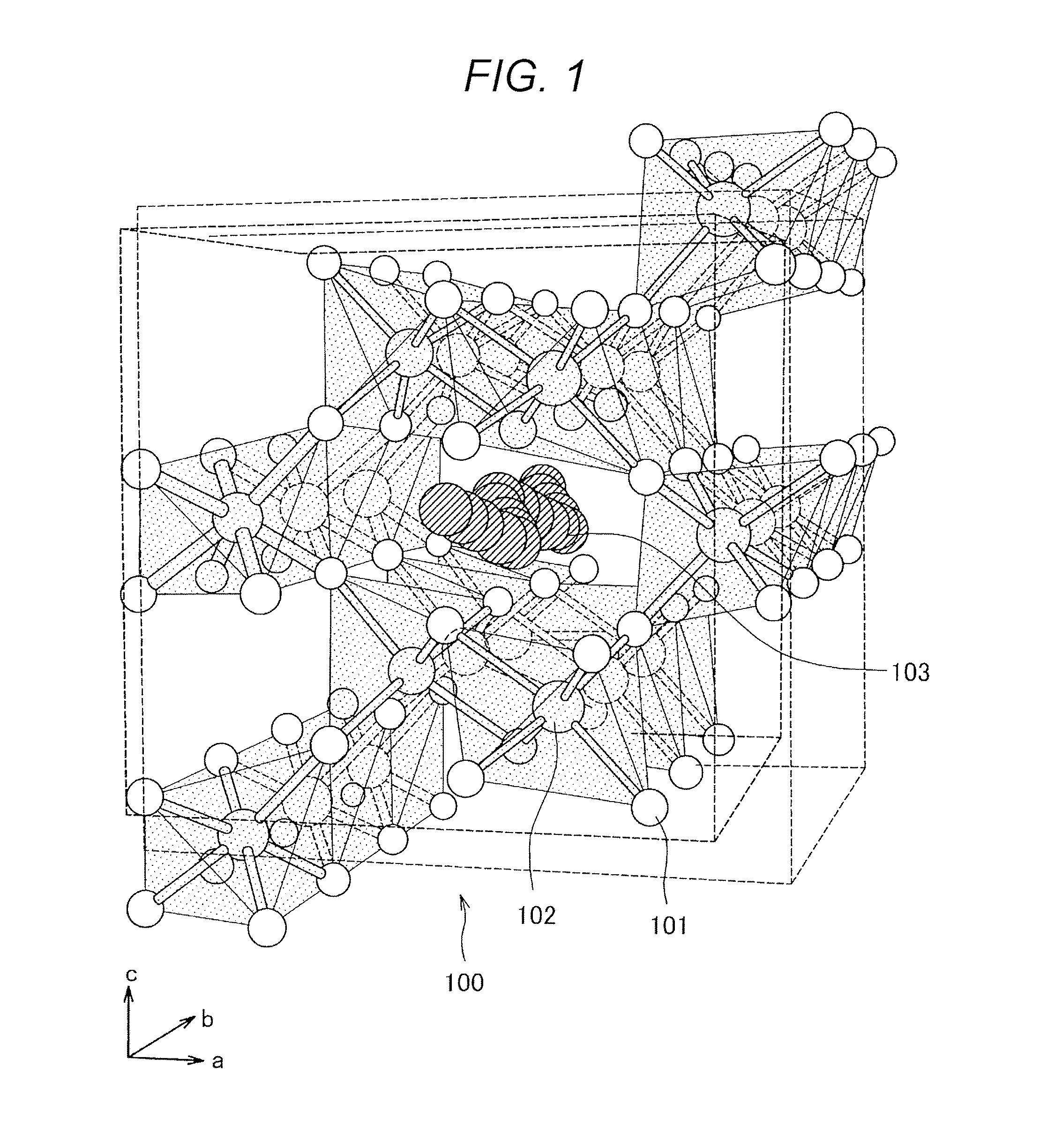
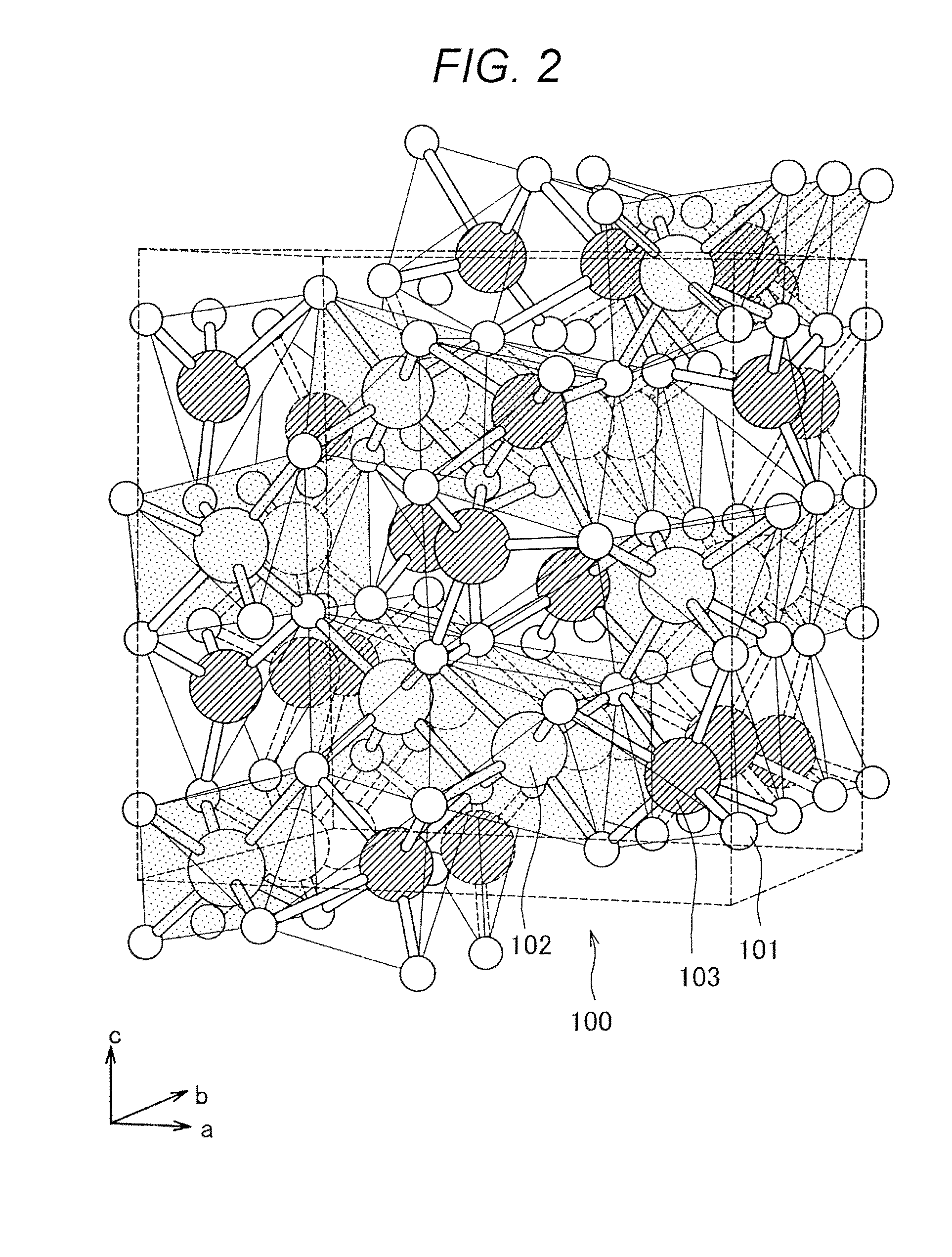
The present invention provides a solid electrolyte with low activation energy and high lithium ionconductivity, which has a ramsdellite-type crystal structure. Additionally, this invention is about an all-solid-state battery utilizing this solid electrolyte and a method for making it. These technical effects enable improved performance of the battery.
Problems solved by technology
However, sulfide solid electrolytes have problems that they have low stability in the air, and react with moisture to generate toxic or corrosive gas.
On the other hand, oxide solid electrolytes have high stability in the air, but have low lithiumionconductivity.
Method used
the structure of the environmentally friendly knitted fabric provided by the present invention; figure 2 Flow chart of the yarn wrapping machine for environmentally friendly knitted fabrics and storage devices; image 3 Is the parameter map of the yarn covering machine
View more
Image
Smart Image Click on the blue labels to locate them in the text.
Viewing Examples
Smart Image
Click on the blue label to locate the original text in one second.
Reading with bidirectional positioning of images and text.
Smart Image
Examples
Experimental program
Comparison scheme
Effect test
example 1
[0084]As Example 1, a ramsdellite-type solid electrolyte represented by Li2.4Sn3.2Mg0.4O8 was made. In this solid electrolyte, x=0.8, a=0.4, b=c=d=0, and 3x−a−2b−c−2d=2.0.
[0085]The solid electrolyte according to Example 1 was made in the same manner as in Comparative Example 1, except that 3.938 g of Li2CO3, 16.062 g of SfO2, and 0.55 g of MgCO3 were weighed, mixed, and dried to obtain a mixed powder.
[0086]The solid electrolyte according to Example 1 was pulverized and subjected to crystal analysis by XRD; a ramsdellite-type crystal structure was confirmed. In addition, the chemical components were determined by ICP-AES; the composition of Li2.4Sn3.2Mg0.4O8 was confirmed.
example 2
[0087]As Example 2, a ramsdellite-type solid electrolyte represented by Li2.0Sn3.2Mg0.6O8 was made. In this solid electrolyte, x=0.8, a=0.6, b=c=d=0, and 3x−a−2b−c−2d=1.8.
[0088]The solid electrolyte according to Example 2 was made in the same manner as in Comparative Example 1, except that 1.21 g of Li2CO3, 7.95 g of SnO2, and 0.84 g of MgCO3 were weighed, mixed, and dried to obtain a mixed powder.
[0089]The solid electrolyte according to Example 2 was pulverized and subjected to crystal analysis by XRD; a ramsdellite-type crystal structure was confirmed. In addition, the chemical components were determined by ICP-AES; the composition of Li2.0Sn3.2Mg0.6O8 was confirmed.
example 3
[0090]As Example 3, a ramsdellite-type solid electrolyte represented by Li1.6Sn3.2Mg0.8O8 was made. In this solid electrolyte, x=0.8, a=0.8, b=c=d=0, and 3x−a−2b−c−2d=1.6.
[0091]The solid electrolyte according to Example 3 was made in the same manner as in Comparative Example 1, except that 0.97 g of Li2CO3, 7.92 g of SnO2, and 1.10 g of MgCO3 were weighed, mixed, and dried to obtain a mixed powder.
[0092]The solid electrolyte according to Example 3 was pulverized and subjected to crystal analysis by XRD; a ramsdellite-type crystal structure was confirmed, but a hetero-phase of MgO was partly found. In addition, the chemical components were determined by ICP-AES; the composition of Li1.6Sn3.2Mg0.8O8 was confirmed.
the structure of the environmentally friendly knitted fabric provided by the present invention; figure 2 Flow chart of the yarn wrapping machine for environmentally friendly knitted fabrics and storage devices; image 3 Is the parameter map of the yarn covering machine
Login to View More
PUM
Login to View More
Abstract
A solidelectrolyte comprises a ramsdellite-type crystal structure and has low activation energy of lithium ions and good lithiumionconductivity. The solidelectrolyte is represented by the general formula Li4x−2a−3b−c−2dSn4−x−c−dM(II)aM(III)bM(V)cM(VI)dO8 [wherein M(II) is a divalent cation, M(III) is a trivalent cation, M(V) is a pentavalent cation, and M(VI) is a hexavalent cation, 0≦x≦1.33], wherein in the general formula, 0<a+b+c+d, 0≦a+b≦x, 0≦c+d<0.9, and 3x−a−2b−c−2d≦2. The all-solid-state battery includes the solid electrolyte in at least one layer of the positive electrode layer, negative electrode layer, and solid electrolyte layer. The method of making the solid electrolyte includes a step of preparing a mixed powder as a raw material and heating with microwaveirradiation.
Description
TECHNICAL FIELD[0001]The present invention relates to a solid electrolyte, an all-solid-state battery including the same, and a method for making a solid electrolyte.BACKGROUND ART[0002]All-solid-state batteries are configured to transport carriers by an inorganic solid electrolyte. Common inorganic solid electrolytes are non-flammable or flame-retardant, so that all-solid-state batteries including an inorganic solid electrolyte are highly resistant against heat generation caused by battery reaction, and are highly safe. Therefore, all-solid-state batteries can be made into a battery module having a simplified safety mechanism for controlling temperature and others, and are suitable for the reduction of production cost and component cost. In addition, the batteries have high resistance against heat generation, so that are regarded as suitable for achieving a high energy density.[0003]An all-solid-state battery usually includes an electrode layer containing active materials, and a so...
Claims
the structure of the environmentally friendly knitted fabric provided by the present invention; figure 2 Flow chart of the yarn wrapping machine for environmentally friendly knitted fabrics and storage devices; image 3 Is the parameter map of the yarn covering machine
Login to View More
Application Information
Patent Timeline
Application Date:The date an application was filed.
Publication Date:The date a patent or application was officially published.
First Publication Date:The earliest publication date of a patent with the same application number.
Issue Date:Publication date of the patent grant document.
PCT Entry Date:The Entry date of PCT National Phase.
Estimated Expiry Date:The statutory expiry date of a patent right according to the Patent Law, and it is the longest term of protection that the patent right can achieve without the termination of the patent right due to other reasons(Term extension factor has been taken into account ).
Invalid Date:Actual expiry date is based on effective date or publication date of legal transaction data of invalid patent.



 Login to View More
  Login to View More