Check patentability & draft patents in minutes with Patsnap Eureka AI!

Multi-layered thermoplastic elastomer foam and process for manufacturing the same

Active Publication Date: 2016-10-06
LEE YUNG TENG
View PDF9 Cites 6 Cited by
  • Summary
  • Abstract
  • Description
  • Claims
  • Application Information

AI Technical Summary

Benefits of technology

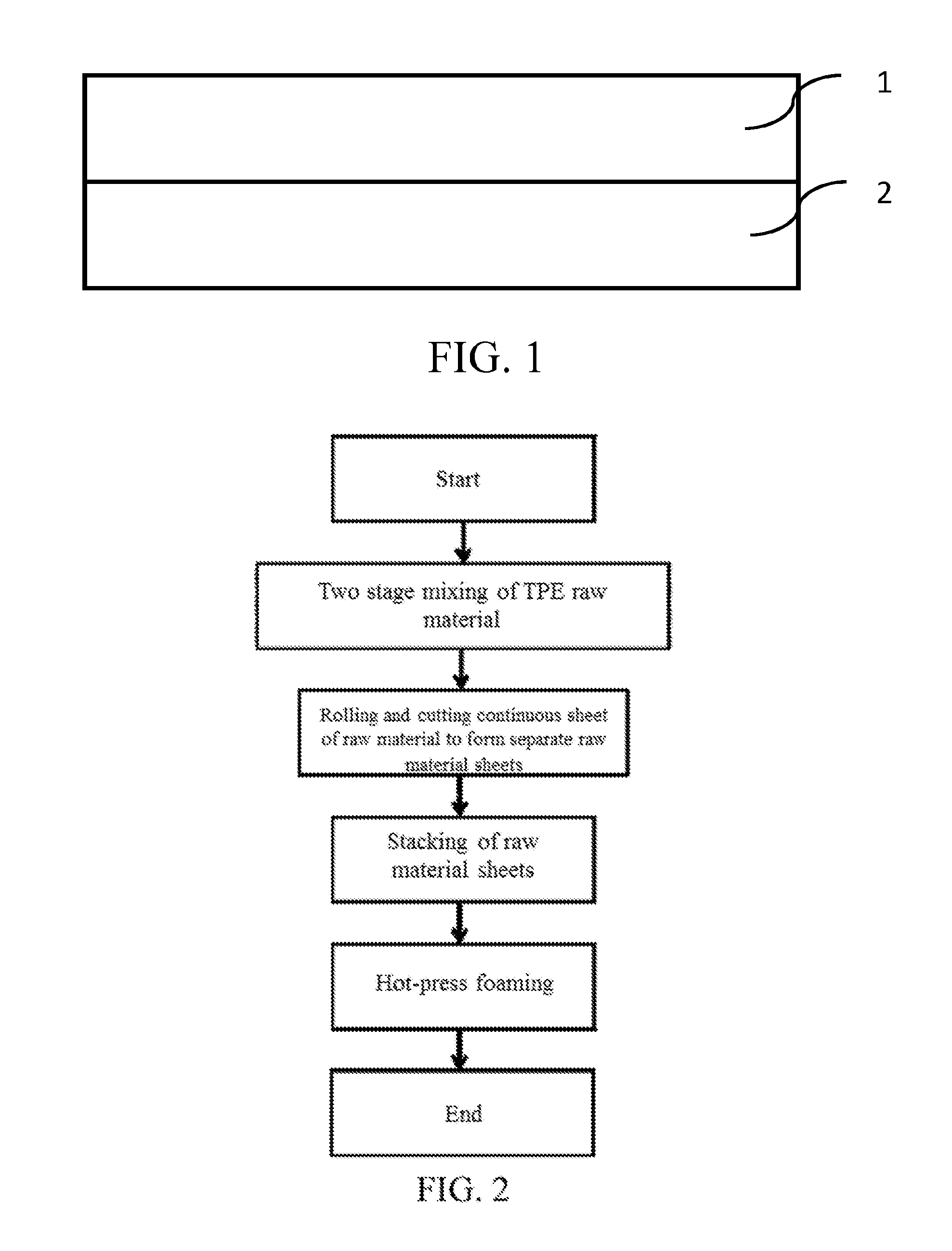
The present invention relates to a multi-layered TPE that has excellent peeling strength without using an adhesive layer or an intermediate layer between adjacent layers. The mechanical properties of the multi-layered TPE such as hardness, density, tensile strength, or elongation rate meet the requirements for commercial applications.

Problems solved by technology

The plastic foams, such as polyvinyl chloride (PVC), EVA and EVA / polyethylene (PE) foams, have advantages of being easy to process and shape and having artistic colors, but also have disadvantages such as poor elasticity, lack of grip properties and being difficult to recycle.
On the other hand, conventional rubber foams, such as polystyrene-butadiene rubber (SBR) and chloroprene rubber, have disadvantages of being difficult to process, shape and recycle and having an odor, although rubber foams have advantages of having good elasticity and grip properties.
However, a multi-layered TPE foam cannot be formed directly by using conventional processes.
Without an adhesive and / or an intermediate fabric cloth layer, a multi-layered TEP material with a satisfactory adhesion cannot be obtained.
However, the process is complicated.

Method used

the structure of the environmentally friendly knitted fabric provided by the present invention; figure 2 Flow chart of the yarn wrapping machine for environmentally friendly knitted fabrics and storage devices; image 3 Is the parameter map of the yarn covering machine
View more

Image

Smart Image Click on the blue labels to locate them in the text.
Viewing Examples
Smart Image
  • Multi-layered thermoplastic elastomer foam and process for manufacturing the same

Examples

Experimental program
Comparison scheme
Effect test

example 1

[0060]40 parts of SBS (LCY 475), 30 parts of SIS (Shell, Kraton D1117), 25 parts of polybutadiene (TSRC, Taipol BR0150), 5 parts of POE (Dow Chemical, Engage EG8150), 15 parts of PS, 10 parts of PP, 50 parts of calcium carbonate, 20 parts of naphthenic oil, and 1.5 parts of ZnSt were placed in a kneader. Gradually heating the components to 160° C. for the first stage of kneading until the components being uniformly mixed. Cooling and pelleting the mixture using a pellet-making machine. Placing the obtained TPE matrix pellets, 7.5 parts of blowing agent AC, 0.25 part of cross-linking agent BIPB, and 0.075 part of cross-linking co-agent TAC (TCI Tokyo Chemical Industry Co., Ltd) in the kneader. Gradually heating the mixture to 100° C. for the second stage of kneading so as to obtain the raw material composition. The raw material composition was transferred to a first double-roller machine, cooled to 80° C., and then transferred to a second double-roller machine where the composition w...

example 2

[0061]Same as Example 1 except for OBSH being used instead of AC.

example 3

[0062]Same as Example 1 except for maleic anhydride grafted SEBS. (Shell Chemical, FG1901) being used instead of a part of the SBS, and ABS being used instead of PP.

the structure of the environmentally friendly knitted fabric provided by the present invention; figure 2 Flow chart of the yarn wrapping machine for environmentally friendly knitted fabrics and storage devices; image 3 Is the parameter map of the yarn covering machine
Login to View More

PUM

PropertyMeasurementUnit
Temperatureaaaaaaaaaa
Fractionaaaaaaaaaa
Fractionaaaaaaaaaa
Login to View More

Abstract

The present invention is related to a multi-layered thermoplastic elastomer (TPE) foam. Due to a specific formulation of the multi-layered TPE foam, adjacent layers of said TPE foam can be perfectly adhered to each other without adhesive or thermocompression after foaming. The present invention is also related to a specific process for forming a multi-layered foam.

Description

CROSS-REFERENCE TO RELATED APPLICATIONS[0001]The present invention claims priority to Taiwan (R.O.C.) Patent Application No. 104110761 filed on Apr. 1, 2015, the contents of which are incorporated herein by reference in their entirety.BACKGROUND OF THE INVENTION[0002]1. Field of the Invention[0003]The present invention is related to a multi-layered thermoplastic elastomer (TPE) foam and a process for manufacturing the same, and in particular, to a TPE material that is a multi-layered structure after foaming and a method for manufacturing the same.[0004]2. Description of the Related Art[0005]At present, there are generally two types of foams, namely, plastic and rubber. The plastic foams, such as polyvinyl chloride (PVC), EVA and EVA / polyethylene (PE) foams, have advantages of being easy to process and shape and having artistic colors, but also have disadvantages such as poor elasticity, lack of grip properties and being difficult to recycle. On the other hand, conventional rubber fo...

Claims

the structure of the environmentally friendly knitted fabric provided by the present invention; figure 2 Flow chart of the yarn wrapping machine for environmentally friendly knitted fabrics and storage devices; image 3 Is the parameter map of the yarn covering machine
Login to View More

Application Information

Patent Timeline
no application Login to View More
IPC IPC(8): B32B5/18B32B25/18B32B25/16
CPCB32B5/18B32B25/16B32B25/18B32B2307/54B32B2250/248B32B2307/72B32B2250/22B32B5/142B32B5/32B32B7/10B32B2266/0207B32B2266/0214B32B2266/0221B32B2266/0228B32B2266/025B32B2266/0257B32B2266/0278B32B2266/0292B32B2274/00B32B2307/732B32B2307/748B32B2266/0235
Inventor LEE, YUNG-TENG
Owner LEE YUNG TENG
Features
  • R&D
  • Intellectual Property
  • Life Sciences
  • Materials
  • Tech Scout
Why Patsnap Eureka
  • Unparalleled Data Quality
  • Higher Quality Content
  • 60% Fewer Hallucinations
Social media
Patsnap Eureka Blog
Learn More