
Electronic device
- Summary
- Abstract
- Description
- Claims
- Application Information
AI Technical Summary
Benefits of technology
Problems solved by technology
Method used
Image

Examples
first embodiment
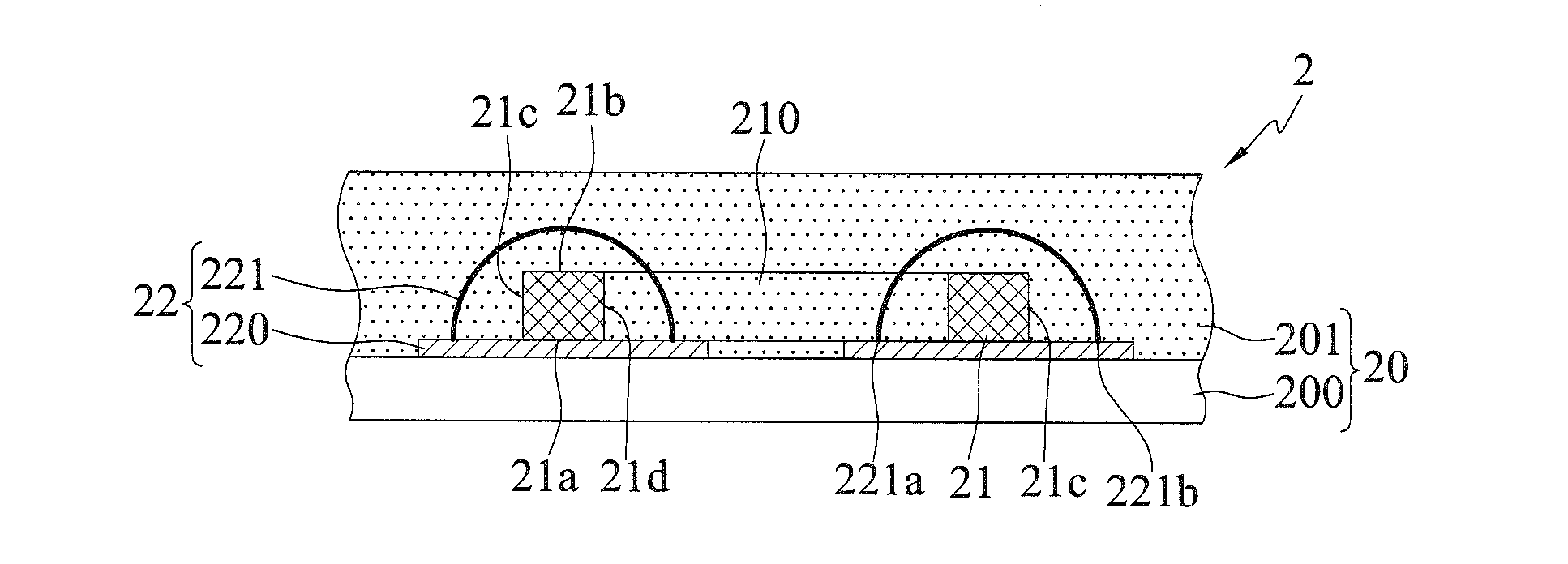
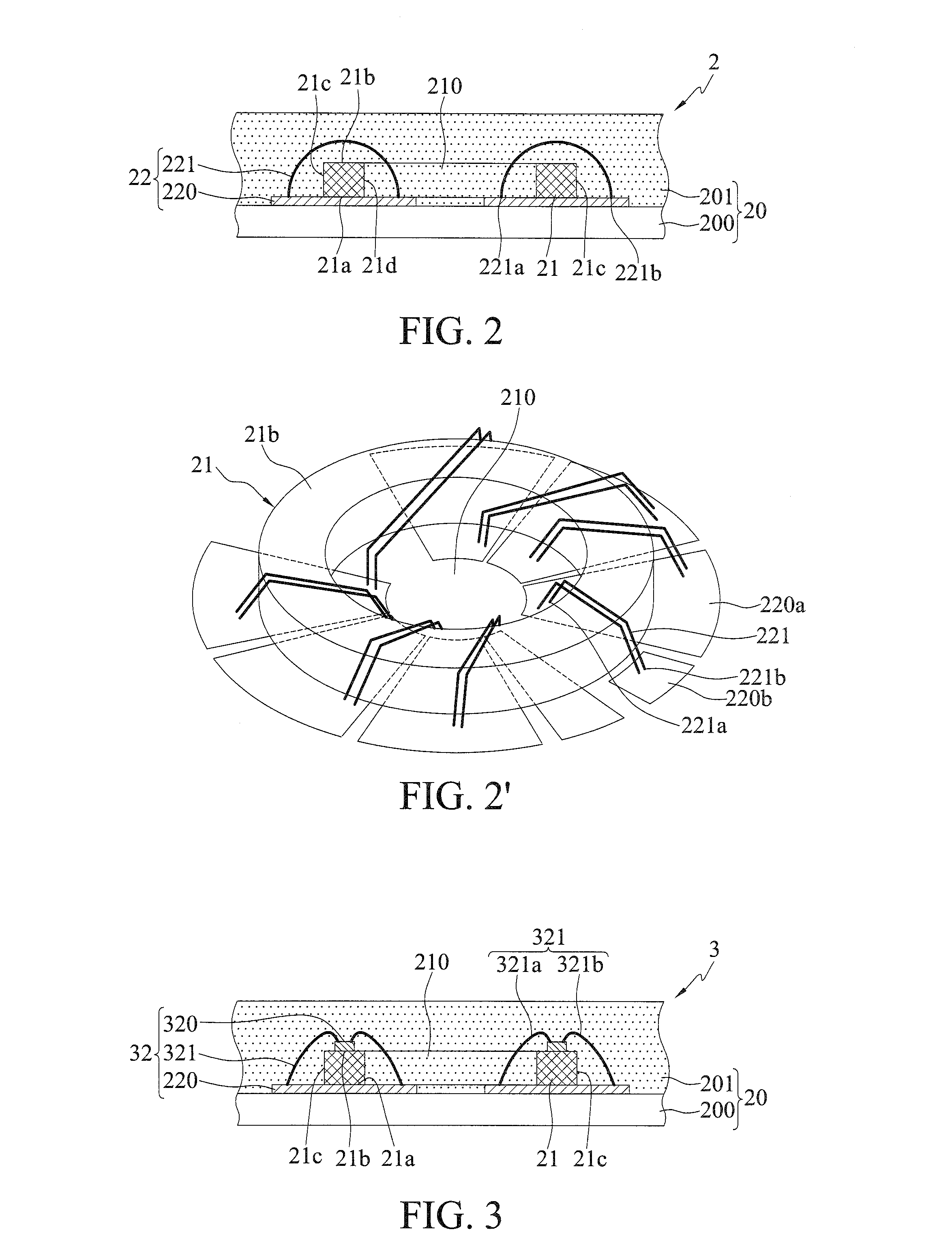
[0033]FIGS. 2 and 2′ show an electronic device 2 according to the present invention.
[0034]Referring to FIGS. 2 and 2′, the electronic device 2 has a magnetically conductive element 21, a conductor structure 22 formed around the magnetically conductive element 21, and a base body 20 encapsulating the magnetically conductive element 21 and the conductor structure 22.
[0035]The magnetically conductive element 21 has high permeability and is made of ferrite, Fe, Mn, Zn, Ni or an alloy thereof. The magnetically conductive element 21 has a first surface 21a, a second surface 21b opposite to the first surface 21a, an outer side surface 21c adjacent to and connecting the first surface 21a and the second surface 21b, and a through hole 210 communicating the first surface 21a and the second surface 21b. Therefore, the magnetically conductive element 21 has a ring shape. The wall surface of the through hole 210 constitutes an inner side surface 21d of the magnetically conductive element 21.
[003...
PUM
 Login to View More
 Abstract
Description
Claims
Application Information
 Login to View More