Unlock instant, AI-driven research and patent intelligence for your innovation.

Systems and Methods for Particulate Removal Using Polymeric Microstructures

a technology of polymeric microstructures and parts, applied in the field of systems and methods, can solve the problems of limited efficiency in the removal of sub-micrometric (0.3 m) particles, substantial disadvantages and/or limitations, and dry cleaning approaches that do not have many drawbacks

Active Publication Date: 2018-11-01
YALE UNIV
View PDF7 Cites 3 Cited by
  • Summary
  • Abstract
  • Description
  • Claims
  • Application Information

AI Technical Summary

Benefits of technology

The present patent provides a new system and method using polymeric microstructures, such as microfibrils or micropillars, to remove micrometric and sub-micrometric particulate con-tamination from solid surfaces without damaging the underlying substrate. These soft and flexible microstructures are effective in establishing interfacial interactions with the particles to be removed, thus debonding them from the substrate surface. The microstructures have minimal interfacial interactions with the substrate but produce strong interfacial interactions with the contaminant particles, achieving detachment of the particles from the surface upon retraction of the cleaning material. This system and method offer a new anomaly for thorough cleaning of dust particles from solid surfaces without damaging the surface.

Problems solved by technology

Removal of micrometric and sub-micrometric contaminant particles—loosely referred to as dust—from solid surfaces is a critical and exacting challenge in various areas of science and technology, including microelectronics, aerospace, optics, xerography, and adhesive bonding.[1-5] While removal of relatively large (>10 μm) particles from a surface is generally achievable, e.g., by blowing the particles from the surface with a gas jet,[3] removal of smaller (e.g., micrometric and sub-micrometric) particles is usually carried out with wet cleaning techniques, including conventional solvent cleaning methods and more advanced acoustic cleaning approaches.[3, 6]
Although traditional wet cleaning techniques are commonly employed, they present substantial disadvantages and / or limitations, including limited efficiency in removal of sub-micrometric ([2, 3] For these reasons, removal of dust particles using dry cleaning techniques (e.g., cleaning with laser beam, microabrasive particles, argon / nitrogen aerosols, and carbon dioxide snow jet) have gained increasing attention in recent decades.[3, 4, 7, 8]
Although dry cleaning approaches do not have many of the drawbacks of the wet cleaning methods, they have one major disadvantage.
In particular, previously developed dry cleaning approaches can damage the surface of the substrate upon removal of the surface contaminants.[7, 9] In particular, effective dry cleaning approaches generally rely on energy transfer from an impacting source (e.g., a laser beam or accelerated microparticles) to the contaminant particles, in order to provide a sufficient amount of energy to overcome the dust particles' adhesion to the surface of the substrate.[3, 4] However, the mechanical and thermal stresses associated with detachment of the dust particles from the surface in the noted dry cleaning approaches may also adversely cause damage and even material loss at the surface of the substrate itself.[7, 9]

Method used

the structure of the environmentally friendly knitted fabric provided by the present invention; figure 2 Flow chart of the yarn wrapping machine for environmentally friendly knitted fabrics and storage devices; image 3 Is the parameter map of the yarn covering machine
View more

Image

Smart Image Click on the blue labels to locate them in the text.
Viewing Examples
Smart Image
  • Systems and Methods for Particulate Removal Using Polymeric Microstructures
  • Systems and Methods for Particulate Removal Using Polymeric Microstructures
  • Systems and Methods for Particulate Removal Using Polymeric Microstructures

Examples

Experimental program
Comparison scheme
Effect test

Embodiment Construction

[0031]As noted above, the present disclosure provides systems and methods for removing particles (e.g., micrometric and sub-micrometric particles) from a surface of a substrate without damage to the substrate. The systems / methods employ polymeric microstructures, e.g., microfibrils / micropillars, that establish interfacial interactions with the particles that permit removal / disassociation of the particles from the substrate without damage to the surface. The disclosed systems and methods have wide ranging applications, including particle removal in art conservation processes, microelectronic applications, optical applications and any other field that stands to benefit from precise removal of particles / dust from a surface without damage to the surface.

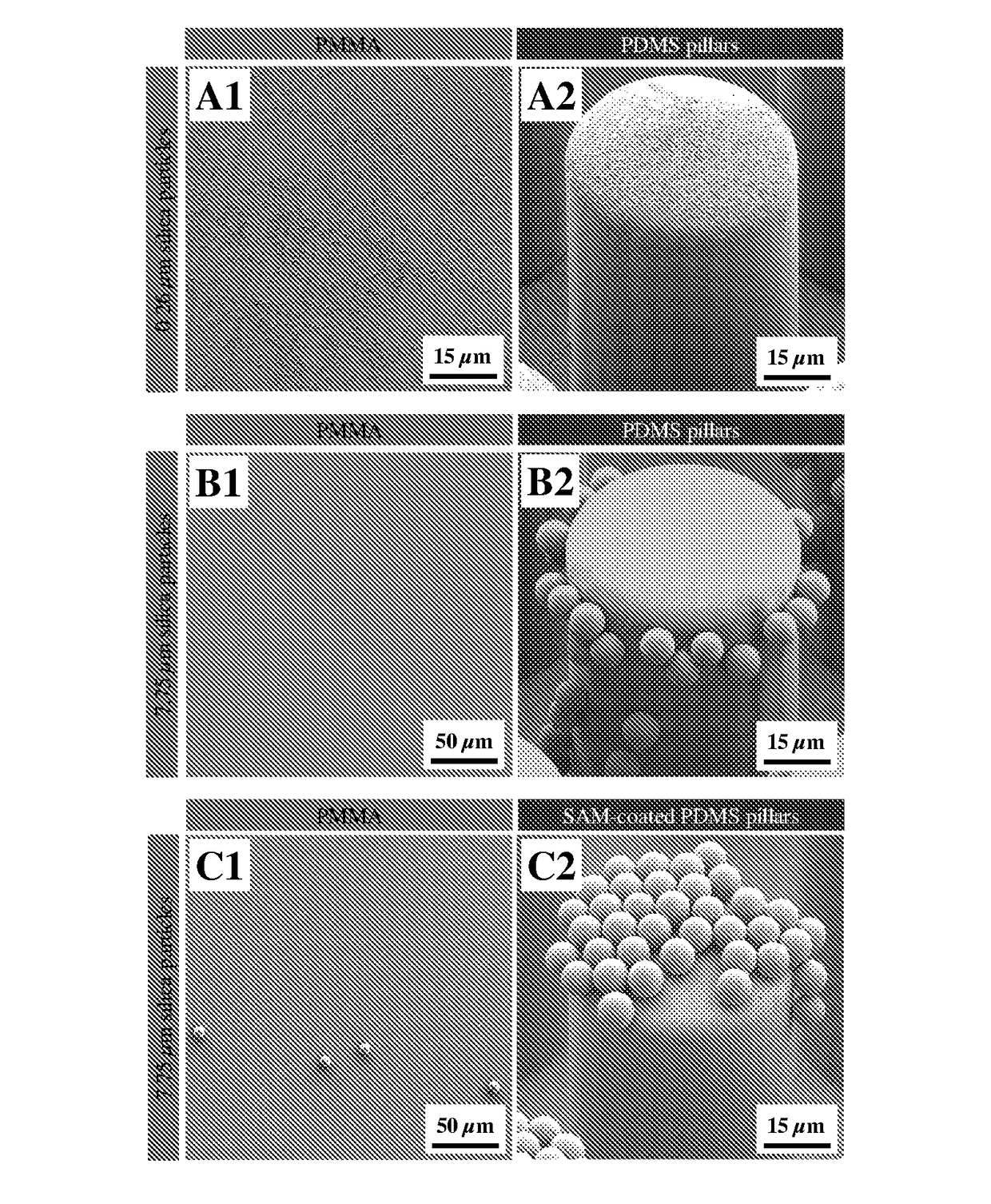
[0032]Experimental studies have demonstrated the efficacy of polymeric microfibrils for removal of micrometric and sub-micrometric particles without surface damage. In an experimental study, silica particles were used as the contaminants...

the structure of the environmentally friendly knitted fabric provided by the present invention; figure 2 Flow chart of the yarn wrapping machine for environmentally friendly knitted fabrics and storage devices; image 3 Is the parameter map of the yarn covering machine
Login to View More

PUM

PropertyMeasurementUnit
diametersaaaaaaaaaa
side lengthaaaaaaaaaa
diameteraaaaaaaaaa
Login to View More

Abstract

Systems and methods for removing particles from a surface of a substrate without damage to the substrate are provided. The disclosed systems / methods use polymeric microstructures, e.g., microfibrils, to remove micrometric and sub-micrometric particles from a substrate surface by establishing interfacial interactions with the particles that effectively debond the particles from the surface of the substrate. The disclosed systems / methods have wide ranging applications, including particle removal in art conservation processes, microelectronic applications, optical applications and any other field that stands to benefit from precise removal of particles / dust from a surface without damage to the surface.

Description

CROSS-REFERENCE TO RELATED APPLICATION[0001]The present application claims priority benefit to a provisional patent application filed in the U.S. Patent Office entitled “Systems and Methods for Particulate Removal Using Polymeric Microfibrils,” which was filed on Oct. 30, 2015, and assigned Ser. No. 62 / 248,834. The entire content of the foregoing provisional patent application is incorporated herein by reference.BACKGROUND1. Technical Field[0002]The present disclosure relates to systems and methods for removing particles from a surface of a substrate without damage to the substrate and, more particularly, to systems / methods that use polymeric microstructures to remove micrometric and sub-micrometric particles from a substrate surface by establishing interfacial interactions with the particles that effectively debond the particles from the surface of the substrate. The disclosed systems and methods have wide ranging applications, including particle removal in art conservation process...

Claims

the structure of the environmentally friendly knitted fabric provided by the present invention; figure 2 Flow chart of the yarn wrapping machine for environmentally friendly knitted fabrics and storage devices; image 3 Is the parameter map of the yarn covering machine
Login to View More

Application Information

Patent Timeline
no application Login to View More
Patent Type & Authority Applications(United States)
IPC IPC(8): C11D3/37B08B7/00C08L83/14C08K5/54H01L21/02
CPCC11D3/37B08B7/0028C08L83/14C08K5/5406H01L21/02041C08L2203/20B23B5/00H01L21/67028C11D3/373C11D3/48C11D2111/22B08B1/10B08B1/12B60J7/141B60J7/198B60P7/02B60R5/048
Inventor IZADI, HADIVANDERLICK, T KYLE
Owner YALE UNIV