Sdd decoder for digital communications

a digital communication and decoder technology, applied in the field of block codes decoders, can solve the problems of high complexity poor performance of hd decoders, etc., and achieve the effect of improving performance, but remaining highly complex

US20180323811A1Active Publication Date: 2018-11-08KHALIFA UNIV OF SCI & TECH
1 Cites 1 Cited by

Patent Information

Authority / Receiving Office
US · United States
Current Assignee / Owner
Publication Date
2018-11-08

Smart Images

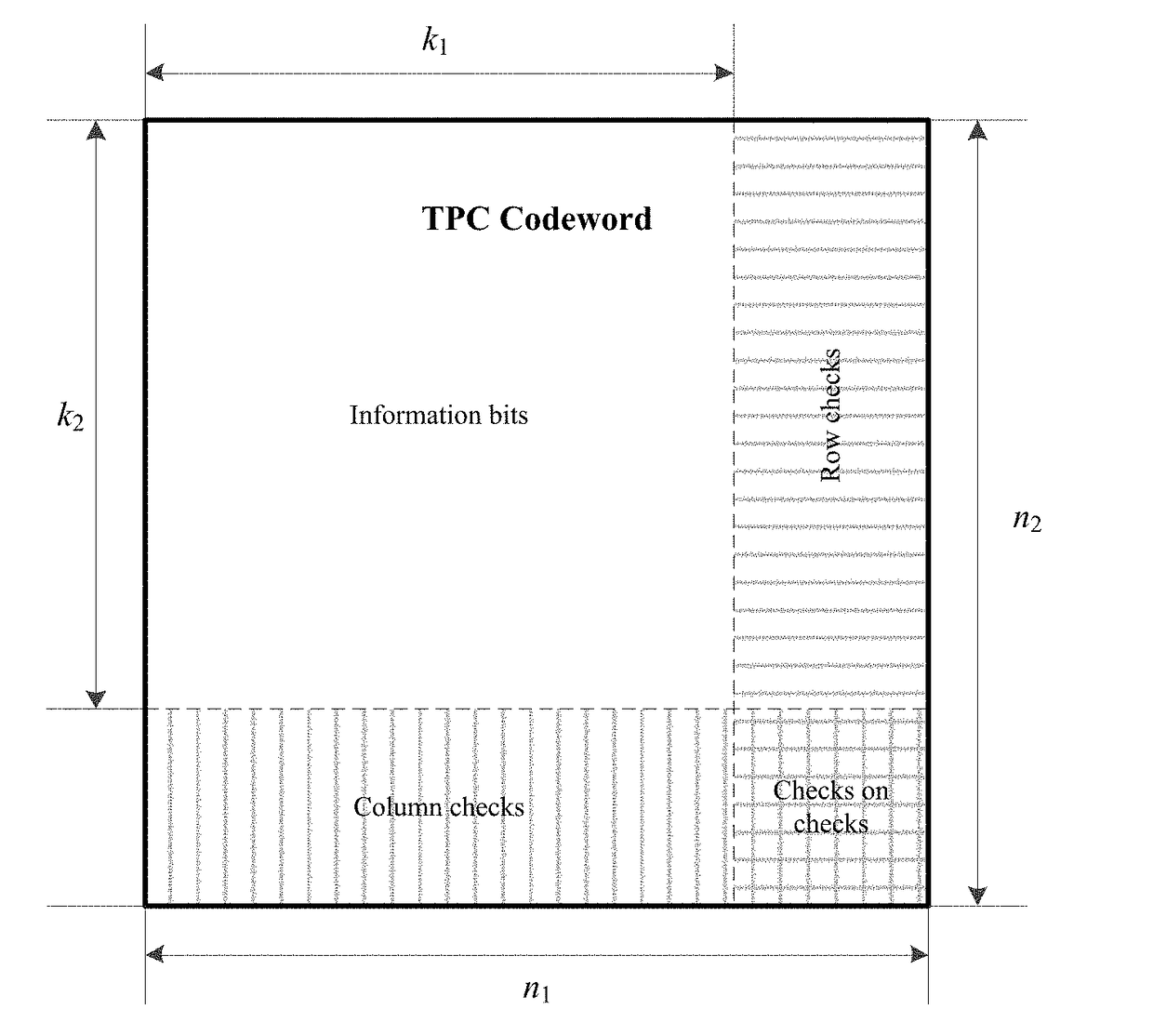
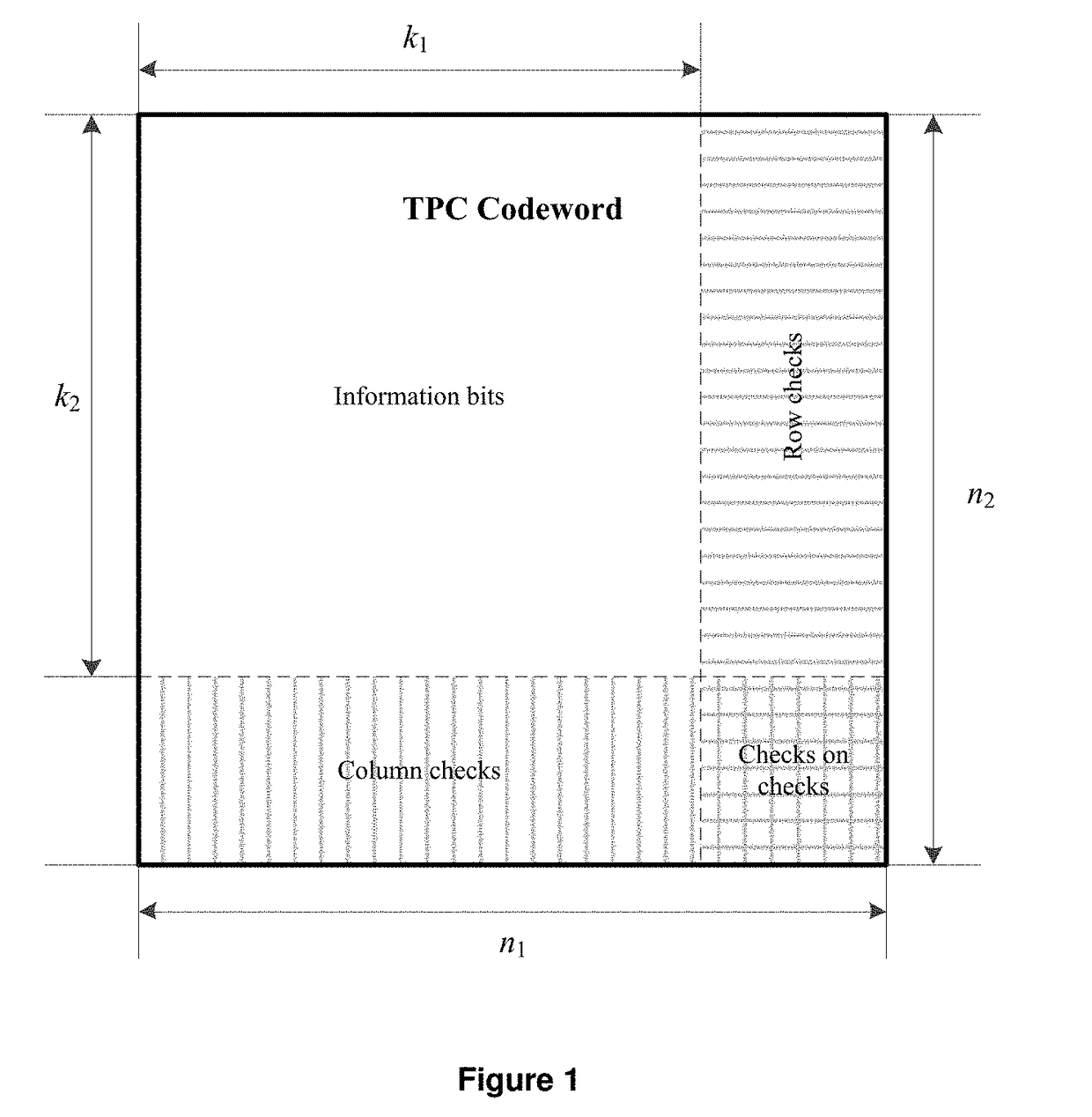
  • Figure 1
    Figure 1
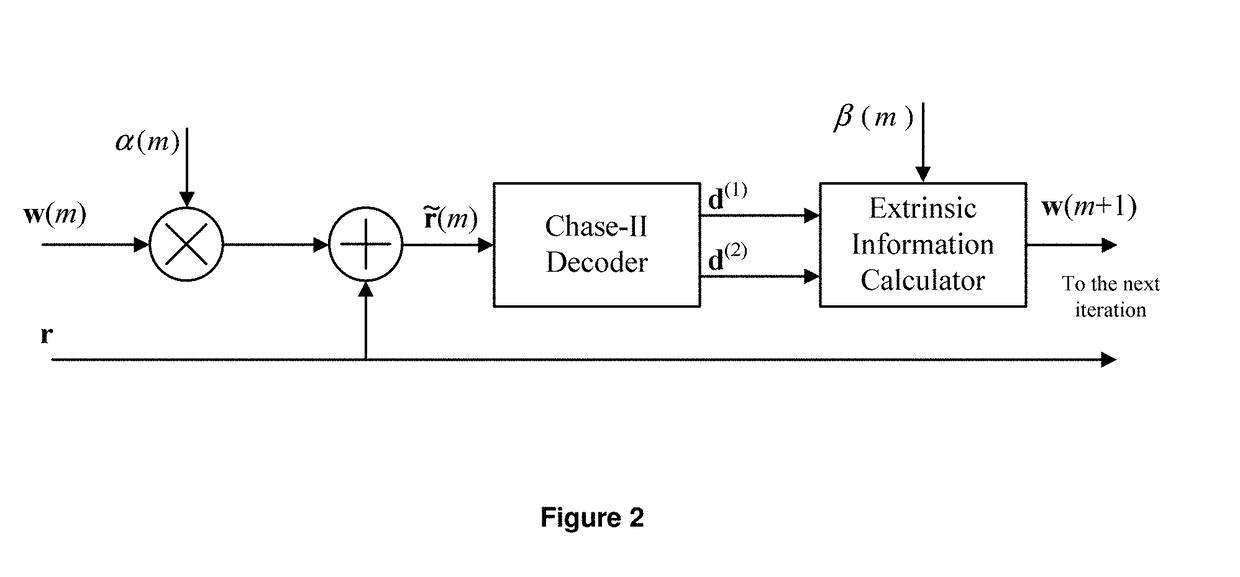
  • Figure 2
    Figure 2
  • Figure 3
    Figure 3
Patent Text Reader

Abstract

There is provided an ultra-light decoder for high speed digital communications based on block codes such as turbo product codes (TPCs). The new decoder can perform soft decision decoding without an algebraic hard decision decoder, which is the core of conventional soft decision decoders. The elimination of algebraic decoder significantly reduces the number of computations required per codeword, consequently, it reduces the decoding delay and processing power. However, reducing the decoding delay would immediately enable increasing the transmission speed, and minimize the need for large buffers at the receiver. Moreover, reducing the complexity and delay would enable using codes with high code rates to increase the system capacity, or use powerful codes with low code rates to reduce the transmission power. Such benefits can be achieved for about 1 dB loss in coding gain. There is also provided a receiver comprising the ultra-light decoder, as well as a decoding process.
Need to check novelty before this filing date? Find Prior Art

Description

FIELD OF THE INVENTION

[0001] The present invention generally relates to block codes decoders used in communication systems and more particularly to an improved Soft Decision (SD) decoder for digital communications.BACKGROUND OF THE INVENTION

[0002] Forward error correction (FEC), known also as channel coding, is one of the key tools that enabled the massive growth of the wireless communications industry in the last decade. The basic role of FEC is to provide the users with reliable digital transmission using minimum excess power, bandwidth and complexity. Consequently, FEC substantially contributed to the success of transformation towards the A5 vision (anyone to access anything from anywhere at any time on any device). Such vision has placed stringent quality of service (QoS) requirements, which require optimal design at all layers of the wireless communications protocol stack to reduce the cost, power consumption and complexity while increasing the capacity, coverage and reliability....

Examples

numerical examples

[0044]To evaluate the performance of the new ULD, we use bit error rate (BER) as a metric and compare the results with near optimal SISO (˜Optimal) and HIHO decoding. The BER for all systems is obtained using Monte Carlo computer simulation. The channel is modeled as an AWGN channel, and the information bits are modulated using BPSK. The proposed and near-optimal decoders are using p=q=4, and the maximum number of iterations is four in all types of decoders.

[0045]The BER of the eBCH(16,11,4)2 is shown in Error! Reference source not found. As it can be noted from the figure, the ULD coding gain of 5.8 dB at BER=10−5, which is only 0.8 dB less than the coding gain of the near-optimal decoder.

[0046]Error! Reference source not found. shows the BER of the eBCH(32,26,4)2 TPC code. For this code, the new ULD has a gain of 5.4 dB at BER=10−5, which is about 1.1 dB less than the coding gain of the near-optimal decoder. Moreover, the ULD coding gain advantage over the HI HO decoder is about 2...